Black Hole Physics
Stellar Gravitational Collapse
When Gravity Wins
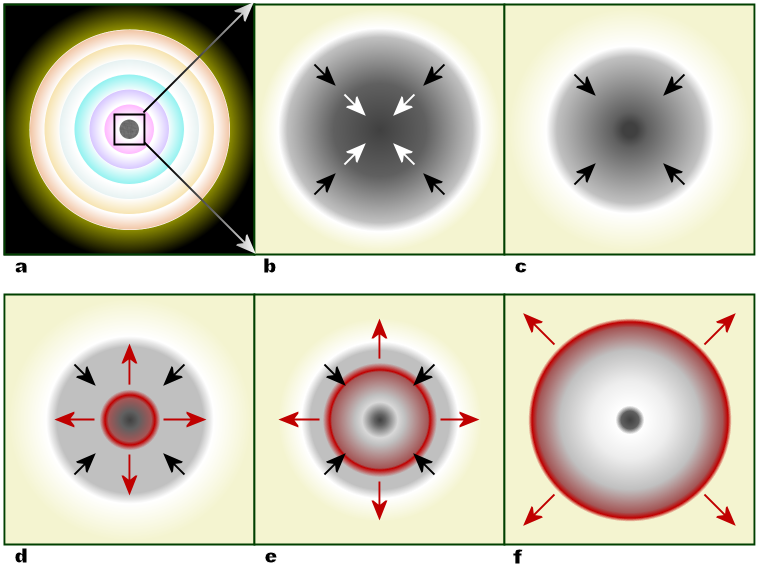
A massive star spends its life in a delicate balance. The immense inward crush of its own gravity is constantly counteracted by the outward pressure from nuclear fusion in its core. For millions of years, this cosmic tug-of-war keeps the star stable. But this stability can't last forever. When a star with more than 20 times the mass of our Sun runs out of fuel, fusion stops. The outward pressure vanishes, and gravity takes over with unstoppable force.
The star's core, now composed of iron, collapses in on itself in a fraction of a second. This cataclysmic event, known as a core-collapse, triggers a massive explosion called a supernova. The outer layers of the star are blasted into space, but what happens to the core depends entirely on its mass. If the core is relatively light, the collapse halts, forming an incredibly dense object called a neutron star. But if the core is too massive, nothing can stop its collapse.
The Point of No Return
The fate of the stellar core is decided by a critical threshold known as the (TOV limit). This is the absolute maximum mass that a non-rotating neutron star can have before collapsing under its own gravity. While the exact number is still a subject of research, it's estimated to be around 2.1 times the mass of the Sun. If the collapsing core exceeds the TOV limit, even the immense force of neutron degeneracy pressure—the quantum mechanical effect that prevents neutrons from occupying the same space—is not enough to halt the collapse.
As the core's mass crushes down, its density skyrockets. The around it becomes more and more extreme. Imagine gravity as a bowling ball on a rubber sheet; a more massive core is like a heavier ball, creating a deeper and steeper well. The collapse continues relentlessly, shrinking the core down to a point of infinite density called a singularity.
At this point, the escape velocity from the collapsing object exceeds the speed of light. A boundary forms, known as the event horizon. Anything that crosses this boundary, including light, can never escape. A black hole is born.
A More Direct Path
The core-collapse of a massive star is the most common way stellar-mass black holes are formed today. However, scientists theorize that in the early universe, another mechanism may have been at play. This model, known as , proposes that enormous clouds of pristine gas, hundreds of thousands of times the mass of the Sun, could have collapsed directly into a black hole without first forming a star.
In this scenario, the gas cloud is so massive that it bypasses the star-formation phase entirely. Its own gravity is overwhelming from the start, leading to a runaway collapse that results in a massive black hole. These 'direct collapse black holes' could have served as the seeds for the supermassive black holes we now see at the centers of most galaxies, including our own Milky Way.
Whether through the violent death of a single star or the direct implosion of a massive gas cloud, the formation of a black hole represents the ultimate victory of gravity over all other forces.