Black Body Radiation Mastery
Classical Radiation Failures
A Crack in the Classical World
By the end of the 19th century, physics seemed to be settling down. Newton's laws described motion, and Maxwell's equations ruled electromagnetism. It felt like a complete picture of the universe. But a nagging problem with something as simple as a glowing-hot object would soon unravel everything. The issue centered on blackbody radiation, the light emitted by an ideal object that absorbs all incoming radiation.
One experimental phenomenon that could not be adequately explained by classical physics was blackbody radiation.
Physicists tried to create a theory to predict the intensity of light emitted at different wavelengths. Two British physicists, Lord Rayleigh and Sir James Jeans, developed a formula based on solid classical principles. They modeled the blackbody as a cavity filled with standing electromagnetic waves, with each wave mode acting like a tiny oscillator.
To determine the energy of these oscillators, they turned to a cornerstone of thermodynamics: the equipartition theorem. This theorem states that in thermal equilibrium, energy is shared equally among all available degrees of freedom. For the oscillators in the blackbody cavity, this meant each mode should have an average energy of , where is the Boltzmann constant and is the temperature in Kelvin.
The Ultraviolet Catastrophe
Combining the number of possible wave modes with the average energy per mode resulted in the Rayleigh-Jeans law. This law described the spectral radiance, or the intensity of the radiation at a specific frequency .
At long wavelengths (low frequencies), the law worked beautifully, matching experimental data almost perfectly. But as the wavelengths got shorter and moved toward the ultraviolet part of the spectrum, the prediction went disastrously wrong. According to the formula, as wavelength approaches zero (and frequency approaches infinity), the energy emitted should become infinite. This impossible result became known as the ultraviolet catastrophe because the divergence was most apparent in the high-frequency, ultraviolet region.
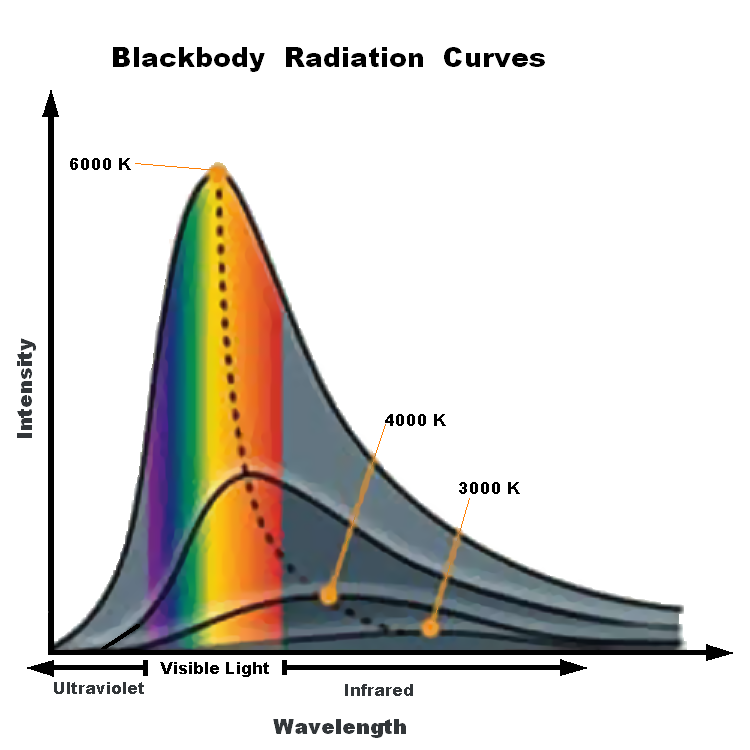
Clearly, something was fundamentally wrong. An oven couldn't possibly emit infinite energy. This wasn't just a small error; it was a complete breakdown of classical physics when applied to the microscopic world of atoms and radiation. The elegant theories that worked so well for planets and pulleys failed to explain the light from a simple fire. The ultraviolet catastrophe was a clear signal that a new way of thinking was needed, one that would challenge the very idea that energy could be continuous.
This failure set the stage for one of the most significant revolutions in the history of science. The solution would require a bold new assumption about the nature of energy itself, leading directly to the birth of quantum mechanics.
Let's check your understanding of these classical concepts before moving on to the quantum solution.
What was the "ultraviolet catastrophe"?
The Rayleigh-Jeans law was derived using principles from classical physics. Which of these principles was a key component of its derivation?
The failure of classical physics to explain blackbody radiation was not just a minor detail. It was a clear indication that the established laws of physics were incomplete. Next, we will explore how Max Planck resolved this crisis.