Black Body Radiation Basics
Thermal Radiation Basics
Why Hot Objects Glow
Ever notice how a stovetop burner or a piece of metal in a fire starts to glow? First it turns a dull red, then a brighter orange, and if it gets hot enough, it might even glow white-hot. This light is a form of energy called thermal radiation. It's not just for things that are visibly hot; every single object with a temperature above absolute zero is constantly emitting this energy. You, the chair you're sitting on, and the ice cream in your freezer are all radiating energy.
Thermal radiation refers to electromagnetic waves emitted by objects due to their temperature.
Most of the time, this radiation is in a form we can't see, like infrared light. That's how night-vision goggles work—they detect the infrared thermal radiation that people and animals emit. But as an object gets hotter, it starts to emit radiation we can see, beginning with red light. The energy it releases takes the form of electromagnetic waves travelling through space.
The Perfect Emitter
To understand thermal radiation better, scientists came up with an idealized concept called a 'black body'. A black body is a theoretical object that absorbs 100% of all radiation that hits it. It doesn't reflect any light and it doesn't let any light pass through it. It swallows everything, regardless of the light's wavelength or the angle it arrives from. Because it's a perfect absorber, it's also a perfect emitter. An object that is good at absorbing energy is also good at radiating it away.
black body
noun
An idealized physical body that absorbs all incident electromagnetic radiation, regardless of frequency or angle of incidence. It is also a perfect emitter of thermal radiation.
Think of it this way: a black T-shirt on a sunny day gets much hotter than a white one. The black fabric is better at absorbing energy from the sunlight. If you heated both shirts to the same high temperature in a dark room, the black T-shirt would glow more brightly because it's also better at emitting energy.
The Hole in the Box
A perfect black body doesn't exist in reality, but physicists created a clever way to approximate one. Imagine a hollow box, completely sealed except for one tiny pinhole. Now, shine a beam of light at that hole.
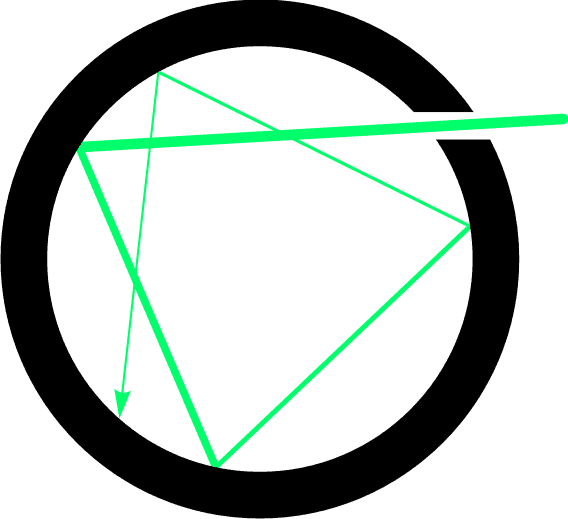
The light ray will enter the box and hit the inside wall. Some of it will be absorbed, and some will be reflected. But the reflected ray will just hit another part of the inner wall. With each bounce, more of the light's energy gets absorbed by the walls. The chance of a light ray finding its way back out of the tiny hole is incredibly small. So, the hole itself acts as a perfect absorber. It traps nearly all the light that enters it.
This setup is called a cavity radiator. The hole doesn't reflect any light, so it's the closest thing we have to a real-life black body.
Now, what happens if you heat the whole box? The walls of the cavity, which are constantly absorbing and emitting radiation, reach a stable temperature, a state known as thermal equilibrium with the radiation inside. The radiation that then escapes from the pinhole is a perfect sample of thermal radiation. Its properties, like its color and intensity, depend only on the temperature of the box, not on the material the box is made from. This simple model was the key that helped scientists begin to unravel the laws governing all thermal radiation.
What is thermal radiation?
Why does a black T-shirt get hotter in the sun than a white T-shirt?
This laid the groundwork for understanding not just why things glow, but also how stars shine and how heat moves through the universe.