BJJ Closed Guard Mastery
Closed Guard Basics
The Closed Guard
In Brazilian Jiu-Jitsu, you'll often find yourself on your back. This might seem like a bad spot, but with the right technique, it can be one of the most powerful positions in grappling. This is where the closed guard comes in. It's a foundational position where you control your opponent using your legs, neutralizing their attacks and setting up your own.
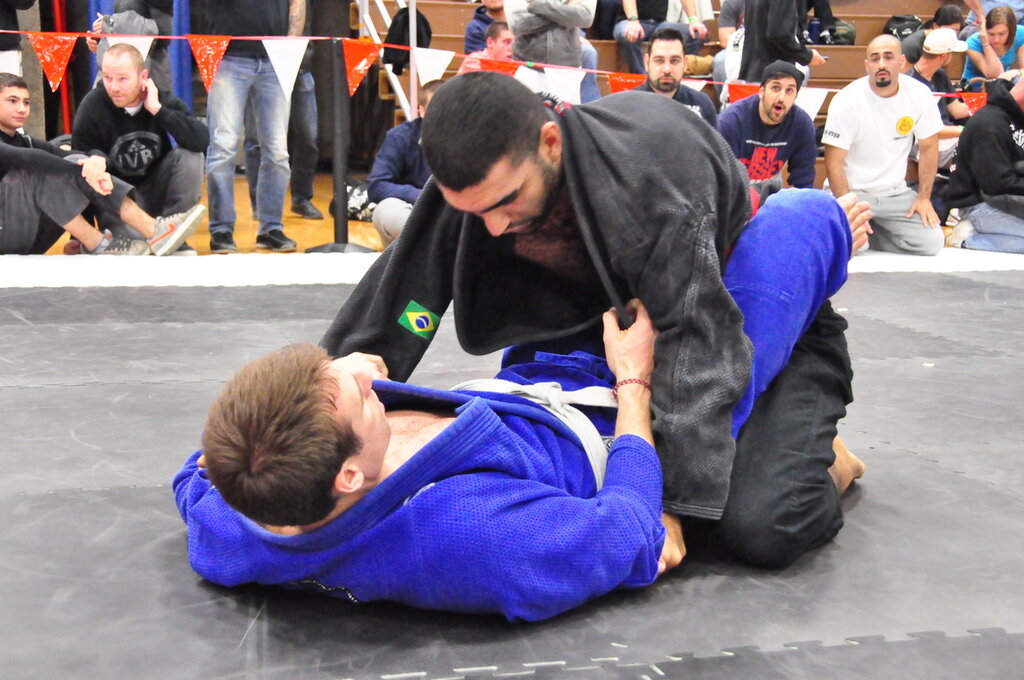
The closed guard is defined by having your opponent between your legs while you are on your back, with your ankles crossed behind their lower back. From here, you can control their posture, limit their movement, and launch a variety of submissions and sweeps. It’s a cornerstone of BJJ defense and a surprisingly effective platform for offense.
Establishing Your Position
Getting into a closed guard is straightforward. When your opponent is in front of you and between your legs, you simply wrap your legs around their torso and lock your feet together behind their back. Your knees should be pinched tightly against their sides to maintain control.
Once your legs are locked, your primary goal is to control their upper body. Use your hands to grip their sleeves, collar, or the back of their head. This prevents them from posturing up and trying to escape.
Think of your legs and arms as a frame that contains and controls your opponent. A tight, well-established guard makes it very difficult for them to generate any offense or even move freely. It neutralizes size and strength advantages, embodying the BJJ principle of using leverage over power.
Control and Posture
Just being in the closed guard isn't enough. The position is a constant battle for posture. Your opponent wants to sit up straight to create space and pass your guard. You want to break their posture, bringing their upper body down towards you.
To break their posture, use your legs and arms in coordination. Pull with your knees and use your hamstrings to bring their hips closer to yours. At the same time, pull down on their head or collar. When their head is lower than their hips, their posture is broken. They are now weaker and vulnerable to attacks.
This is the essence of the closed guard: control the distance, break the posture, then attack.
From a position of control with broken posture, you can begin to transition. You might open your guard to attempt a sweep, where you reverse the position and get on top. Or, you might set up a submission, like a triangle choke or an armbar. These attacks become possible only after you've established complete control from your guard.
Mastering these basic principles of the closed guard will give you a solid foundation for both defense and offense in your BJJ journey.
What is the defining characteristic of the closed guard position in Brazilian Jiu-Jitsu?
When in the closed guard, what is your primary objective before attempting a submission or sweep?