Bitcoin Mining Power and Infrastructure
Bitcoin Mining Basics
The Work Behind the Coins
Bitcoin mining isn't like digging for gold in a mine. It's more like a global competition to perform a vital accounting service for the entire Bitcoin network. Miners are the decentralized bookkeepers who confirm transactions and add them to the public ledger, known as the blockchain.
Every time someone sends bitcoin, that transaction is bundled together with others into a 'block.' Miners compete to be the one to add the next block to the chain. This process serves two crucial purposes: it verifies the legitimacy of transactions, preventing fraud like double-spending, and it's how new bitcoins are created and introduced into circulation.
This process is essential for validating transactions and adding new blocks to a blockchain, for which miners are rewarded with cryptocurrency.
Proof of Work
To win the right to add the next block, miners must solve a complex computational puzzle. This system is called Proof-of-Work (PoW). It requires miners to use their computing power to be the first to find a specific number, called a 'nonce.' When a miner finds the right nonce, it creates a unique digital signature, or 'hash,' for the new block.
The puzzle is designed to be difficult to solve but easy for others to verify. Once a miner finds the solution, they broadcast it to the network. Other computers can quickly check if the answer is correct, confirm the block, and add it to their copy of the blockchain.
The first miner to solve the puzzle is rewarded. This reward consists of two parts: a predetermined amount of newly created bitcoin, called the 'block reward,' and the transaction fees from all the transactions included in that block.
The block reward is not constant. A critical feature of Bitcoin's design is the 'halving,' an event that occurs approximately every four years (or every 210,000 blocks). The halving cuts the block reward in half, slowing down the rate at which new bitcoins are created. This process is designed to control inflation and will continue until the maximum supply of 21 million bitcoins is reached.
Keeping the Pace
The Bitcoin network is designed to produce a new block roughly every 10 minutes. But what happens if more miners join the network, increasing the total computing power? The puzzle would be solved much faster. To prevent this, the network automatically adjusts the 'mining difficulty.'
Every 2,016 blocks (about two weeks), the network checks how long it took to find those blocks. If they were found too quickly, the difficulty of the puzzle increases. If they were found too slowly, the difficulty decreases. This self-regulating system ensures that no matter how many miners are competing, the 10-minute block time remains consistent.
The Tools of the Trade
In the early days of Bitcoin, it was possible to mine using a standard home computer (CPU). As competition grew, miners switched to more powerful graphics cards (GPUs). Today, the industry is dominated by highly specialized hardware.
ASIC
noun
An Application-Specific Integrated Circuit. It's a type of microchip designed for a single purpose, in this case, performing the calculations for Bitcoin mining as fast as possible.
These ASIC miners are thousands of times more powerful than CPUs or GPUs for this specific task, making them the only competitive option for mining today.
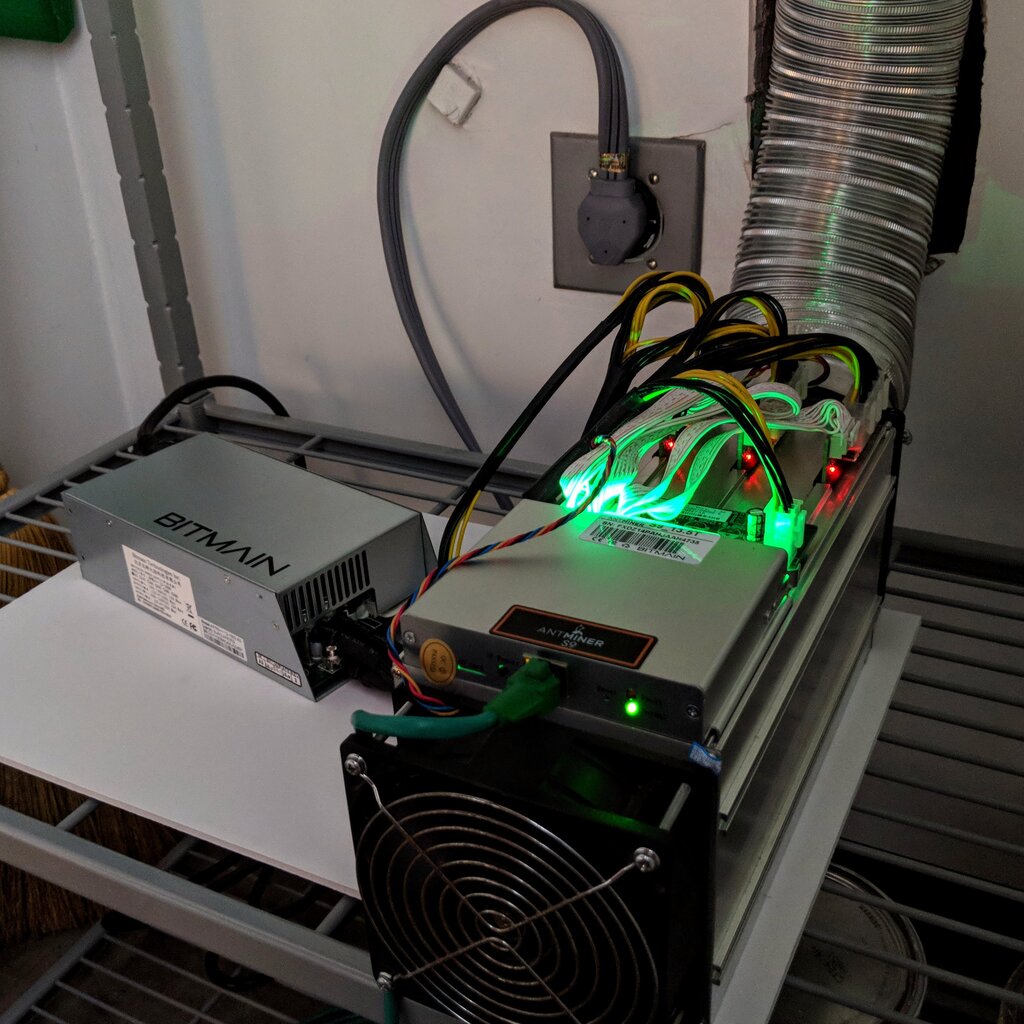
The immense difficulty of finding a block alone means that individual miners have a very small chance of earning a reward. To overcome this, most miners join a 'mining pool.' A mining pool is a group of miners who combine their computational resources to increase their collective chance of solving the puzzle. When the pool successfully mines a block, the reward is distributed among all participants, proportional to the amount of computing power each contributed. It’s like buying a lottery ticket with a group of friends—you share the prize, but your odds of winning are much better.
Time to check your understanding of how Bitcoin mining works.
What are the two primary functions of Bitcoin mining?
The computational system that requires miners to use their computing power to solve a puzzle is called...
Mining is the engine that keeps the Bitcoin network running. It's a competitive, decentralized process that validates transactions, secures the blockchain, and introduces new coins into the system in a predictable way.