Bitcoin Explained
Introduction to Bitcoin
A New Kind of Money
In the midst of the 2008 global financial crisis, a paper was quietly published online. It was titled "Bitcoin: A Peer-to-Peer Electronic Cash System" and was written by someone using the name Satoshi Nakamoto. To this day, no one knows for sure who Nakamoto is.
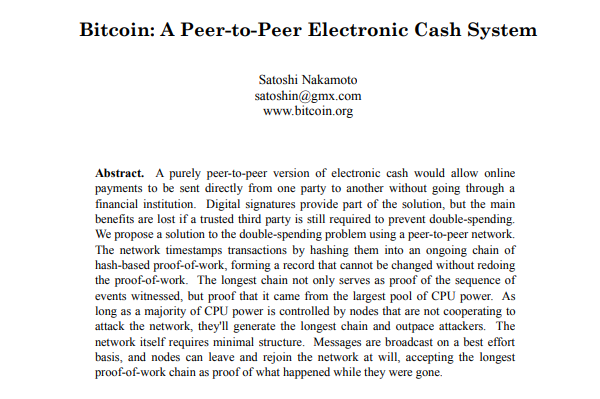
The paper proposed a radical idea: a form of digital money that could be sent directly from one person to another without needing a bank or any other financial institution. Before Bitcoin, sending money online always required a trusted middleman. This was necessary to prevent a problem called "double-spending," where someone could try to spend the same digital coin twice.
Nakamoto's paper offered a solution. It described a system where transactions were publicly recorded on a shared ledger, making it impossible to cheat. This system was the birth of Bitcoin, the world's first decentralized digital currency.
No More Middlemen
The traditional financial system is centralized. Banks, credit card companies, and payment processors sit in the middle of transactions. They hold the ledgers, verify payments, and have the power to approve or deny them. They are central authorities.
Bitcoin works differently. It's built on a decentralized, or peer-to-peer (P2P), network. Instead of one central ledger held by a bank, the ledger is distributed and shared among all the participants in the network. Think of it like a shared public notebook that everyone can see and update together.
decentralization
noun
The transfer of control and decision-making from a centralized entity (individual, organization, or group thereof) to a distributed network.
When you send Bitcoin, you aren't asking a bank for permission. You're broadcasting the transaction to this network of peers. The network itself then works together to verify that the transaction is valid and add it to the shared ledger.
This peer-to-peer structure means no single person, company, or government controls Bitcoin. It's a global system open to anyone. This feature eliminates the need for traditional intermediaries and their associated fees, delays, and restrictions.
With Bitcoin, you can send value to anyone, anywhere in the world, without needing permission from a third party.
Bitcoin's Impact
The creation of Bitcoin was a landmark moment. It introduced the idea that money didn't have to be issued or controlled by a government. It could be a purely digital asset, secured by mathematics and a community of users rather than a central authority.
This challenged the very foundation of the modern financial industry. For the first time, there was a viable alternative for transferring value globally that operated outside the traditional banking system. While it started as a niche interest for cypherpunks and technologists, Bitcoin has since grown into a globally recognized asset.
Its success also sparked a revolution. The technology that powers Bitcoin inspired the creation of thousands of other digital currencies, known as altcoins, and kicked off the broader cryptocurrency movement.
Bitcoin proved the viability of decentralized digital money and became the first global cryptocurrency
The conversation around money has fundamentally changed. Bitcoin forced people to ask new questions: What gives money its value? Who should control it? And what role will digital currencies play in the future of finance?
What fundamental problem in digital money did Satoshi Nakamoto's 2008 paper on Bitcoin propose a solution for?
In the context of Bitcoin, what does a 'peer-to-peer' (P2P) network mean?