Biotech Project Management Essentials
Biotech R&D Lifecycles
From Lab Bench to Project Plan
In standard project management, you often know what you're building. In biotech, the project is about discovering what to build. The drug discovery pipeline isn't a fixed assembly line; it's a journey of scientific inquiry where each step informs the next. Instead of managing tasks, you're managing uncertainty. Your goal is to move a potential therapeutic from a mere hypothesis to a viable candidate for clinical trials.
This process starts with and validation. A "target" is a specific biological molecule, like a protein or gene, that is believed to play a critical role in a disease. If you can interact with that target—say, by blocking an overactive enzyme—you might be able to treat the disease. The project's first phase is dedicated to proving that the chosen target is the right one. Getting this wrong can lead to years of wasted effort and millions of dollars spent on a dead end.
The Phase-Gate Framework
Biotech projects are too expensive and uncertain to run without strict controls. This is where the Phase-Gate process comes in. Think of it as a series of checkpoints. To pass through a "gate" and receive funding for the next phase, a project must meet a predefined set of scientific milestones. These are not arbitrary. They are rigorous, data-driven criteria that prove the project is worth continued investment.
For example, to move from Target Validation to Hit Identification, a team might need to demonstrate that inhibiting the target in a cell culture model reduces a specific disease marker by at least 50%.
Once the target is validated, the search begins for a molecule that can affect it. High-throughput screening can test thousands or even millions of compounds to find initial "hits." Most hits are weak and unsuitable as drugs, but they provide a starting point. The next phase, Lead Optimization, is a detailed chemistry effort to refine these hits into a potent and safe lead compound. This iterative cycle of designing, synthesizing, and testing new versions of a molecule is a project in itself, with its own milestones and timelines.
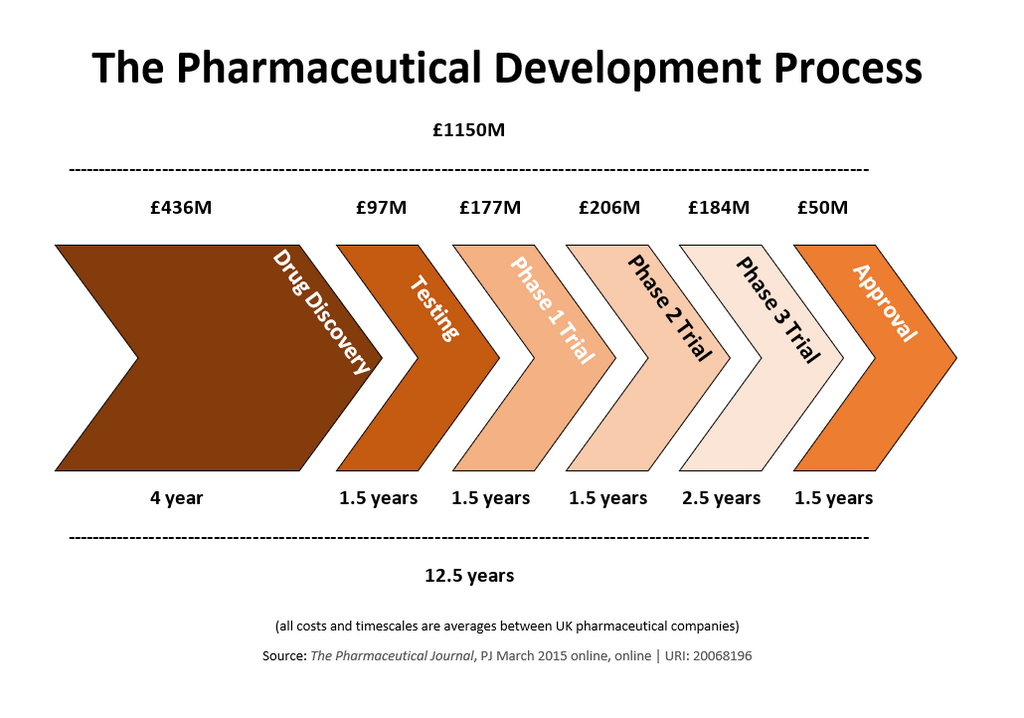
Scheduling Scientific Discovery
How do you schedule a project when you can't predict a discovery? You don't schedule the discovery itself. You schedule the experiments that could lead to it. A Gantt chart for a lead optimization project wouldn't have a task called "Invent Drug." Instead, it would list activities like: "Synthesize Batch 12 of Analogs," "Test Batch 12 for Potency," and "Analyze Batch 12 Toxicity Data."
Each of these tasks has a planned duration and resource allocation. The Phase-Gate meeting is the key milestone where the results of these experiments are reviewed. Did the latest batch of compounds show improved potency without increasing toxicity? If yes, the project proceeds. If not, the team may need to pivot their chemical strategy or, in some cases, terminate the project.
This framework allows you to manage R&D with discipline. By breaking the long, uncertain road of drug discovery into discrete, milestone-driven phases, you can make informed investment decisions, manage risk, and provide stakeholders with a clear view of the project's progress, even when the final outcome is still a hypothesis.
How does project management in biotech fundamentally differ from standard project management?
What is the primary purpose of the Phase-Gate process in a biotech drug discovery project?