Biomimicry Cheetah Speed to Motorcycle Design
Cheetah Biomechanics
Engineered for the Chase
A cheetah's body is a marvel of evolutionary engineering, designed for one primary purpose: explosive speed. Unlike other big cats built for power and aggression, the cheetah is a specialist sprinter. This specialization is evident in its entire anatomy, from its lightweight skeleton to the unique composition of its muscles.
The cheetah has evolved for speed rather than power and aggression.
The power behind a cheetah's sprint comes from its massive hindquarters, packed with a high concentration of specialized muscle fibers. These are known as Type IIx, or fast-twitch fibers. Think of them as the biological equivalent of a drag racer's engine: they contract incredibly quickly and forcefully, providing immense power for rapid acceleration. The trade-off is that they fatigue just as quickly, which is why a cheetah's chase is an all-out sprint, not a marathon.
The Spine as a Spring
Perhaps the most critical element of the cheetah's speed is its spine. It is exceptionally long and flexible, far more so than any other large cat's. During a sprint, the spine coils and uncoils like a powerful spring. This motion stores and releases elastic energy, propelling the cheetah forward with each bound.
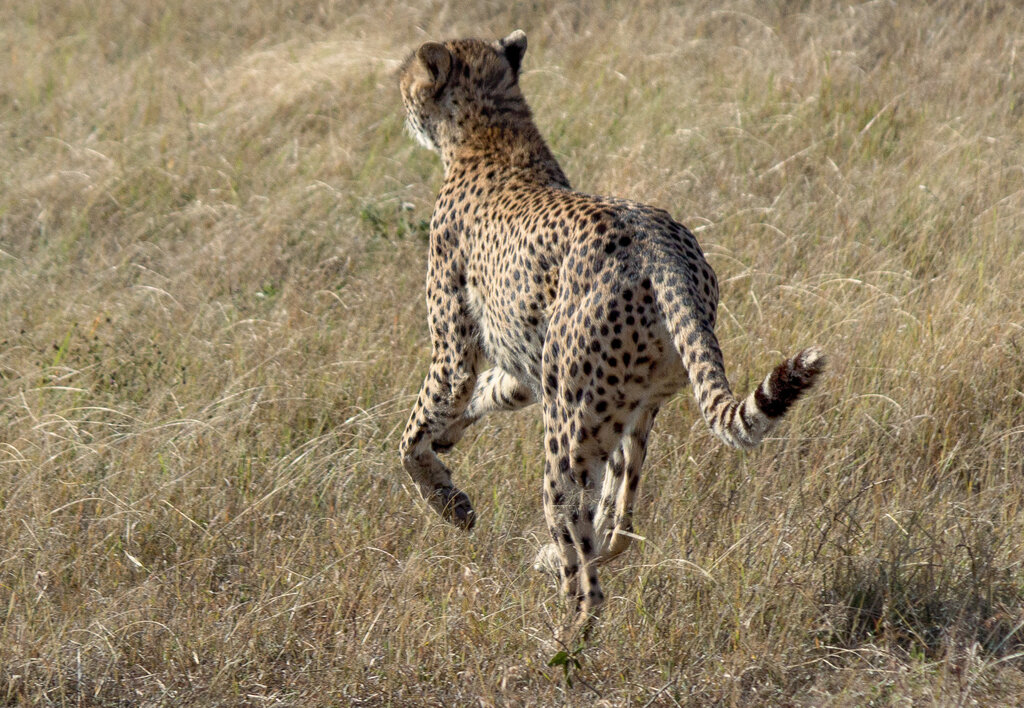
This coiling action enables a unique running style called the double suspension gallop. The spine flexes so dramatically that the cheetah’s hind legs land far in front of where its front legs just were. This results in two moments per stride where all four paws are off the ground: once when its legs are bunched up under its body, and again when they are fully extended. This massively increases its stride length, allowing it to cover more than 7 meters in a single bound.
Traction and Steering
Speed is useless without control. A cheetah's long limbs act as levers to generate a powerful stride, but its paws and tail are what provide crucial traction and maneuverability.
Unlike most cats, a cheetah's claws are only semi-retractable. They are always partially exposed, digging into the ground like the spikes on a sprinter's shoes. This provides superior grip for rapid acceleration and making sharp turns without slipping.
The claws function much like the cleats on a track shoe, providing essential grip.
The cheetah's long, muscular tail is another key tool. It doesn't provide power, but instead acts as a rudder or counterbalance. When the cheetah makes a high-speed turn, it swings its tail to counteract the rotational forces of its body, helping it stay balanced and precisely follow the sharp cuts of its prey.
Ready to test your knowledge on the biomechanics of speed?
What is the primary function of a cheetah's exceptionally flexible spine during a sprint?
A cheetah's powerful hind legs are packed with a high concentration of which type of muscle fiber, specialized for explosive acceleration?
Every part of the cheetah, from its muscle fibers to the tip of its tail, is finely tuned for the explosive chase. It's a perfect example of how anatomy and physiology combine to create an animal that is the undisputed champion of land speed.