Biomechanics of Resistance Equipment
Cams and Pulleys
The Shape of Resistance
In the world of resistance training, not all machines are created equal. While free weights provide constant resistance due to gravity, many machines offer variable resistance. This is achieved through clever engineering, most notably with the use of cams. A cam is essentially a wheel that isn't perfectly round. This non-circular shape is the key to manipulating the difficulty of an exercise throughout its range of motion.
Think of a seated leg extension. Your quadriceps are strongest when your leg is nearly straight and weakest when it's fully bent. A standard circular pulley would provide constant resistance, making the exercise too hard at the beginning and too easy at the end. A Nautilus-style cam, however, changes the effective lever arm throughout the movement.
The cam's shape alters the length of the moment arm—the perpendicular distance from the pivot point to the line of action of the force. Since torque equals force multiplied by the moment arm (), changing the moment arm () changes the torque required to lift the same weight ().
When the movement begins (e.g., leg fully bent), the cam presents a short moment arm. This means less torque is required from your muscles to move the weight, giving you a high mechanical advantage. As you extend your leg into a stronger position, the cam rotates, presenting a longer moment arm. This increases the required torque, making the exercise feel heavier to match your body's natural strength curve.
The goal of a well-designed cam is to make the resistance feel consistently challenging throughout the entire range of motion, loading the muscle effectively at every point.
Pulleys and Force Vectors
While cams modify resistance, pulleys primarily redirect it. In a cable machine, a pulley system allows you to pull down, forward, or across your body while lifting a weight stack that only moves vertically. Each pulley in the system changes the direction of the cable's force vector.
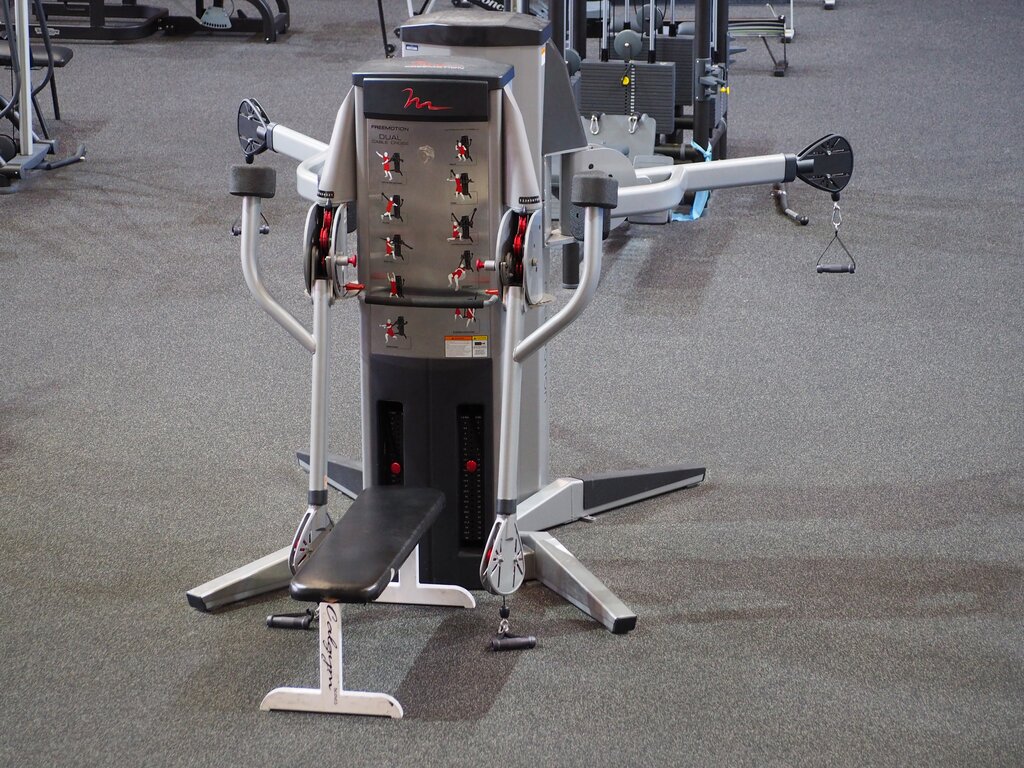
However, this redirection isn't free. Each time a cable passes over a pulley, friction occurs at the pulley's axle, and a small amount of energy is required to get the pulley itself spinning (its moment of inertia). This results in a loss of force. A machine with many pulleys will have more friction than one with few. This is why a 100 lb selection on a multi-pulley functional trainer might feel lighter than 100 lbs on a simple lat pulldown machine.
With a movable pulley, you do have a mechanical advantage.
The type of machine also matters. Selectorized machines with weight stacks often have more inherent friction due to the guide rods the stack slides on, in addition to the pulleys. Plate-loaded machines, which often use simpler lever arms, typically have less friction because they only pivot on a few bearing points. This difference in friction and inertia can subtly change the feel of the resistance.
Putting It All Together
Let's analyze the mechanical advantage of a pec deck machine, which often uses both cams and pulleys. The machine is designed to mimic the strength curve of the pectoral muscles, which are typically weaker at the start (arms wide) and end of the motion (arms together) but strongest in the middle.
By combining a precisely shaped cam with a system of pulleys, the pec deck provides variable resistance that strengthens the pectoral muscles through their entire contractile range. The pulleys redirect the vertical force of the weight stack into a horizontal resistance for the user's arms, while the cam fine-tunes that resistance moment by moment.
Test your understanding of these mechanical principles.
What is the primary purpose of a cam in a resistance training machine?
On a leg extension machine equipped with a properly designed cam, when is the resistance torque felt by the user at its lowest?
Understanding how machines use cams and pulleys allows for a more informed approach to exercise selection, helping you match the right equipment to your specific training goals.