Biological Systems Classification and Cellular Architecture
Modern Phylogenetic Taxonomy
Beyond Appearances
For centuries, classifying life was a lot like organizing a library by the color of the book covers. Biologists, following the Linnaean system, grouped organisms based on shared physical traits. If it had feathers and a beak, it was a bird. If it had scales and cold blood, it was a reptile. This system was revolutionary for its time, giving us familiar terms like genus and species. But it had a fundamental limitation: appearances can be deceiving.
Just because two organisms look alike doesn't mean they're closely related. A dolphin and a shark both have fins and a streamlined body, yet one is a mammal and the other is a fish. Their similarities are the result of adapting to the same environment, a phenomenon called convergent evolution, not a shared recent ancestor.
Modern taxonomy has moved beyond just looking at physical traits. It focuses on genetics to build a family tree for all of life. This approach, called phylogenetic classification, groups organisms based on their evolutionary history—who descended from whom. It's less about what an organism looks like and more about what its DNA says about its relatives.
A Universal Family Tree
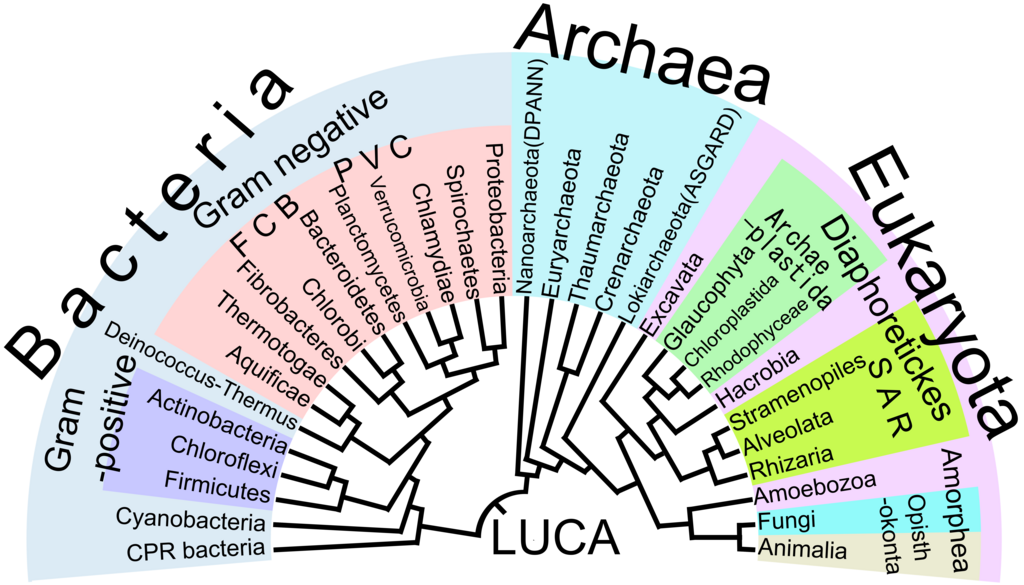
This genetic revolution completely redrew the map of life. Instead of the five kingdoms you might have learned in school, we now primarily use a three-domain system. At the highest level, all life is grouped into Bacteria, Archaea, and Eukarya.
How did we arrive at this structure? Scientists needed a reliable genetic marker—a sort of molecular clock—that could be compared across all living things. The marker had to be something every organism possesses, and it needed to change very, very slowly over eons. They found it in ribosomal RNA, or rRNA.
Ribosomes are the protein-building factories inside every cell, and rRNA is a key component. Because its job is so essential, its genetic code is highly conserved. Mutations are rare, but they happen at a steady enough rate to be tracked.
Specifically, the gene for a small subunit of rRNA, called 16S rRNA in Bacteria and Archaea, became the gold standard. By comparing the subtle differences in the 16S rRNA sequence between two organisms, scientists can calculate how long it's been since they shared a common ancestor. It’s the ultimate tool for peering deep into evolutionary time.
Keeping Families Together
The goal of modern phylogenetics is to create groups that are monophyletic. A monophyletic group, also called a clade, includes a common ancestor and all of its descendants. Think of it as a single, complete branch of the evolutionary tree. Mammals are a good example: the first mammal and all of its descendants, from shrews to blue whales, form a single, unbroken lineage.
This strict rule forces us to re-evaluate many traditional groupings. Any group that leaves out a descendant is considered paraphyletic and is no longer seen as a valid classification. It’s like inviting most of your cousins to a family reunion but deliberately excluding one—it's not the whole family.
A classic casualty of this approach is the former Kingdom Protista. Originally, Protista was a catch-all category for any eukaryotic organism that wasn't a plant, animal, or fungus. It was a kingdom of leftovers, containing everything from single-celled amoebas to giant kelp.
Genetic analysis revealed that the organisms lumped into Protista don't share a single common ancestor. Instead, they're scattered all over the eukaryotic branch of the tree of life. Some protists are more closely related to plants than to other protists; others are more closely related to animals. The kingdom is a clear example of a paraphyletic group, and as a result, biologists are actively dismantling it and reclassifying its members into new, monophyletic kingdoms.
Even the definition of a 'species' is getting a genomic makeover. For bacteria and other microbes that reproduce asexually, the old concept of a species based on interbreeding doesn't apply. Today, scientists often use genomic typing, defining a species as a group of organisms with a high degree of similarity in their overall genome sequence.
This shift to a genetic, evolutionary framework is more than just academic housekeeping. It gives us a more accurate picture of how life evolved and how different organisms are truly related. It helps us track the spread of diseases, understand biodiversity, and discover new forms of life. By reading the stories written in DNA, we build a tree of life that reflects history, not just superficial resemblance.