Biological Systems and Functional Mechanisms
Cellular Energetics and Metabolism
Regulating the Fuel Line
Cells don't burn glucose uncontrollably. Instead, they manage their energy supply with incredible precision. The metabolic pathways of glycolysis and the citric acid cycle are like fuel lines with sensitive valves, responding constantly to the cell's energy needs.
In glycolysis, the most critical control point is an enzyme called (PFK). Think of it as a smart gatekeeper. When the cell is rich in ATP, some of that ATP binds to PFK and inhibits its activity, slowing down glucose breakdown. High levels of citrate, an early product of the citric acid cycle, also signal a surplus and inhibit PFK. Conversely, when energy is low, levels of AMP (a breakdown product of ADP) rise. AMP activates PFK, opening the floodgates to produce more ATP.
Similarly, the citric acid cycle has its own regulators. The enzyme isocitrate dehydrogenase is a key player. It's inhibited by high concentrations of ATP and NADH, the very products the pathway helps generate. When the cell has plenty of energy, the cycle slows down. When it needs more, lower levels of these molecules allow the cycle to speed up. This constant feedback ensures the cell produces just enough energy, never wasting precious resources.
Cashing in Electrons
After glycolysis and the citric acid cycle, the cell's energy isn't primarily in ATP yet. It's stored in high-energy electron carriers: NADH and FADH₂. The electron transport chain (ETC) is where these carriers are cashed in for a much larger ATP payout.
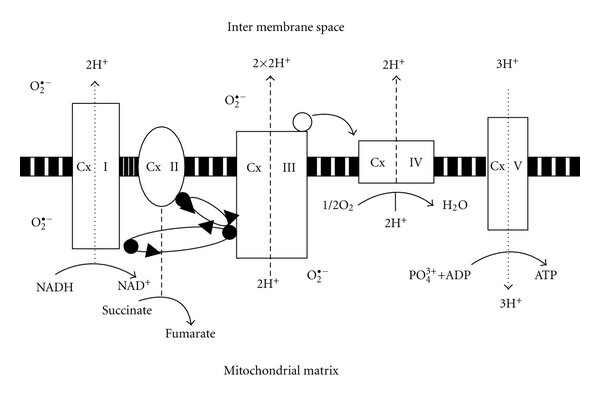
Embedded in the inner mitochondrial membrane, the ETC is a series of four protein complexes. NADH drops its electrons off at Complex I, while FADH₂ hands them to Complex II. The electrons are then passed down the line from one complex to the next, a bit like a molecular bucket brigade. A small, mobile protein called ferries electrons between Complex III and Complex IV.
With each transfer, the electrons lose a bit of energy. This released energy isn't wasted; it powers the complexes to actively pump protons (H⁺ ions) from the mitochondrial matrix into the intermembrane space. This creates a steep electrochemical gradient, with a high concentration of positively charged protons packed into a tiny space. At the very end of the line, the now low-energy electrons are handed off to oxygen, which combines with protons to form water. This is why oxygen is essential for aerobic respiration.
The entire purpose of the electron transport chain is to convert the energy stored in electron carriers into the potential energy of a proton gradient.
This proton gradient is a form of stored energy, much like water held back by a dam. The final stage of respiration, chemiosmosis, is the process of harnessing that stored energy.
The only way for protons to get back into the matrix is through a remarkable enzyme called ATP synthase. As protons rush through a channel in this enzyme, they force a component of it to spin like a turbine. This mechanical rotation drives the synthesis of ATP from ADP and inorganic phosphate. This coupling of chemical transport (chemi) and movement (osmosis) is why the process is called chemiosmosis.
It's an incredibly efficient system. For every molecule of glucose, aerobic respiration can generate around 30 to 32 molecules of ATP. The vast majority of this yield comes from the chemiosmotic work of ATP synthase.
Harvesting Sunlight
Photosynthesis uses many of the same principles as cellular respiration, but in reverse. Instead of breaking down glucose to release energy, it uses light energy to build glucose.
This process is divided into two main stages: the light-dependent reactions and the light-independent reactions (the Calvin cycle).
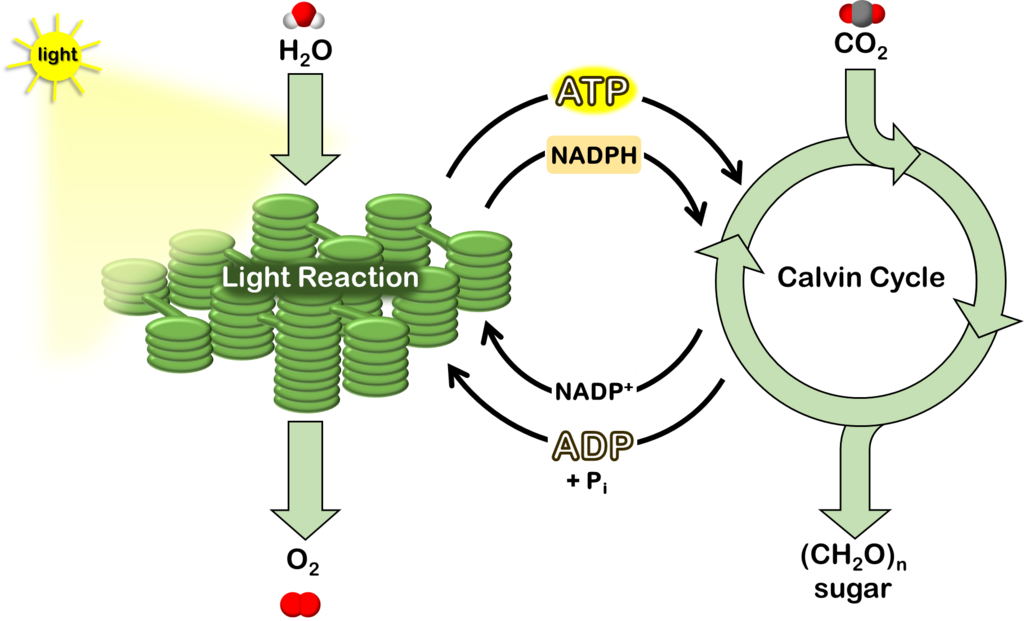
The light-dependent reactions occur in the thylakoid membranes of chloroplasts. Here, pigments like chlorophyll absorb light energy, which excites electrons. These high-energy electrons enter an electron transport chain. Just as in mitochondria, as electrons are passed along, their energy is used to pump protons—this time from the stroma into the thylakoid lumen, creating a proton gradient.
Water is split to replace the lost electrons, releasing oxygen as a byproduct. The proton gradient then powers an ATP synthase, producing ATP. The high-energy electrons ultimately end up on an electron carrier called NADP⁺, reducing it to NADPH. So, the light reactions convert light energy into the chemical energy of ATP and NADPH.
The light reactions produce ATP and NADPH. The [{
}] uses that ATP and NADPH to build sugar from carbon dioxide.
The Calvin cycle takes place in the stroma. It doesn't directly require light, but it depends on the products of the light reactions. In this series of reactions, an enzyme called RuBisCO captures CO₂ from the atmosphere and fixes it into an organic molecule. Using the energy from ATP and the reducing power of NADPH, the cycle rearranges this molecule into a three-carbon sugar (G3P). Some of this G3P is used to make glucose and other organic molecules, while the rest is used to regenerate the starting material of the cycle.
Efficiency vs. Power
Aerobic respiration is highly efficient, but it has a bottleneck: it requires a steady supply of oxygen. What happens when oxygen is scarce, like during an intense sprint? Cells switch to anaerobic pathways, primarily fermentation.
Fermentation begins with glycolysis, just like aerobic respiration. Glycolysis produces 2 ATP and 2 NADH. Without oxygen to act as a final electron acceptor, the electron transport chain backs up. NADH can't drop off its electrons, so the cell's supply of NAD⁺, which is needed for glycolysis to continue, runs out.
The entire purpose of is to solve this problem. It regenerates NAD⁺ by having NADH donate its electrons to pyruvate, the end product of glycolysis. In humans, this produces lactate. In yeast, it produces ethanol and CO₂. This allows glycolysis to continue making small amounts of ATP very quickly, even without oxygen.
This reveals a fundamental metabolic trade-off. Aerobic respiration is efficient, providing a massive ATP yield per glucose molecule, but it's relatively slow. Anaerobic fermentation is incredibly fast, providing immediate power, but it's inefficient, yielding only 2 ATP per glucose and leaving most of the energy locked in the waste product (lactate or ethanol). Organisms must balance these strategies to maintain homeostasis under varying metabolic demands and oxygen availability.
| Pathway | Oxygen Required? | ATP Yield (per glucose) | Speed |
|---|---|---|---|
| Aerobic Respiration | Yes | ~32 ATP | Slow |
| Anaerobic Fermentation | No | 2 ATP | Very Fast |
This choice between a high-efficiency, low-power system and a low-efficiency, high-power system is a core principle of bioenergetics, governing everything from a single cell to the metabolism of an entire organism.
Which of the following molecules acts as an inhibitor for the enzyme phosphofructokinase (PFK) during glycolysis?
What is the final electron acceptor at the end of the mitochondrial electron transport chain?