Biological Foundations and Theory of Spiking Neural Networks
Biological Neuron Dynamics
From Biology to Bits
To model a neuron, we first need to understand its electrical properties. The cell's outer layer, the lipid bilayer, is a fatty membrane that doesn't let charged ions pass through easily. This separation of charge makes it act like a capacitor, storing electrical potential.
Embedded in this membrane are various ion channels, which are specialized proteins that act like gates. When open, they allow specific ions, like sodium () or potassium (), to flow through. This flow of ions is an electrical current. Because these channels can resist the flow of ions, they function as resistors. Together, the membrane's capacitance and the channels' resistance form a basic RC circuit, the fundamental electrical model of a neuron.
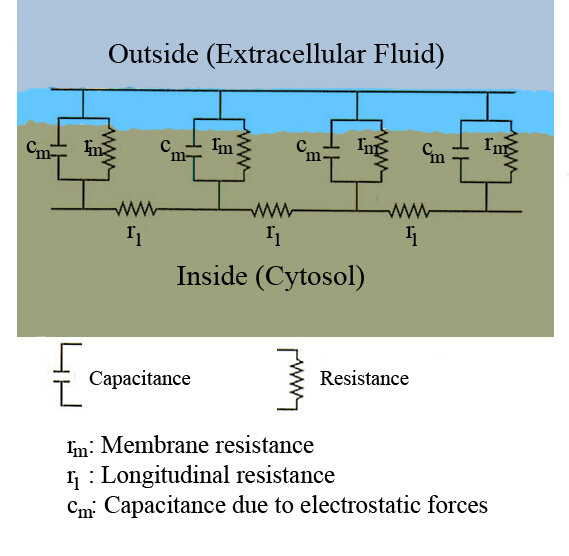
In the 1950s, Alan Hodgkin and Andrew Huxley developed a groundbreaking model to describe precisely how the voltage across a neuron's membrane changes during an action potential. The Hodgkin-Huxley model is a set of four coupled differential equations that account for the detailed behavior of sodium and potassium ion channels. These equations describe the channels' conductances (the inverse of resistance) as functions of voltage and time, providing a highly accurate, biophysically realistic simulation of a neuron's spike.
The model's complexity and power come from how it defines the conductances, . They aren't fixed values. Instead, they depend on voltage-sensitive 'gating variables' that model the probability of channels being open or closed. While incredibly detailed, solving these four equations for thousands or millions of neurons in a network is computationally expensive, creating a bottleneck for large-scale brain simulations.
The Need for Simplicity
For many data science and computational neuroscience applications, we don't need to know the exact shape of an action potential. We just need to know when it happens. This is the core trade-off: sacrificing some biological detail for a massive gain in computational efficiency. This is where the Leaky Integrate-and-Fire (LIF) model comes in.
The LIF model is an abstraction. It captures the essential dynamics of a neuron—integrating inputs over time and firing a spike when a threshold is reached—without the overhead of modeling ion channel kinetics.
The LIF model simplifies the neuron to a single equation. We start with the basic capacitor equation for the membrane: . The "leaky" part comes from adding a resistor that constantly lets charge leak out, pulling the membrane potential back to a resting state. This leak current is described by Ohm's law, .
Combining these, the total current changes the membrane potential according to the following equation:
This equation can be rearranged into a standard form by defining the membrane time constant, , which describes how quickly the membrane potential decays back to rest.
Firing and Resetting
The LIF model has two more rules. First, if the membrane potential reaches a certain threshold voltage, , the neuron fires a spike. Second, immediately after firing, the voltage is manually reset to a specific value, , and held there for a short duration.
This reset mechanism is a crucial abstraction of the biological refractory period—the brief time after an action potential when a neuron cannot fire again. During this period, sodium channels are inactivated and potassium channels are open, making it much harder to reach the firing threshold. The LIF model's hard reset and enforced delay efficiently mimics this complex biophysical process, preventing the model neuron from firing unrealistically fast.
By replacing the four complex differential equations of the Hodgkin-Huxley model with a single, simpler equation and a threshold-reset rule, the LIF model provides an excellent balance. It retains the essential temporal dynamics of neural integration and firing while being computationally efficient enough to simulate vast networks. This makes it a powerful and foundational tool in data science and computational neuroscience, providing a biologically plausible yet practical way to model neural computation.
In the basic electrical model of a neuron, the cell's lipid bilayer acts as a __________ and the ion channels act as __________.
What is the primary trade-off when choosing the Leaky Integrate-and-Fire (LIF) model over the Hodgkin-Huxley model?