Bioinformatics and Computational Genomics
Sequence Alignment Algorithms
The Logic of Alignment
Comparing two biological sequences isn't as simple as lining them up and looking for differences. Imagine trying to compare two versions of a novel, where entire paragraphs might be shifted, sentences added, and words changed. A simple side-by-side check would be chaotic. We need a systematic way to find the best possible alignment, accounting for matches, mismatches, and gaps (insertions or deletions). The solution lies in an approach called which breaks this massive comparison problem into a series of tiny, solvable decisions.
Instead of solving the whole problem at once, we solve the smallest possible parts and use those answers to build up to the final, optimal alignment.
This method creates a grid, or matrix, where one sequence forms the columns and the other forms the rows. Each cell in the grid represents the score of the best alignment up to that point. By filling out the grid based on a clear set of scoring rules, we can trace a path from one corner to the other that reveals the optimal alignment. This guarantees we find the mathematically best alignment without having to check every single possibility.
Global vs. Local Alignment
There are two primary strategies for sequence alignment, each suited for different biological questions.
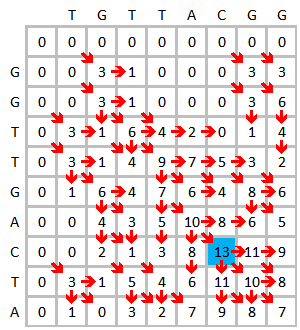
Dynamic programming optimises sequence alignment by breaking down the problem into smaller subproblems
The Needleman-Wunsch algorithm performs a global alignment. It assumes the two sequences are generally similar and attempts to align them from end to end. Think of it as comparing two closely related genes to see their overall similarity. The algorithm fills a matrix and finds the path from the bottom-right corner to the top-left that yields the highest total score. This path represents the best possible alignment across the entire length of both sequences.
Conversely, the Smith-Waterman algorithm performs a local alignment. This is useful when you're looking for conserved regions or domains within two otherwise dissimilar sequences. For example, finding a functional protein domain that appears in two very different proteins. The key difference is that scores in the matrix are never allowed to be negative; if a score would become negative, it's set to zero. The alignment then starts from the highest-scoring cell anywhere in the matrix and traces back until it hits a zero. This identifies the most similar subsequence shared between the two sequences, ignoring the rest.
How to Score an Alignment
The results of these algorithms are only as good as the scoring system used. A scoring system has two main components: a substitution matrix for matches and mismatches, and penalties for gaps.
Substitution Matrices
For DNA, scoring is often simple: a positive score for a match, a negative for a mismatch. For proteins, it's more complex. Some amino acid substitutions are chemically similar and occur frequently in evolution, while others are rare and disruptive. Scoring matrices capture these probabilities.
Two families of matrices are widely used: PAM and
| Feature | PAM (Point Accepted Mutation) | BLOSUM (Blocks Substitution Matrix) |
|---|---|---|
| Basis | Based on an explicit evolutionary model of mutations. | Derived from direct observation of substitutions in aligned blocks. |
| Data Source | Alignments of closely related proteins (>85% identity). | Alignments of conserved regions in more divergent proteins. |
| Numbering | Higher numbers (e.g., PAM250) mean greater evolutionary distance. | Lower numbers (e.g., BLOSUM45) mean greater evolutionary distance. |
| Best For | Comparing closely related sequences. | Comparing more distantly related sequences. |
The choice of matrix is crucial. Using a PAM30 matrix (for closely related sequences) to compare two distant homologs would likely fail, just as using a BLOSUM45 matrix on two nearly identical sequences might obscure their close relationship.
Gap Penalties
A gap represents an insertion or deletion event. Simply penalising each gap character equally isn't biologically realistic. A single event could insert or delete several residues at once. To model this, we use an affine gap penalty.
This system uses two penalties:
- A high gap opening penalty for starting a new gap.
- A lower gap extension penalty for each additional character in the gap.
This makes a single long gap more 'favourable' in the scoring than multiple short gaps, which better reflects the underlying biological mechanisms of insertion and deletion.
Now, let's test your understanding of these core alignment concepts.
When comparing two proteins you suspect are distantly related, which algorithm is best suited for identifying a short, conserved functional domain they might share?
What is the primary advantage of using an affine gap penalty in sequence alignment?
Understanding these algorithms and scoring systems is the foundation for almost all comparative genomics. They allow us to move from raw sequence data to meaningful biological insights about function, evolution, and relationships.