Binary Numbers in Computing
Introduction to Binary Numbers
The Language of Computers
At its core, every computer, smartphone, and digital device speaks a very simple language. It's not English or Chinese, but a system with only two characters: 0 and 1. This is the binary number system.
Everything you see on a screen—text, images, videos—is ultimately a long string of these two digits. It's a system built on simplicity, which is what makes it so powerful for electronics.
Binary is a base-2 number system. This means it only uses two symbols, 0 and 1, to represent all possible numbers.
We're used to the decimal system, or base-10, which uses ten symbols (0 through 9). The switch to base-2 might seem strange at first, but it follows the same underlying logic of place value. In our familiar decimal system, each position in a number is ten times greater than the position to its right. We have the ones place, the tens place, the hundreds place, and so on.
In binary, each position is two times greater than the one to its right. Instead of powers of ten, binary uses powers of two.
| Decimal (Base-10) | Binary (Base-2) | How to Read It |
|---|---|---|
| 0 | 0 | Zero |
| 1 | 1 | One |
| 2 | 10 | One two, and zero ones |
| 3 | 11 | One two, and one one |
| 4 | 100 | One four, zero twos, and zero ones |
| 5 | 101 | One four, zero twos, and one one |
Place Value is Key
Let's look closer at place value. The decimal number 123 is really just a shorthand. It means:
That's 1 hundred, 2 tens, and 3 ones. Binary works the same way, but with powers of two. For example, the binary number 1101 isn't one thousand, one hundred and one. It's:
This calculates to , which equals 13 in our decimal system.
This system of on/off states is perfect for computers. Electronic circuits can be in one of two states: high voltage (represented by 1) or low voltage (represented by 0). This makes processing and storing information incredibly reliable and efficient.
An Idea Through Time
The concept of a base-2 system isn't new. Ancient Egyptian scribes used a system for fractions that involved doubling, similar to binary powers. The ancient Chinese text I Ching, dating back to the 9th century BC, used broken and unbroken lines to form trigrams and hexagrams in a system that maps directly to 3-bit and 6-bit binary numbers.
However, the modern binary system was formally studied and documented by the German mathematician Gottfried Wilhelm Leibniz in the late 17th century. He was fascinated by the system's elegance and saw a connection to his Christian faith, where 1 represented God and 0 represented the void, or nothingness. Leibniz's work laid the groundwork for the digital logic that would appear centuries later.
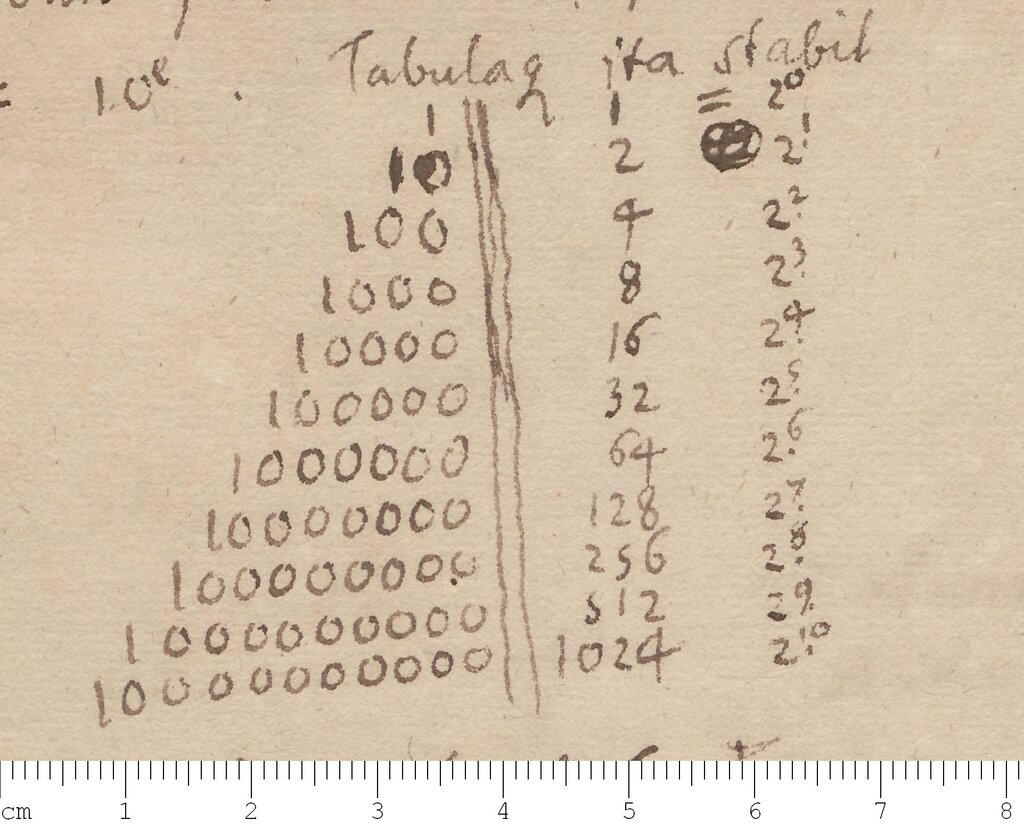
It took until the 1930s and 40s for engineers to realize that the binary system Leibniz described was perfect for building electronic computers. George Boole's work on Boolean algebra, which uses true/false logic, provided the final piece of the puzzle. By combining binary numbers with Boolean logic, pioneers like Claude Shannon showed how electric circuits could solve any logical or numerical problem.
From these foundations, the entire digital world was built. Every time you use a computer, you're using a system of thought that spans millennia, refined by a philosopher, and put into practice by engineers.
What is the decimal (base-10) equivalent of the binary (base-2) number 1101?
Why is the binary system particularly well-suited for use in electronic computers?