Bilingual Childlike Explanations
Understanding Child Development
The Five-Year-Old Mind
A five-year-old's brain is not just a smaller version of an adult's. They are in what child psychologist Jean Piaget called the "preoperational stage" of cognitive development. This means they are masters of symbolic thinking—a toy block can be a car, a phone, or a piece of cake. However, their thinking is still very literal and centered on themselves.
They struggle to see things from another person's perspective. If you ask a five-year-old to describe what you see from across the table, they will likely describe what they see from their own seat. They don't yet grasp that your view is different. When teaching languages, this means abstract grammar rules are useless. Concepts need to be concrete and tied to their immediate world: their toys, their family, and their daily activities.
How Kids Learn Language
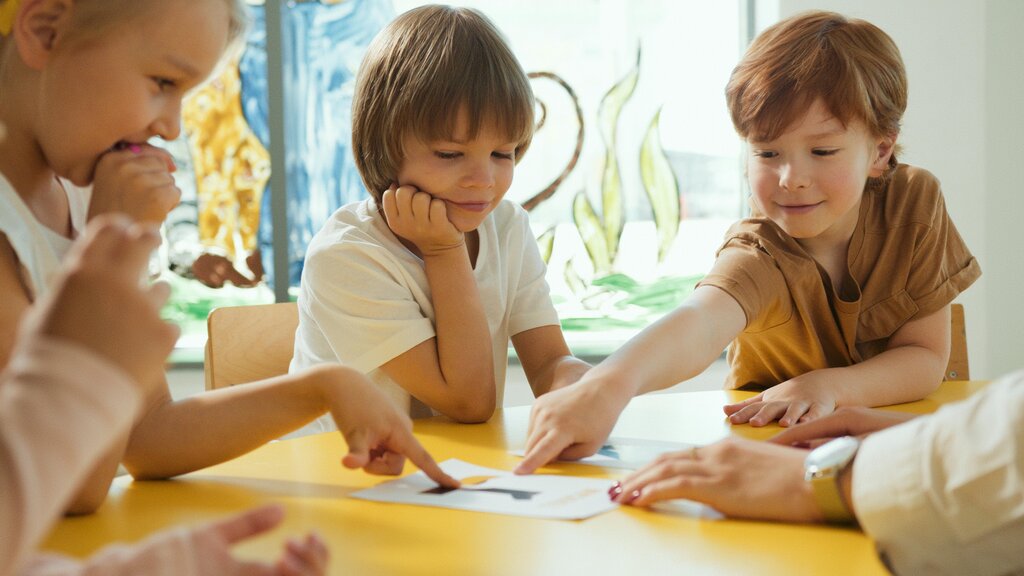
Young children acquire language naturally, not by studying it. Their brains are wired to absorb patterns, sounds, and structures simply by being exposed to them. This is why immersion is so powerful at this age. They don't need to be told that in French, adjectives often come after the noun (e.g., un chat noir). After hearing it enough times, their brain simply accepts it as the way things are.
Think of it like learning the rules of a game by watching others play. You pick up on the patterns and logic without ever reading an instruction manual. For a five-year-old, language is a game they are eager to play. The goal is to communicate, not to be grammatically perfect.
By weaving learning into everyday moments, you’re helping your toddler develop critical thinking, language, and problem-solving skills without them even realizing it.
cognition
noun
The mental process of acquiring knowledge and understanding through thought, experience, and the senses.
Attention and Learning Styles
A five-year-old's attention span is short. A good rule of thumb is to expect about two to five minutes of focused attention per year of their age. For a five-year-old, this means you have about 10 to 25 minutes for a single activity, but it's often best to switch things up even more frequently.
Variety is essential. Plan lessons that move between different types of activities. You might sing a song in Arabic, then move to a hands-on craft, and then play a quick movement game. Keeping things dynamic prevents boredom and helps maintain engagement.
Keep activities short and focused. A 10-minute game is far more effective than a 30-minute lecture.
Children also have different learning styles. Some learn best by hearing (auditory), some by seeing (visual), and others by doing (kinesthetic). A strong lesson will appeal to all three styles.
An auditory learner will love songs, rhymes, and stories in French. A visual learner will benefit from colorful flashcards and picture books. A kinesthetic learner needs to move; they will learn vocabulary best by acting out verbs like "jump" (sauter) or "run" (courir).
| Learning Style | Arabic/French Activity Example |
|---|---|
| Visual | Using illustrated flashcards for vocabulary like 'kitab' (book) or 'maison' (house). |
| Auditory | Singing a simple song like "Frère Jacques" or an Arabic alphabet song. |
| Kinesthetic | Playing a game of Simon Says using commands like 'touchez votre nez' (touch your nose). |
Now, let's review some of the key ideas we've covered.
Ready to check your knowledge?
According to Jean Piaget, a five-year-old is in the "preoperational stage." What is a primary characteristic of their thinking at this age?
Which teaching approach is most effective for a five-year-old learning a new language?
By understanding these developmental foundations, you can create language lessons that are not only effective but also joyful and engaging for a five-year-old.