Big History and The Global Timeline
Cosmic Origins and Complexity
From Simplicity to Structure
The early universe was almost featureless. A few minutes after the Big Bang, it was a hot, expanding sea of mostly hydrogen and helium nuclei, with a dash of lithium. Everything was simple and spread out. Yet, over 13.8 billion years, this bland cosmic soup organized itself into the staggering complexity we see today: galaxies, stars, planets, and living beings.
This journey from simple to complex wasn't random; it happened in stages, crossing critical thresholds. Each stage created new platforms for even greater complexity to emerge. The first and most fundamental driver was gravity. Tiny, almost imperceptible variations in the density of the early cosmic gas were the seeds. Gravity, patient and relentless, began to pull matter from less dense regions into slightly denser ones. What started as a nearly uniform cloud slowly became a network of clumps and filaments.
This clumping was the first step, creating the large-scale cosmic web. But for true complexity, something more was needed. Stars had to turn on.
The First Forges
Star formation required what are often called Goldilocks Conditions – a set of circumstances that are 'just right.' Gravity had to pull enough hydrogen and helium into a small enough space. As the gas cloud collapsed, the pressure and temperature at its core skyrocketed. When it became hot and dense enough, around 10 million Kelvin, a new process ignited: nuclear fusion.
This was the universe's second major threshold. Hydrogen atoms began fusing into helium, releasing enormous amounts of energy. This outward push of energy balanced gravity's inward pull, creating a stable, long-lived star. The first stars lit up the cosmic dark ages.
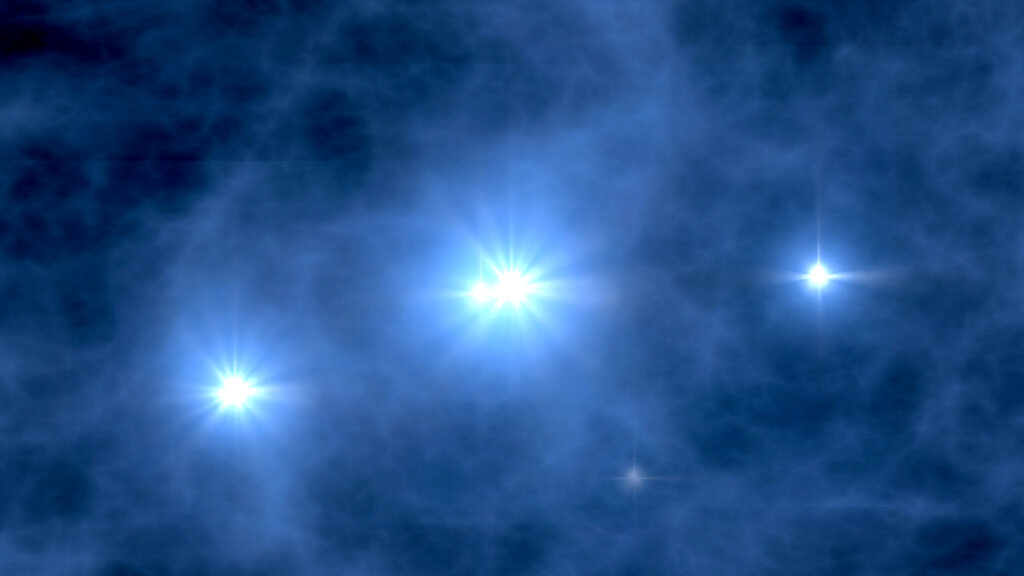
These first-generation stars were giants, hundreds of times more massive than our sun. They burned through their fuel furiously and died in spectacular supernova explosions after only a few million years. But in their death came a crucial gift: chemical enrichment. Inside their cores, fusion had forged heavier elements like carbon, oxygen, and iron. The supernovae scattered these new ingredients across the cosmos, seeding the next generation of stars and planetary systems.
Building Worlds
Without the heavy elements forged in stars, the universe would only contain gas giants. Solid, rocky planets like Earth simply couldn't exist. This chemical enrichment enabled the next threshold: the formation of planetary systems.
After a star forms, it is surrounded by a spinning disk of leftover gas and dust. Within this protoplanetary disk, the new, heavier elements started to stick together through a process called . Tiny dust grains collided and merged, growing into pebbles, then boulders, then kilometer-sized planetesimals. Through millions of years of collisions, these planetesimals swept up more material and grew into the planets we see today.
Each generation of stars added more heavy elements to the cosmic mix, making the formation of complex, rocky planets more likely over time.
Life's Emergence
The final threshold, and perhaps the most profound, was the emergence of life. On at least one of these newly formed rocky planets, Earth, conditions were right for chemistry to become biology.
Life is a fundamentally new kind of complexity. It's not just a passive structure; it's an active, information-processing system. Living organisms harness energy from their environment (like sunlight or chemical reactions) to maintain their structure and create copies of themselves. They take in low-entropy energy and matter and expel high-entropy waste, locally reversing the universe's general trend towards disorder.
This jump required another set of Goldilocks Conditions: liquid water, a stable source of energy, and a rich supply of the right chemical building blocks, especially carbon. Once these were in place, self-replicating molecules could form, setting the stage for evolution by natural selection. Life became a new engine of complexity, transforming Earth's geology and atmosphere over billions of years.
And so, from a simple, hot beginning, the universe built itself up, one threshold at a time. Each step, from the first clump of gas to the first self-replicating cell, created a new platform for even more intricate structures to arise.
Ready to test your understanding of how complexity arises in the cosmos?
What was the primary force that began pulling matter together in the nearly uniform early universe, leading to the formation of the first large-scale structures?
Why was the death of the first-generation stars crucial for the eventual formation of rocky planets like Earth?