Big Data Fundamentals
Introduction to Big Data
What Is Big Data?
You’ve probably heard the term "Big Data" used everywhere. It’s more than just a buzzword for having a lot of information. Big Data refers to datasets that are so large, fast-moving, and complex that traditional data-processing software just can't handle them. Think of trying to pour the entire ocean through your kitchen faucet. It’s not just about the amount of water; it’s also about the speed and pressure.
The real significance of Big Data isn't its size, but what we can do with it. By analyzing these massive datasets, we can uncover patterns, trends, and associations that were previously invisible. This helps businesses, scientists, and governments make smarter decisions.
The Five Vs
To really understand what makes Big Data different, experts define it using five core characteristics, often called the "5 Vs."
Let's break down each of these characteristics.
Volume
noun
The sheer scale of data. Big Data involves enormous quantities, often measured in terabytes, petabytes, or even exabytes.
Imagine all the books ever written. Now imagine that collection multiplied a thousand times over. That starts to give you a sense of the scale we're talking about. Companies like Google and Facebook process amounts of data that are hard to comprehend on a daily basis.
Velocity
noun
The speed at which data is generated and must be processed. In many cases, this data is streaming in real-time.
Think about the millions of tweets, stock trades, and sensor readings created every second. This data needs to be processed almost instantly to be useful, like detecting credit card fraud as a transaction happens, not hours later.
Variety
noun
The different forms that data can take. Big Data comes from many sources and in many formats.
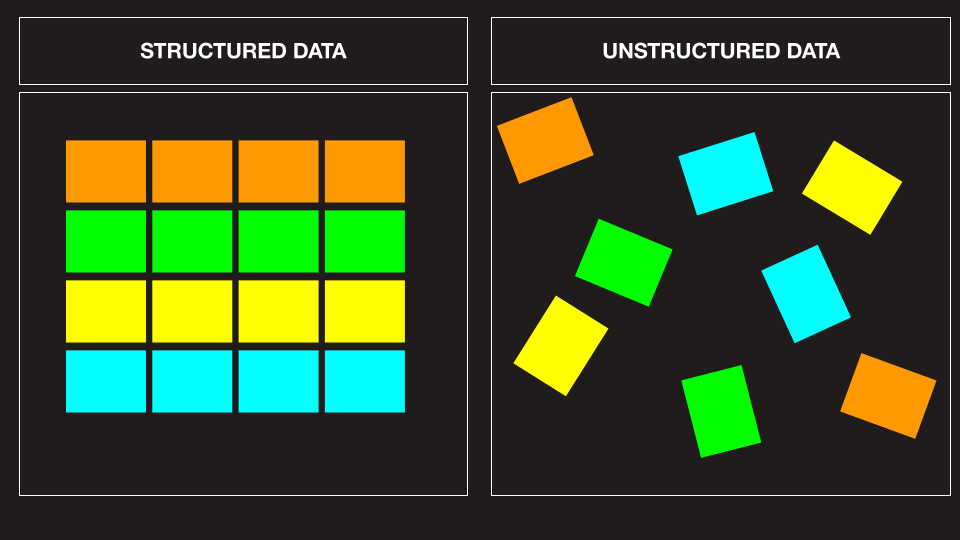
Data isn't always neat and tidy. It comes in three main types:
- Structured data: Highly organized and easily searchable, like a spreadsheet or a database of customer names and addresses.
- Unstructured data: Not organized in a pre-defined way. This includes things like text in emails, social media posts, videos, and audio files. It makes up the vast majority of data in the world.
- Semi-structured data: A mix of both. It isn't in a rigid database format but contains tags or markers to separate elements. An example is an XML file.
Veracity
noun
The quality or trustworthiness of the data. With so much data coming from so many sources, it can be messy and contain inaccuracies.
Think about it like this: if you're making a decision based on data, you need to know you can trust it. Veracity deals with biases, noise, and abnormalities in data. Is a customer review genuine or fake? Is a sensor reading accurate or the result of a malfunction? Poor quality data leads to poor quality insights.
Value
noun
The ultimate goal of collecting and analyzing Big Data. Data is only useful if it can be turned into something valuable.
This is arguably the most important V. There's no point in collecting massive amounts of fast-moving, varied, and messy data if you can't get anything useful out of it. The value could be anything from identifying a new market opportunity and improving a medical diagnosis to making a city's traffic flow more efficiently. It's the 'so what?' of Big Data.
Ready to check your understanding of these core concepts?
Which of the following best describes the term 'Big Data'?
A company analyzes customer emails, social media posts, and video reviews to understand public sentiment. Which of the 5 Vs does this scenario primarily illustrate?
Understanding these five characteristics is the first step to grasping the power and challenge of working with Big Data.