Bhagavad Gita Wisdom for Modern Challenges
Introduction to the Bhagavad Gita
The Song of God
The Bhagavad Gita, or "The Song of God," is a 700-verse Hindu scripture that captures a conversation between a warrior prince, Arjuna, and his charioteer, the god Krishna. The setting isn't a peaceful temple or a quiet ashram. It's a battlefield, moments before a great war is about to begin.
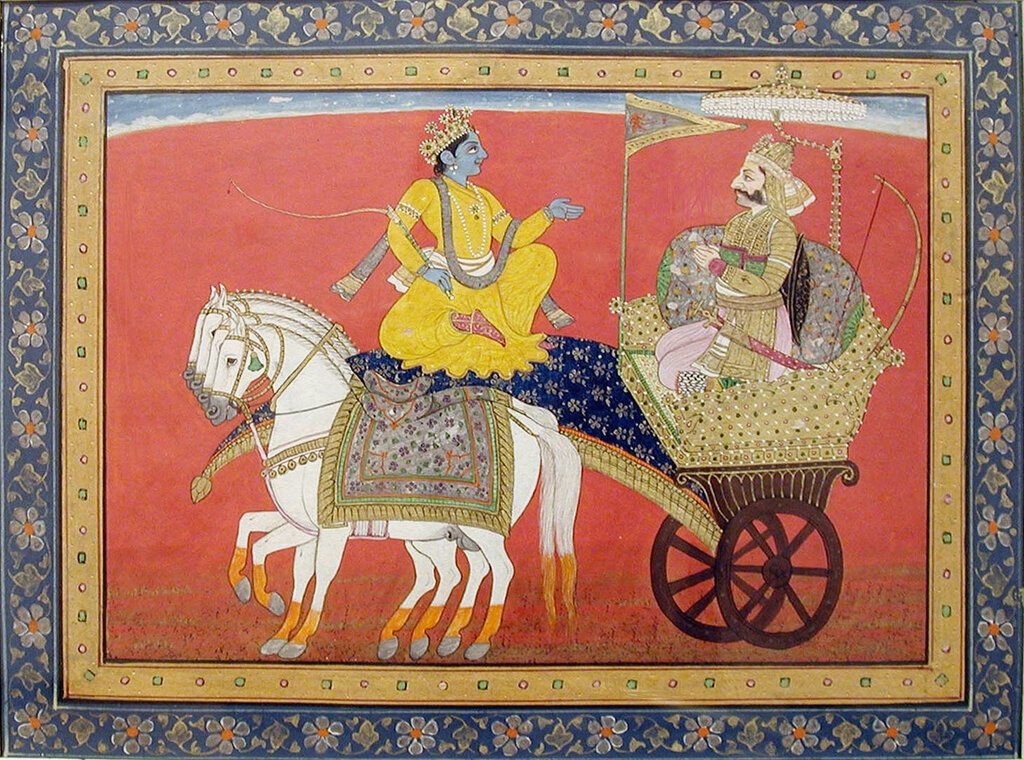
The Gita is a small part of a much larger Indian epic, the Mahabharata. This epic tells the story of a dynastic struggle between two sets of cousins, the Pandavas and the Kauravas, for the throne of Hastinapura. Arjuna is one of the five Pandava princes. As he stands on the battlefield of Kurukshetra, he sees his own relatives—uncles, cousins, and teachers—lined up in the opposing army. Overcome with grief and doubt about the morality of fighting his own kin, he lays down his weapons.
A Guide in 18 Chapters
What follows is a dialogue that unfolds over 18 chapters. Krishna’s guidance to Arjuna forms the entirety of the Bhagavad Gita. This conversation moves from Arjuna's immediate crisis to a profound discussion about the nature of life, duty, and the universe. The text synthesizes many different strands of Hindu philosophy, exploring concepts that are central to the tradition.
Dharma
noun
A complex concept in Hinduism referring to one's righteous duty, cosmic law, and the principles that govern the universe and individual conduct.
Krishna explains to Arjuna the importance of performing his dharma, or duty, without attachment to the results. He introduces several spiritual paths, or Yogas, that one can follow to achieve spiritual understanding. These include Karma Yoga (the path of action), Bhakti Yoga (the path of devotion), and Jnana Yoga (the path of knowledge). Each path offers a way to navigate life's challenges while moving toward spiritual liberation, or moksha.
Why the Gita Matters
The Bhagavad Gita is considered one of the most important texts in Hindu philosophy, often described as a summary of the wisdom of the Upanishads, which are foundational philosophical texts. Its power lies in its setting. By placing a profound spiritual conversation in the middle of a battlefield, the Gita suggests that philosophical questions are not just for quiet contemplation—they arise in the midst of our most difficult struggles.
The Bhagavad Gita is core text of Hindu philosophy and is known as a text that summarises the key philosophies of the Upanishads with major focus on the philosophy of karma.
Arjuna's crisis is a universal one. He feels anxious, confused, and unable to act. Krishna's response isn't just for a prince facing a war; it's guidance for anyone facing a moral or personal dilemma. The text addresses the fundamental human condition of having to act in a complex world, often without clear answers. This is why the Gita has remained a source of inspiration for millions, both within and outside of India, for centuries.
The profound dialogue of the Bhagavad Gita unfolds in what unconventional setting?
Who are the two central figures engaged in the dialogue of the Bhagavad Gita?