Belonging Productivity and Innovation
Introduction to Group Dynamics
What Are Group Dynamics?
Think of a rowing team. For the boat to move quickly and smoothly, it's not enough for each person to row as hard as they can. They have to row in sync. One person out of rhythm can throw the whole boat off course. That synchronization—the combination of individual actions into a collective force—is the essence of group dynamics.
Group dynamics are the invisible forces that shape how people interact in a group. It's the study of how groups form, how they function, and how they affect both the individuals within them and the group's overall performance. Understanding these dynamics is crucial, whether you're on a sports team, a project committee at work, or even just part of a book club. It's the difference between a group that clicks and one that clashes.
Group dynamics theories serve as foundational frameworks for understanding how individuals interact within groups, influencing behaviors, decision-making processes, and overall group cohesion.
The Unspoken Rules
Every group has its own set of rules, some written and many unwritten. These rules are governed by two key concepts: roles and norms.
Role
noun
A specific set of behaviors expected of a person occupying a particular position within a group.
Roles can be formal, like a team captain or project manager. They can also be informal. Think about your group of friends. Is there someone who always plans the outings? Someone who mediates disagreements? Someone who cracks jokes to lighten the mood? These are informal roles that emerge naturally based on personality and group needs.
Norm
noun
The unwritten rules or standards of behavior shared by members of a group.
Norms guide how we're supposed to act. They can be about communication (is it okay to interrupt?), decision-making (do we vote or build consensus?), or punctuality (does the meeting start exactly on time or five minutes late?). These shared expectations create a sense of order and predictability. When someone violates a norm, it often feels awkward or disruptive, even if no one can point to a written rule that was broken.
From Strangers to a Team
Groups don't just appear fully formed. They evolve over time, often moving through predictable stages. Psychologist Bruce Tuckman created a memorable model that outlines this journey. It describes five phases many groups go through as they come together to achieve a goal.
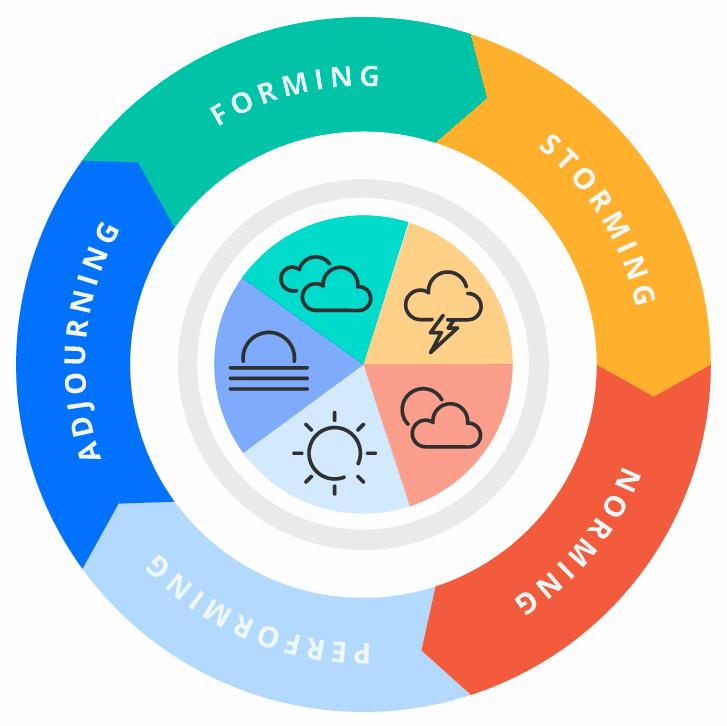
1. Forming: This is the polite, get-to-know-you phase. The group is new, and everyone is on their best behavior. There's excitement mixed with anxiety. The main goal is to understand the task and learn about each other. Leadership is often directive during this stage.
2. Storming: Reality sets in. People start to push against the boundaries established in the forming stage. Disagreements arise, and different working styles can cause friction. This stage can be uncomfortable, but it's a necessary part of figuring out how to work together.
3. Norming: The group starts to resolve its differences. Members appreciate each other's strengths and begin to develop a stronger commitment to the team goal. They establish norms and agree on procedures. A sense of unity emerges.
4. Performing: The group is now mature, organized, and well-functioning. The structure is clear and accepted. The team is focused on problem-solving and achieving its goals, operating smoothly and efficiently without inappropriate conflict.
5. Adjourning: For temporary groups, like a specific project team, this is the final stage. The team disbands after the task is complete. Members may feel a sense of accomplishment, but also sadness about the group ending.
The Glue That Holds It Together
What makes some groups feel magnetic, while others feel like a chore? The answer is often cohesion. Group cohesion is the 'we-feeling'—the bond that ties members to one another and to their shared goal. It’s the sum of all the forces acting on members to remain in the group.
Highly cohesive groups tend to have better communication, higher member satisfaction, and lower turnover. Members are more likely to support each other and stick together during tough times. This bond often translates directly into better performance.
When a team has strong cohesion, its members are more motivated to contribute to the group's success. This collective energy often leads to results that individuals couldn't achieve alone.
However, cohesion isn't always a silver bullet. Sometimes, a group can become so cohesive that it resists new ideas or outside perspectives, a phenomenon known as 'groupthink'. The key is to foster a bond strong enough to fuel performance but flexible enough to welcome healthy debate and change.
What is the primary focus of the study of group dynamics?
In a book club, there is an unwritten rule that members should not interrupt each other. This is an example of a group ___.
Understanding these basic elements—roles, norms, stages of development, and cohesion—gives you a powerful lens through which to see any group you're a part of. It helps you diagnose problems and understand what makes a team truly effective.