Bell's Theorem Explained
Quantum Mechanics Basics
The Particle That's Also a Wave
In our everyday world, things are predictable. A baseball is a baseball. A wave is a wave. But when we zoom way down to the level of atoms and electrons, these familiar rules break down. Welcome to quantum mechanics.
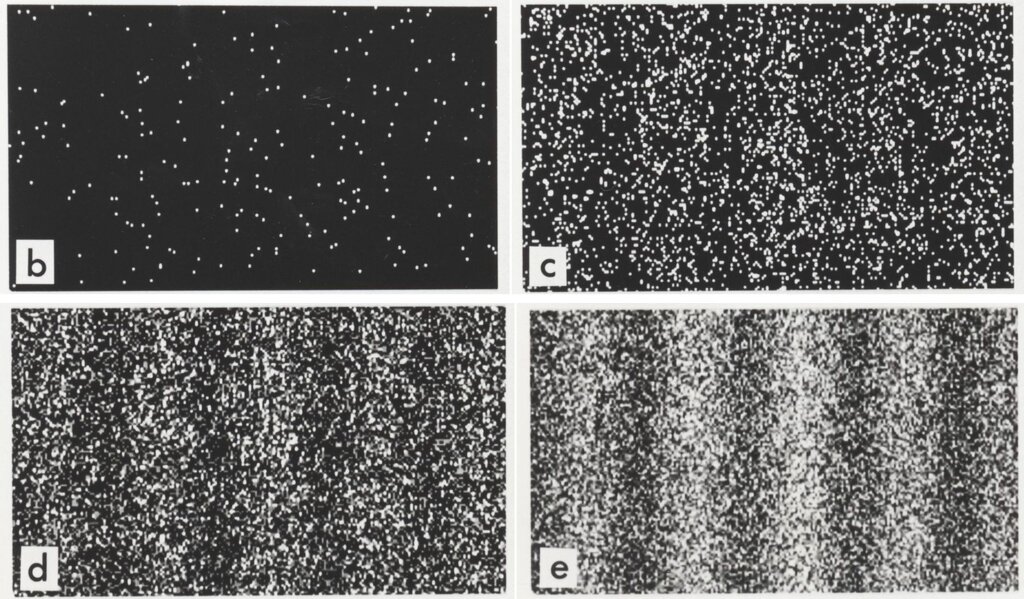
The most famous example of this strangeness is the double-slit experiment. Imagine firing tiny particles, like electrons, at a screen with two narrow slits in it. Behind the screen is a detector that shows where each electron lands.
If electrons were just tiny balls, you'd expect to see two bands on the detector, one behind each slit. But that's not what happens. Instead, a pattern of many bands appears, just like the interference pattern created when waves pass through two slits and interact with each other.
Somehow, each electron seems to pass through both slits at once, like a wave, and interfere with itself. This is wave-particle duality: quantum objects behave as both particles and waves, depending on how you observe them.
A State of Superposition
So how can an electron go through two slits at once? It exists in a state of superposition. This means it can be in multiple states—in this case, multiple locations—at the same time.
Think of a spinning coin. While it's in the air, it's not heads and it's not tails. It's in a combination of both states. Only when it lands (when we measure it) does it settle into a single, definite outcome. A quantum particle is similar. Before measurement, it exists as a cloud of probabilities. It has a certain chance of being here, and a certain chance of being there. The complete description of this cloud of possibilities is its quantum state.
A quantum state is the full description of a quantum system, encompassing all of its potential properties before measurement.
The Language of Quanta
To describe these strange behaviors, scientists needed a new mathematical language. Classical physics uses numbers to describe properties like position and velocity. Quantum mechanics uses more abstract objects called vectors in a special kind of space.
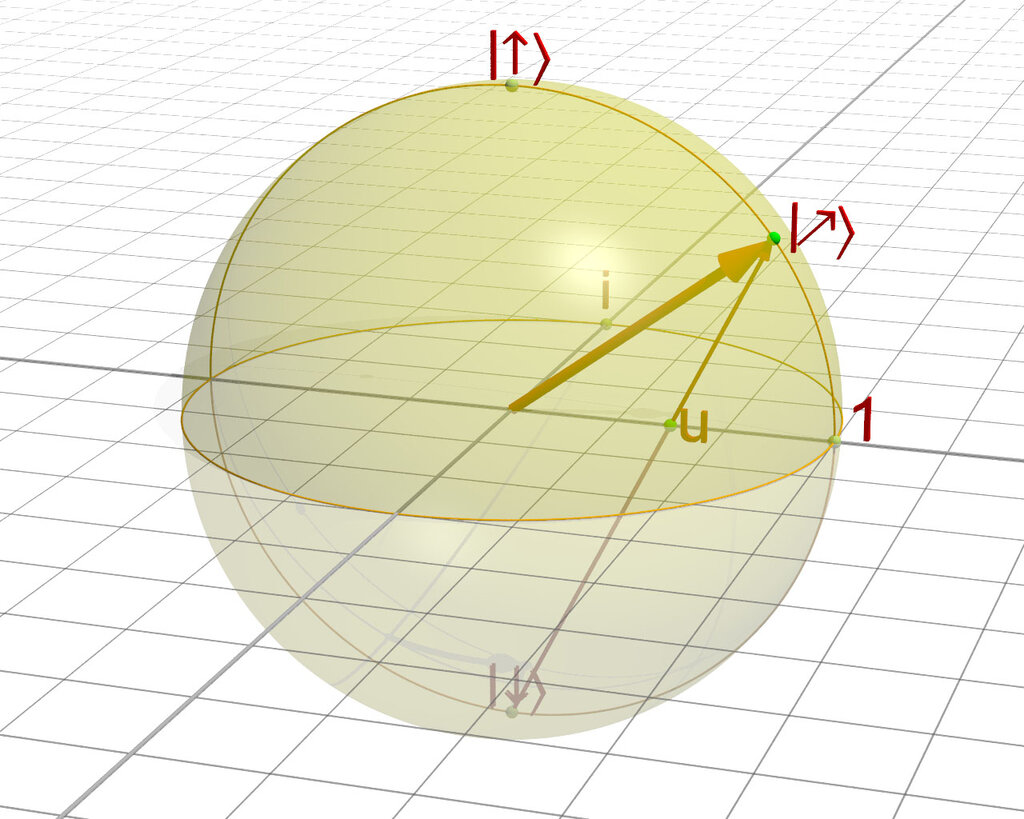
This space is called a Hilbert space. You can think of it as a vast, multi-dimensional map of every possible state a system can be in. A system's quantum state is represented by a vector—an arrow—pointing to a specific spot in this space. Because a qubit can be a mix of 0 and 1, its state vector can point anywhere on the surface of a sphere, as shown below.
How do we get information out of a quantum state? We use operators. An operator is a mathematical rule that corresponds to a physical measurement. For example, there's an operator for measuring position, another for momentum, and another for energy.
When an operator acts on a state vector, it extracts a value for that property. In the math, operators are often represented by matrices, and states are represented by vectors.
The Act of Looking
Here's the final twist. In the classical world, observing something doesn't change it. Measuring the length of a table doesn't alter the table.
In the quantum world, the act of measurement is a dramatic event. When you measure a particle in superposition, its wave of possibilities instantly collapses into a single, definite state. The spinning coin hits the table. The electron that went through both slits suddenly appears at a single point on the detector.
This is called the collapse of the wavefunction. Before measurement, the system evolves according to the smooth, wave-like Schrödinger equation. But the measurement itself forces the system to make a random choice from its available options.
The observer isn't a passive bystander. The very act of measuring a quantum system forces it out of superposition and into a single, concrete reality.
This raises deep questions about the nature of reality and the role of the observer, which physicists and philosophers still debate. What's clear is that at the fundamental level, reality is probabilistic, not deterministic. We can only predict the odds of different outcomes, not which one will happen for sure.
These core ideas—wave-particle duality, superposition, and the nature of measurement—are the foundation for everything else in the quantum world.
Ready to check your understanding?
In the double-slit experiment, when a beam of electrons is fired at a screen with two slits, the pattern that forms on the detector behind it is an interference pattern of many bands. What does this outcome suggest about the nature of electrons?
The principle of superposition is a fundamental concept in quantum mechanics. Which of the following best describes it?