Beginner Violin Fundamentals
Violin Posture
Finding Your Stance
Before you even pick up the violin, your journey begins with your feet. A solid, balanced posture is the foundation for everything else. It allows you to play comfortably, move freely, and avoid strain.
Most violinists alternate between standing and sitting, so it's important to learn both correctly from the start.
Think of your body as the stage, and the violin is the performer. A stable stage allows for the best performance.
If you're standing, place your feet shoulder-width apart. Your weight should be distributed evenly, not leaning forward or backward. Keep your knees slightly bent, not locked. This creates a stable but flexible base.
When sitting, choose a firm chair without arms. Sit on the front half of the seat with your back straight and feet flat on the floor, also shoulder-width apart. Avoid slouching or leaning against the back of the chair. Your goal is to maintain the same upright, aligned spine you have when standing.
Placing the Violin
Now, let's bring the instrument into the picture. Hold the violin by its neck with your left hand and bring it up to your shoulder. The back of the violin should rest on your collarbone, not directly on top of your shoulder muscle. This spot provides a solid, bony shelf for the instrument.
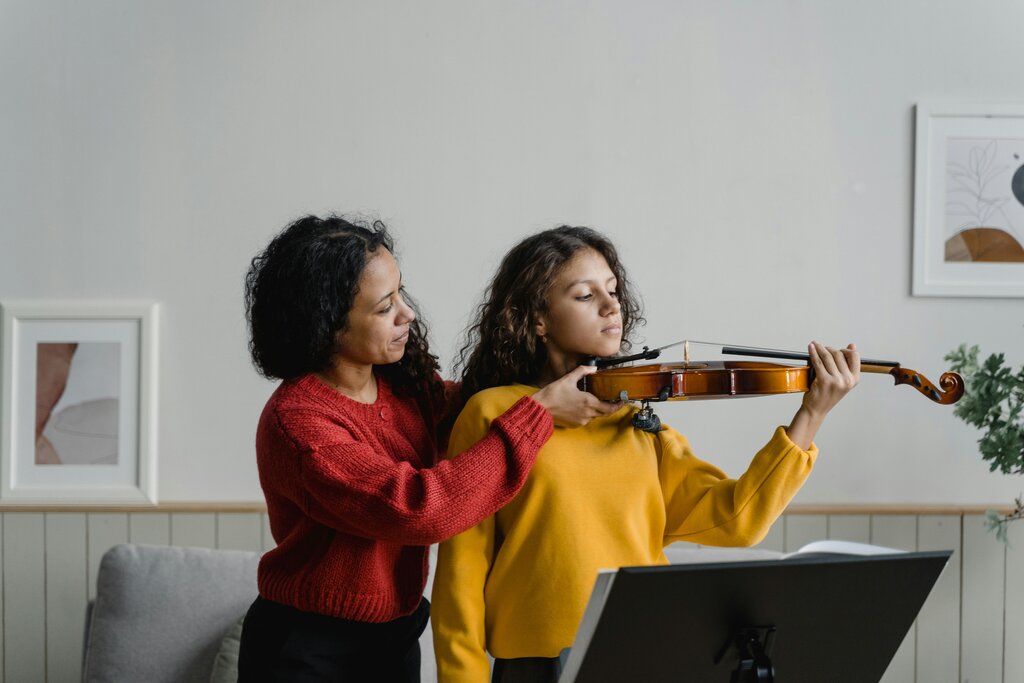
Next, turn your head slightly to the left and lower your jaw onto the chin rest. The chin rest is designed to help you hold the instrument securely without needing to clamp down hard. You should be able to hold the violin in place using just the gentle pressure of your head and the support of your collarbone. You can test this by letting go with your left hand for a moment. The violin should stay put.
Staying Relaxed
The final, and perhaps most important, piece of the puzzle is relaxation. Tension is the enemy of good violin playing. It can lead to a harsh sound, slow progress, and even injury.
Keep your head, neck, and spine in a straight, natural line. The idea is to bring the violin to your body, not to crane your neck or hunch your shoulders to reach the violin. Your left shoulder should remain down and relaxed, not raised up to meet the instrument.
Good posture is the foundation of good technique.
Take a moment to check for tension. Are your shoulders creeping up toward your ears? Is your neck stiff? Take a deep breath, and as you exhale, consciously relax those muscles. This is a habit you'll want to cultivate every time you practice.
Ready to check your understanding? Let's review the key points of violin posture.
When standing to play the violin, how should your feet be positioned for optimal balance and support?
The back of the violin should rest primarily on which part of your body?
Establishing good posture from day one will make learning the violin much more enjoyable and rewarding. It's a fundamental skill that supports every note you'll ever play.