Beginner Urdu Essentials
Urdu Script Fundamentals
A New Direction
The first thing to know about Urdu is that it’s written from right to left. While English marches across the page from the left, Urdu flows in the opposite direction. Your hand, your eye, and your brain will need a moment to adjust.
Think of it like learning to drive on the other side of the road. It feels strange at first, but it quickly becomes natural.
All words, sentences, and books follow this right-to-left rule. This might be the biggest initial hurdle, but once you get the hang of it, you've unlocked the first secret of the script.
Meeting the Alphabet
The Urdu alphabet, or Alif-Be, has 39 letters. Many are borrowed from Persian and Arabic, but several are unique to Urdu to represent sounds specific to South Asia. The script you'll be learning is called , a beautiful, flowing calligraphy style. For now, we'll focus only on each letter in its isolated, or standalone, form.
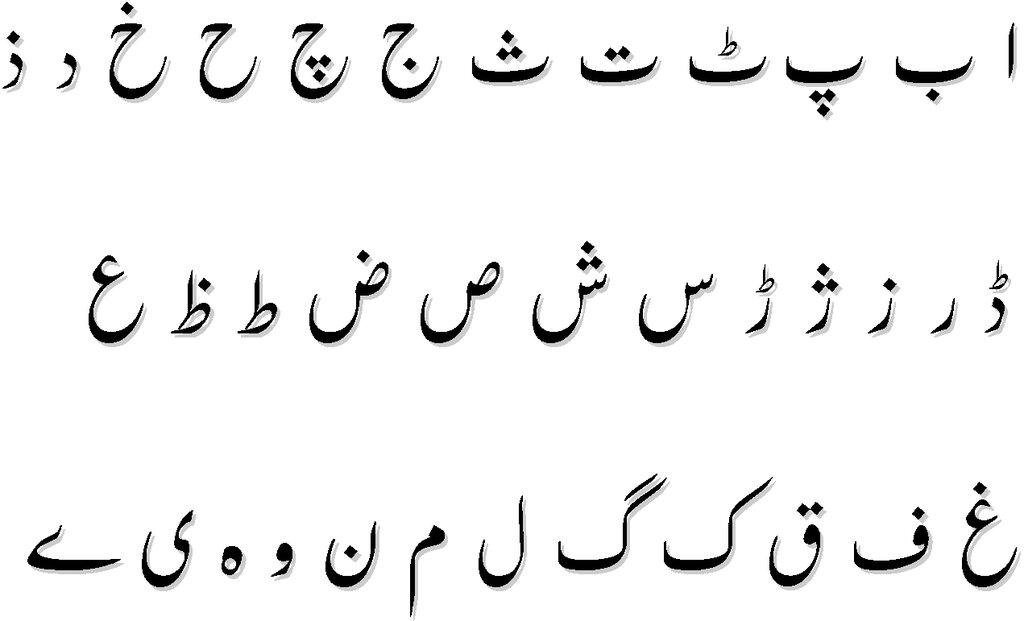
Here are the basic letters and their sounds. Don't worry about memorizing them all at once. Just get familiar with their shapes.
| Letter | Name | Sound |
|---|---|---|
| ا | alif | a, ā |
| ب | be | b |
| پ | pe | p |
| ت | te | t (dental) |
| ٹ | ṭe | t (retroflex) |
| ث | se | s |
| ج | jīm | j |
| چ | che | ch |
| ح | baṛī he | h (breathy) |
| خ | khe | kh (throaty) |
| د | dāl | d (dental) |
| ڈ | ḍāl | d (retroflex) |
| ذ | zāl | z |
| ر | re | r (trilled) |
| ڑ | ṛe | r (retroflex) |
| ز | ze | z |
| ژ | zhe | zh (as in 'measure') |
| س | sīn | s |
| ش | shīn | sh |
| ص | suād | s (emphatic) |
| ض | zuād | z (emphatic) |
| ط | to'e | t (emphatic) |
| ظ | zo'e | z (emphatic) |
| ع | ‘ain | (guttural stop) |
| غ | ghain | gh (gargling) |
| ف | fe | f |
| ق | qāf | q (deep k) |
| ک | kāf | k |
| گ | gāf | g |
| ل | lām | l |
| م | mīm | m |
| ن | nūn | n |
| و | vā'o | v, w, o, ū |
| ہ | choṭī he | h |
| ھ | do-chashmī he | (aspirates letters) |
| ء | hamzā | (glottal stop) |
| ی | choṭī ye | y, ī, e |
| ے | baṛī ye | ai, e |
Sounds You Haven't Met
Some Urdu sounds don't have a direct equivalent in English. Mastering these is key to good pronunciation.
Retroflex Consonants: Tongue Gymnastics
Urdu has a set of sounds called retroflex consonants. To make them, you curl the tip of your tongue upwards and touch the roof of your mouth, just behind the tooth ridge, then release. English doesn't do this.
The main retroflex letters are:
- ٹ (ṭe): Like the 't' in the English word "top," but with your tongue curled back.
- ڈ (ḍāl): Like the 'd' in "dog," but again, with the tongue curled back.
- ڑ (ṛe): This sound is unique. It’s a quick flap of the curled tongue against the roof of the mouth. It never appears at the start of a word.
Aspirated Sounds: The Puff of Air
Aspiration means releasing a small puff of air when you make a sound. In English, we do this unconsciously. For example, hold your hand in front of your mouth and say "pin" versus "spin." You'll feel a puff of air on "pin" but not on "spin." Urdu makes this distinction official.
The letter (ھ) is the key. It doesn't have its own sound. Instead, it pairs with other consonants to make them aspirated (breathy). For example:
- ب (b) becomes بھ (bh)
- پ (p) becomes پھ (ph)
- ت (t) becomes تھ (th)
- ک (k) becomes کھ (kh)
This simple addition creates a whole new set of sounds to learn.
Hamza: The Little Break
The (ء) isn't a letter in the same way 'a' or 'b' are. It represents a glottal stop. That’s the little catch in your throat you hear in the middle of the English expression "uh-oh!" In Urdu, it's used to separate two vowel sounds that appear next to each other in a word. It sits on top of other letters to signal this quick pause or transition between vowels.
That's your first look at the building blocks of Urdu. In the next section, we'll see how these letters connect to form words.
Ready to check your understanding? Let's see what you've learned about these fundamental concepts.
In which direction is the Urdu script written?
What is the name of the beautiful, flowing calligraphy style used for the Urdu script mentioned in the text?
Great job taking your first step. Keep practicing recognizing these letters, and you'll be reading in no time.