Beginner Piano Fundamentals
Keyboard Familiarity
Meet the Keyboard
Let's start with the basics of the piano keyboard. At first glance, it might seem like a random assortment of white and black keys, but there's a simple, repeating pattern that makes it easy to navigate.

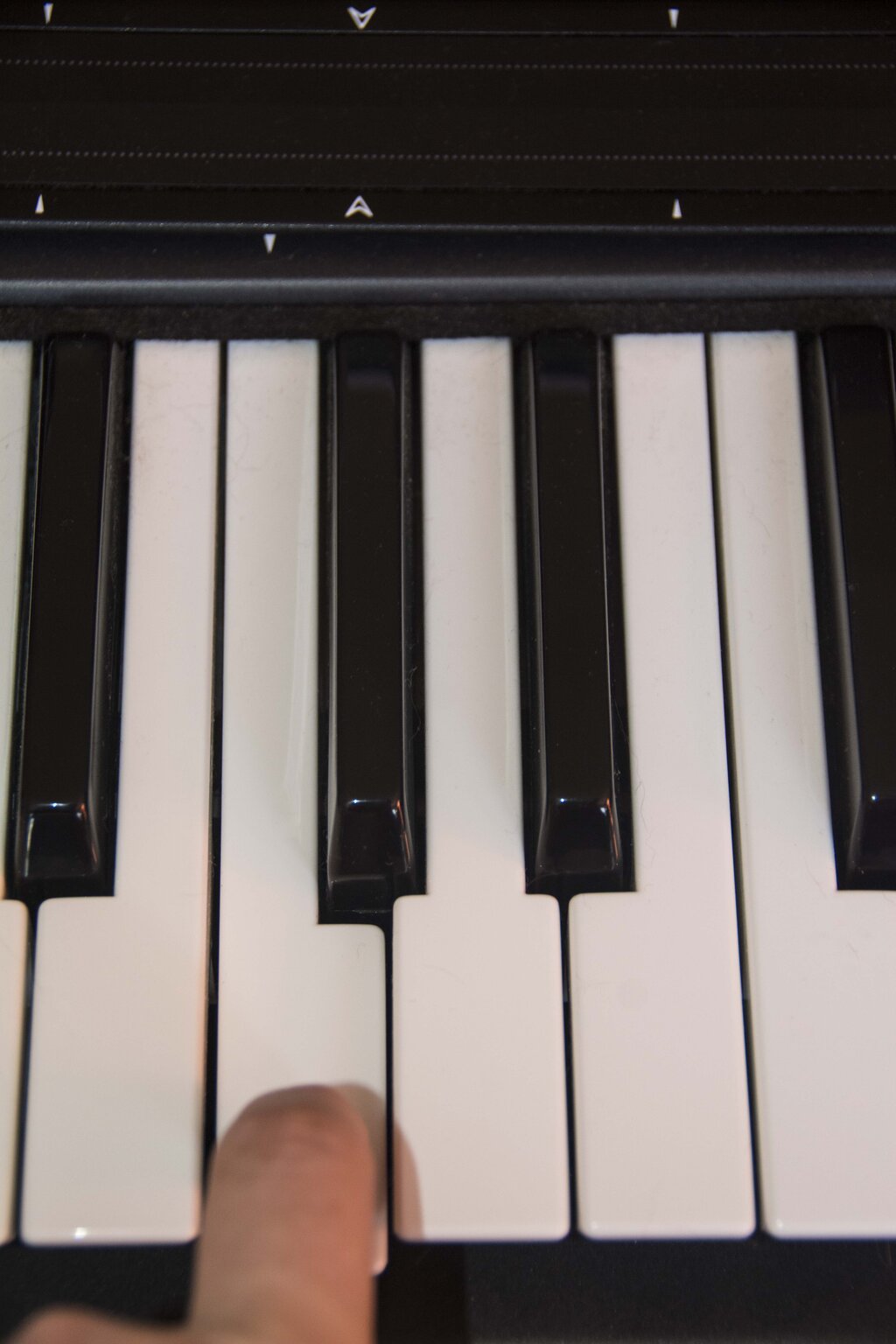
Look at the black keys. You'll notice they're arranged in groups of two and three. These groups are your landmarks. Every white key immediately to the left of a group of two black keys is a C. Find all the C's on your keyboard.
The white key to the left of any two-black-key group is always C.
Once you've found a C, the rest of the white keys follow the musical alphabet: D, E, F, G, A, B. After B, the pattern starts over with the next C. This C-D-E-F-G-A-B sequence repeats all the way up the keyboard.
The black keys are named relative to their white-key neighbors. A black key is a "sharp" (♯) of the key to its immediate left or a "flat" (♭) of the key to its immediate right. For example, the black key between C and D is called C-sharp or D-flat. They are the same note.
Understanding Octaves
The pattern of seven white keys and five black keys is called an octave. A standard piano has 88 keys, which covers just over seven octaves. Each time the pattern repeats, the pitch gets higher as you move to the right and lower as you move to the left.
The note C that's closest to the middle of the piano is called Middle C. It's a central reference point for musicians.
Numbering Your Fingers
To play efficiently, we assign numbers to our fingers. This system is the same for both the left and right hands. Your thumb is always 1, your index finger is 2, middle finger is 3, ring finger is 4, and pinky is 5.
| Finger | Number |
|---|---|
| Thumb | 1 |
| Index | 2 |
| Middle | 3 |
| Ring | 4 |
| Pinky | 5 |
This numbering is universal and will help you follow instructions for hand positioning. For now, just get comfortable with the idea that your thumb is 1 and your pinky is 5.
A common starting position for your right hand is to place your thumb (1) on Middle C. Your other fingers will naturally rest on the next four white keys: D, E, F, and G.
Hand positions are useful in the beginning stages of learning to play the piano, giving students a starting place for note recognition.
For your left hand, you can place your pinky (5) on the C an octave below Middle C. Your other fingers will then cover D, E, F, and G. This creates a balanced, foundational hand position.
Take some time to find these notes and place your hands. Don't worry about pressing the keys perfectly just yet. The goal is simply to get familiar with the layout and how your hands fit on the keyboard.
How can you consistently find the note 'C' on a piano keyboard?
In the musical alphabet used for piano keys (C-D-E-F-G-A-B), what note comes immediately after G?
With these fundamentals, you're ready to start exploring the sounds of the piano.