Beginner Piano Fundamentals
Piano Basics
Finding Your Way Around
Look at a piano keyboard. You'll see a repeating pattern of white and black keys. Notice the groups of black keys: some are in sets of two, others in sets of three. This pattern is your map.
The white key immediately to the left of any two-black-key group is called C. From there, the white keys follow the musical alphabet: C, D, E, F, G, A, B. After B, the pattern repeats with the next C. Find the C key that is closest to the middle of your piano. This is Middle C, a central landmark for navigating the keyboard.
Octave
noun
The distance between one musical note and the next one with the same name. For example, the stretch from one C to the next C is an octave.
Setting Up for Success
How you sit at the piano matters more than you might think. Good posture helps you play comfortably and prevents strain. Sit on the front half of your bench, centered on Middle C. Your back should be straight but not stiff, and your feet should be flat on the floor. Adjust the bench height so your forearms are level with the keyboard when your hands are on the keys.
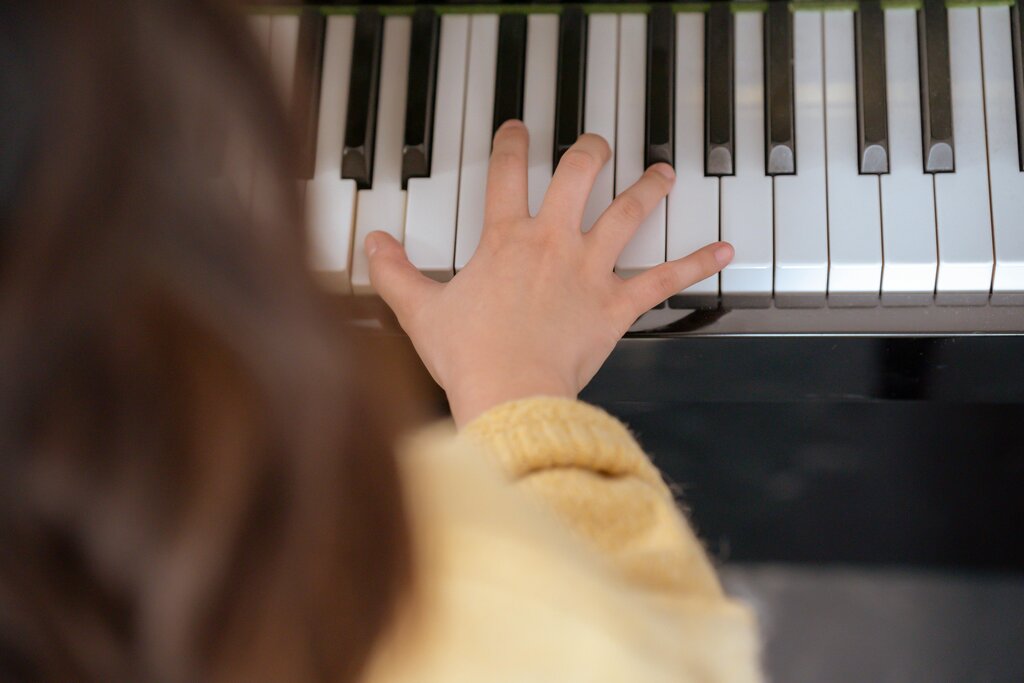
Your hands should be relaxed. Let your fingers curve naturally, with your thumbs resting lightly on the keys. Your wrists should be flexible and level, not bent up or down. Think of your arms, wrists, and fingers as a single, relaxed unit. Any tension in your shoulders or neck will travel down to your hands and make playing difficult.
Relaxed hands make for happy playing. Tension is the enemy of fluid motion.
Getting Your Fingers Moving
To talk about which finger plays which note, we number them. For both hands, your thumb is finger 1, your index finger is 2, middle finger is 3, ring finger is 4, and your pinky is 5. It’s a universal system that makes instructions clear and simple.
Let’s try a simple exercise. Place your right hand on the keys so your thumb (1) is on Middle C. Let your other fingers fall naturally on the next four white keys: D (2), E (3), F (4), and G (5).
Slowly press down each key one at a time, from thumb to pinky, and then back down. Try to make each note sound even and clear. Use just the weight of your arm and hand, not force. Do the same with your left hand, placing your pinky (5) on the C below Middle C.
This five-finger exercise, often called a pentascale, is a fundamental building block. It helps build finger independence, strength, and an even touch. Practice it daily, and you'll begin to develop the muscle memory needed for playing music.
How can you reliably identify any 'C' note on a piano keyboard?
According to the standard finger numbering system for piano, which finger is assigned the number 3?
These fundamentals are the bedrock of your piano journey. Mastering them now will make everything that comes next easier and more enjoyable.