Beginner Irish Language Basics
Irish Alphabet
The 18-Letter Alphabet
The Irish alphabet uses the same Latin script as English, but it's more streamlined. It officially has only 18 letters. The letters j, k, q, v, w, x, y, and z are missing from native Irish words, though they sometimes appear in loanwords from other languages.
The 18 letters are: a, b, c, d, e, f, g, h, i, l, m, n, o, p, r, s, t, u.
Historically, each letter was named after a native Irish tree or shrub. While you don't need to memorize these names to speak the language, they offer a beautiful glimpse into the culture's deep connection with nature.
| Letter | Irish Name | Tree/Shrub |
|---|---|---|
| a | ailm | elm |
| b | beith | birch |
| c | coll | hazel |
| d | dair | oak |
| e | edad | aspen |
| f | fern | alder |
| g | gort | ivy |
| h | úath | hawthorn |
| i | idad | yew |
| l | luis | rowan |
| m | muin | vine |
| n | nin | ash |
| o | onn | gorse |
| p | pin | pine |
| r | ruis | elder |
| s | sail | willow |
| t | tinne | holly |
| u | úr | heather |
Vowels Long and Short
Like English, Irish has five vowels: a, e, i, o, u. Each one has a short sound and a long sound. The difference is marked by an accent called a síneadh fada (sheen-oo fa-da), which means "long mark." It's an acute accent that slants to the right.
A vowel with a fada is always long. For example, 'a' sounds like the 'a' in "cat," while 'á' sounds like the 'aw' in "saw."
| Vowel | Short Sound (like...) | Long Sound (with fada) | Long Sound (like...) |
|---|---|---|---|
| a | apple | á | father |
| e | pet | é | ca fé |
| i | pin | í | machine |
| o | pot | ó | boat |
| u | put | ú | rude |
This little line makes a huge difference. For instance, sean (shan) means "old," but seán (shawn) is the name Seán.
Consonants Broad and Slender
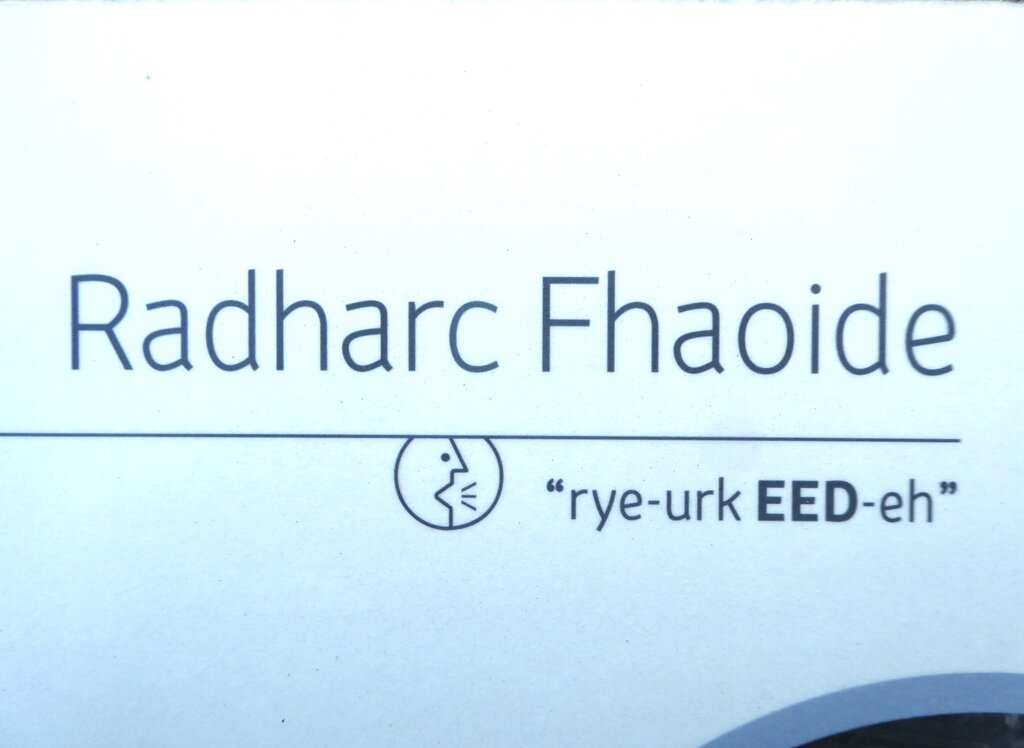
Here's where Irish pronunciation gets its unique character. Every consonant has two distinct sounds: broad and slender. What determines the sound is the vowel next to it.
- Broad vowels: a, o, u
- Slender vowels: e, i
A consonant is "broad" if its nearest vowel is broad. It's "slender" if its nearest vowel is slender. This leads to a fundamental spelling rule in Irish: caol le caol agus leathan le leathan (slender with slender and broad with broad). In simple terms, the vowels on either side of a consonant (or group of consonants) must match.
So, how does this change the sound? A broad 'b' sounds like the 'b' in "boat." A slender 'b', on the other hand, sounds more like the 'b' in "beauty," with a slight 'y' sound attached. A broad 's' is like the 's' in "see," but a slender 's' is like the 'sh' in "she."
For example, in the word bó (cow), the 'b' is broad because of the 'ó'. In beo (alive), the 'b' is slender because it's next to an 'e'.
This is the biggest challenge for new learners. Don't worry about perfecting it right away. Just being aware of the concept is a massive first step. As you listen to more Irish, your ear will start to pick up on the difference.
How many letters are in the official native Irish alphabet?
What is the primary function of the accent mark known as a síneadh fada?
Getting comfortable with these foundational concepts will make your journey into learning Irish much smoother. Listen often, practice speaking, and be patient with yourself.