Beginner Guitar Chords Made Easy
Guitar Basics
Know Your Instrument
Before you can play a single note, it helps to know your way around the guitar. Think of it like learning the names of the pieces on a chessboard. While acoustic and electric guitars can look very different, they share the same fundamental parts.
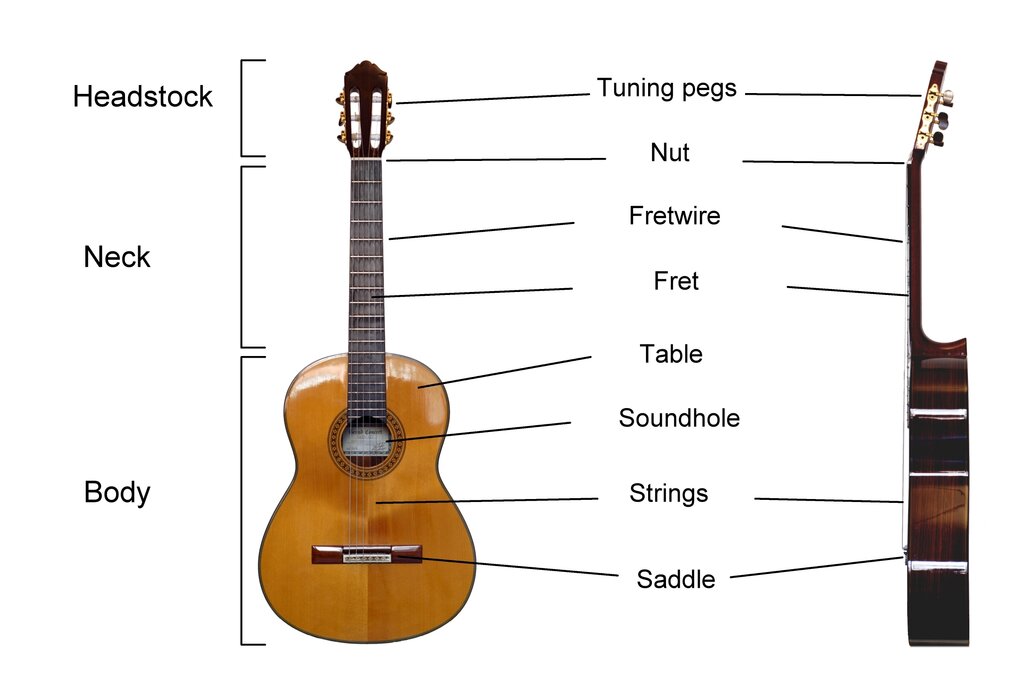
Let's walk through the key components from top to bottom.
The headstock is at the very top, and its main job is to hold the tuning pegs. These are the knobs you turn to tighten or loosen the strings, which changes their pitch. The strings pass over the nut, a small grooved strip that guides them down the neck.
The long part you'll be holding is the neck. The front of the neck is the fretboard, which has metal strips called frets embedded in it. Pressing a string against a fret shortens its vibrating length, creating different notes.
Finally, there's the body, the largest part of the guitar. On an acoustic guitar, the body is hollow and has a soundhole that amplifies the strings' vibrations. On an electric guitar, the body is usually solid and uses electronic pickups to convert string vibrations into electrical signals. All guitars have a bridge on the body, which anchors the strings at the other end.
Fret
noun
A raised element on the neck of a stringed instrument. Frets divide the neck into fixed segments at intervals of a semitone.
Sit Right, Play Right
How you hold the guitar is more important than you might think. Good posture prevents bad habits and discomfort down the road, letting you play for longer. Start by sitting on a chair without armrests, with your back straight.
If you're right-handed, rest the curved part of the guitar's body, called the waist, on your right thigh. The back of the guitar should be flush against your stomach and chest. Angle the neck upwards slightly, at about a 45-degree angle. This position gives both of your hands easy access to the strings without straining your wrists or back. If you're left-handed, just mirror this setup.

Your fretting hand (your left hand, if you're right-handed) supports the neck with your thumb placed on the back, roughly opposite your index or middle finger. Your other hand, the strumming hand, rests over the soundhole or pickups. The goal is to be relaxed. If you feel any tension in your shoulders, neck, or wrists, take a moment to adjust your position.
Comfort is key. A relaxed player can practice longer and learns faster. Don't slouch or contort your body to hold the guitar.
Getting in Tune
A guitar that isn't in tune will never sound good, no matter how well you play it. Tuning is the process of adjusting the strings so they produce the correct notes. The standard tuning for a six-string guitar is, from thickest to thinnest string: E, A, D, G, B, E. This is your starting point for almost every song you'll learn.
The easiest way to tune is with an electronic tuner. This can be a physical clip-on tuner, a pedal, or an app on your phone. Most tuners work the same way.
- Pluck a string. Start with the thickest string, the low E.
- Look at the tuner. It will tell you what note you're playing and whether it's sharp (too high) or flat (too low).
- Adjust the tuning peg. If the note is flat, slowly tighten the string by turning its corresponding peg. If it's sharp, loosen it. Watch the tuner's display until it indicates the note is correct, usually with a green light or a centered needle.
- Repeat for all strings. Move from the thickest string to the thinnest: E-A-D-G-B-E.
Once you've tuned all six strings, it's a good idea to go back and check them all one more time, as adjusting one string can slightly affect the tension of the others.
As a beginner, one of the most essential things to learn is how to tune your guitar.
Now that you know the parts of your guitar, how to hold it, and how to get it in tune, you're ready to start making music.
What is the primary function of the frets on a guitar's fretboard?
Which part of the guitar holds the tuning pegs?