Beginner German A1
German Alphabet and Pronunciation
The German Alphabet
The German alphabet uses the same 26 letters as English, but with a few additions. Pronunciation is very consistent. Once you learn the rules for each letter, you can reliably sound out new words. Let's start with the basics.
| Letter | Name | Letter | Name |
|---|---|---|---|
| A a | Ah | N n | En |
| B b | Bay | O o | Oh |
| C c | Tsay | P p | Pay |
| D d | Day | Q q | Koo |
| E e | Ay | R r | Err |
| F f | Eff | S s | Ess |
| G g | Gay | T t | Tay |
| H h | Hah | U u | Ooh |
| I i | Ee | V v | Fow |
| J j | Yot | W w | Vay |
| K k | Kah | X x | Iks |
| L l | Ell | Y y | Upsilon |
| M m | Emm | Z z | Tset |
Most consonants sound like their English counterparts, but a few are different. The letter 'v' is pronounced like an 'f' in English, as in Vater (father). A German 'w' sounds like the English 'v', as in Wasser (water). The 'z' is sharp, like 'ts' in the word cats, and 'j' sounds like the 'y' in yes.
In German, what you see is usually what you say. Once you know the rules, you can pronounce almost any word.
Vowels (a, e, i, o, u) can be long or short. A vowel is usually long when it's followed by a single consonant or an 'h', like in Hafen (harbor). It's short when followed by two or more consonants, like in Hand (hand).
Special Characters
Beyond the standard alphabet, German has four special characters: three vowels with dots above them, called umlauts, and a unique consonant.
Umlaut
noun
A mark (¨) placed over a vowel in German to indicate a change in sound.
Here’s how to pronounce the umlauts:
- Ä/ä: Sounds like the 'e' in bed. Think of the word Äpfel (apples).
- Ö/ö: This one is tricky. Purse your lips as if you're about to say "ooh," but try to say "ee" instead. The word schön (beautiful) uses this sound.
- Ü/ü: Similar to ö. Purse your lips to say "ooh," but say the German long 'i' sound, which is like the "ee" in see. Try it with the word fünf (five).
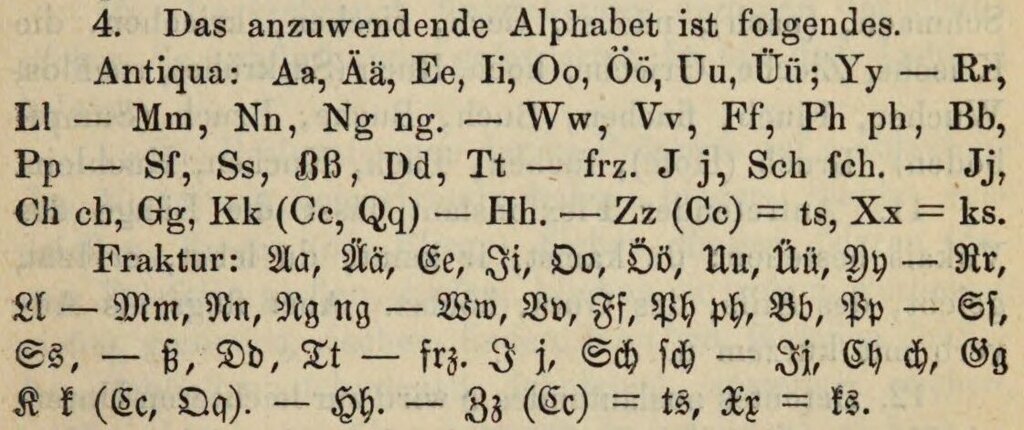
The fourth special character is the Eszett, or sharp S (ß). It simply represents a double 's' sound and is never used at the beginning of a word. For example, the word for street, Straße, uses the ß. If you can't type it, you can always write 'ss' instead. Note that Switzerland's version of standard German doesn't use the ß at all, opting for 'ss' in all cases.
Common Letter Combinations
Certain letter pairs in German always make the same sound. Learning these will make reading and speaking much easier.
| Combination | Sound | Example Word | Meaning |
|---|---|---|---|
| ch | (soft) like 'h' in huge | ich | I |
| ch | (hard) like 'k' in Bach | Buch | book |
| sch | like 'sh' in shoe | Schule | school |
| ei | like 'eye' in eye | drei | three |
| ie | like 'ee' in see | sie | she, they |
| eu / äu | like 'oy' in boy | neu / Häuser | new / houses |
The ch sound has two versions. After the vowels a, o, u, or au, it's a hard sound from the back of your throat, like the Scottish 'ch' in loch. After any other vowel or a consonant, it's a soft, breathy sound made at the front of your mouth, almost like the 'h' in huge.
Now, let's test what you've learned about German letters and sounds.
How is the German letter 'w' typically pronounced?
The German umlaut 'ä' sounds most similar to the vowel sound in which English word?
With these rules, you have a solid foundation for pronouncing German. Consistent practice is the key to making these sounds feel natural.