Becoming an Electrician
Electrical Theory
The Fundamentals of Electricity
Think of electricity like water flowing through a pipe. This simple analogy helps explain the three core concepts you need to know: voltage, current, and resistance. They work together to make electricity do its job, whether that's lighting a room or charging your phone.
Voltage is like the water pressure. It's the force that pushes electric charge through a circuit. Without voltage, there's no push, and the current won't flow.
Current is the rate at which the charge flows, similar to how you'd measure the amount of water moving through the pipe per second.
Resistance is any opposition to that flow. In our analogy, it's like a narrow section in the pipe that slows the water down.
Voltage
noun
The difference in electric potential energy between two points in a circuit. It is the 'push' that causes current to flow.
Current
noun
The rate of flow of electric charge. It is measured in amperes (amps).
Resistance
noun
A measure of the opposition to current flow in an electrical circuit. It is measured in ohms (Ω).
Ohm's Law
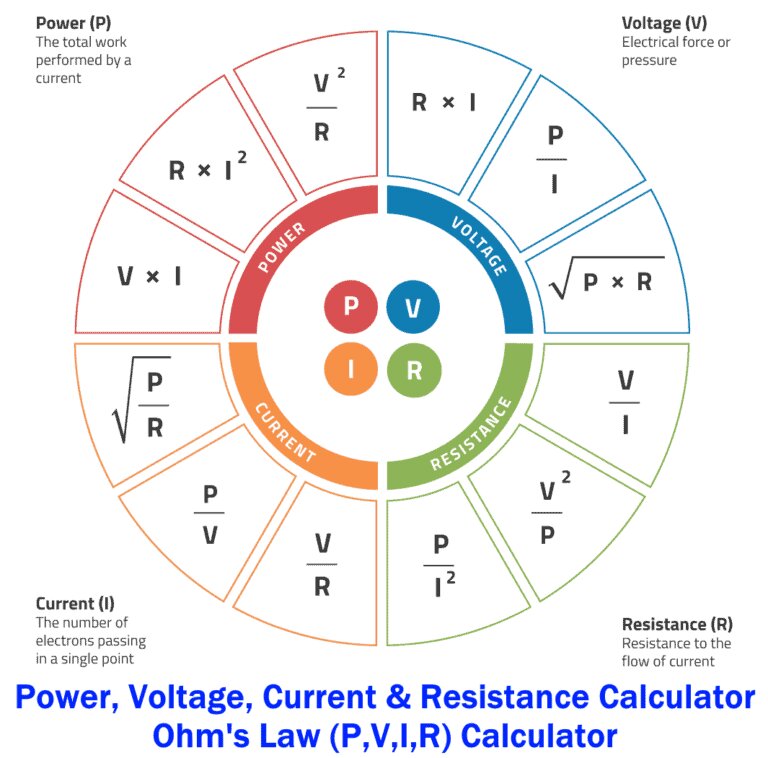
These three concepts are linked by a fundamental rule called Ohm's Law. It describes the relationship between voltage (), current (), and resistance () in a circuit. The law states that the voltage across a conductor is directly proportional to the current flowing through it, provided all physical conditions and temperatures remain constant.
In simple terms: if you increase the pressure (voltage), more water (current) will flow, assuming the pipe's width (resistance) stays the same.
The formula for Ohm's Law is straightforward.
Here, is voltage in volts, is current in amps, and is resistance in ohms.
You can also rearrange the formula to solve for current or resistance.
Let's say you have a simple circuit with a 12-volt battery and a component with 4 ohms of resistance. To find the current, you would use the formula . The current would be 12 volts divided by 4 ohms, which equals 3 amps.
Power and Circuits
Electrical power () is the rate at which electrical energy is transferred or used in a circuit. It's what you pay for on your utility bill. Power is measured in watts (W).
The formula for calculating power is a combination of voltage and current.
For example, if a light bulb is connected to a 120-volt source and draws 0.5 amps of current, its power consumption is .
A circuit is simply a closed path that allows electricity to flow from a source, through a component (like a light bulb), and back to the source. If the path is broken, it's an open circuit, and no current can flow.
There are two basic ways to connect components in a circuit: in series or in parallel.
In a series circuit, components are connected end-to-end, so there is only one path for the current to flow. If one component breaks (like an old string of holiday lights), the entire circuit is broken, and nothing works.
In a parallel circuit, components are connected on separate branches, like the rungs of a ladder. The current splits to flow through each branch. If one component breaks, the current can still flow through the other branches, so the rest of the circuit stays on. This is how most homes are wired.
Time to test what you've learned.
In the analogy of electricity as water flowing through a pipe, what does the water pressure represent?
If you increase the resistance in a circuit while keeping the voltage constant, the current will decrease.
Understanding these basic principles is the first and most important step in working with electricity. They are the foundation for everything else you will learn.