Becoming a Doctor
Undergraduate Education
The Foundation: Your Undergraduate Years
The journey to becoming a doctor begins long before medical school. It starts with your undergraduate degree. This four-year period is where you build the academic foundation necessary for a career in medicine. It's a time to explore your interests, develop strong study habits, and prove you can handle rigorous scientific coursework.
Choosing Your Path
A common myth is that you must major in biology or chemistry to get into medical school. While these are popular choices, they aren't your only options. Medical schools accept students from all academic backgrounds, including humanities, arts, and social sciences. A history or music major has the same shot as a biology major, provided they meet the other requirements.
What's most important? Excelling in your chosen field and completing all the prerequisite science courses. Admissions committees look for students who are passionate and dedicated, regardless of their major. A high GPA in any subject demonstrates that you're a capable and committed learner.
Your major is less important than your grades and your completion of the required science courses. Pick a subject you love and do well in it.
The Prerequisite Checklist
Regardless of your major, you'll need to complete a set of core science and humanities courses. These classes ensure you have the foundational knowledge to succeed in medical school and on the MCAT. The specific requirements can vary slightly from one medical school to another, but they almost always include the following:
| Subject | Typical Requirement |
|---|---|
| Biology | 2 semesters with lab |
| General Chemistry | 2 semesters with lab |
| Organic Chemistry | 2 semesters with lab |
| Biochemistry | 1 semester |
| Physics | 2 semesters with lab |
| English / Writing | 2 semesters |
| Mathematics | 2 semesters (Calculus and/or Statistics) |
Think of these courses as the building blocks for your medical education. It's crucial to not just pass them, but to understand the material deeply. Always check the admissions websites for the specific medical schools you're interested in to confirm their unique requirements.
Conquering the MCAT
The Medical College Admission Test (MCAT) is a standardized, multiple-choice exam required by nearly all U.S. and Canadian medical schools. It's more than just a science test; it's designed to assess problem-solving, critical thinking, and your understanding of scientific concepts and principles.
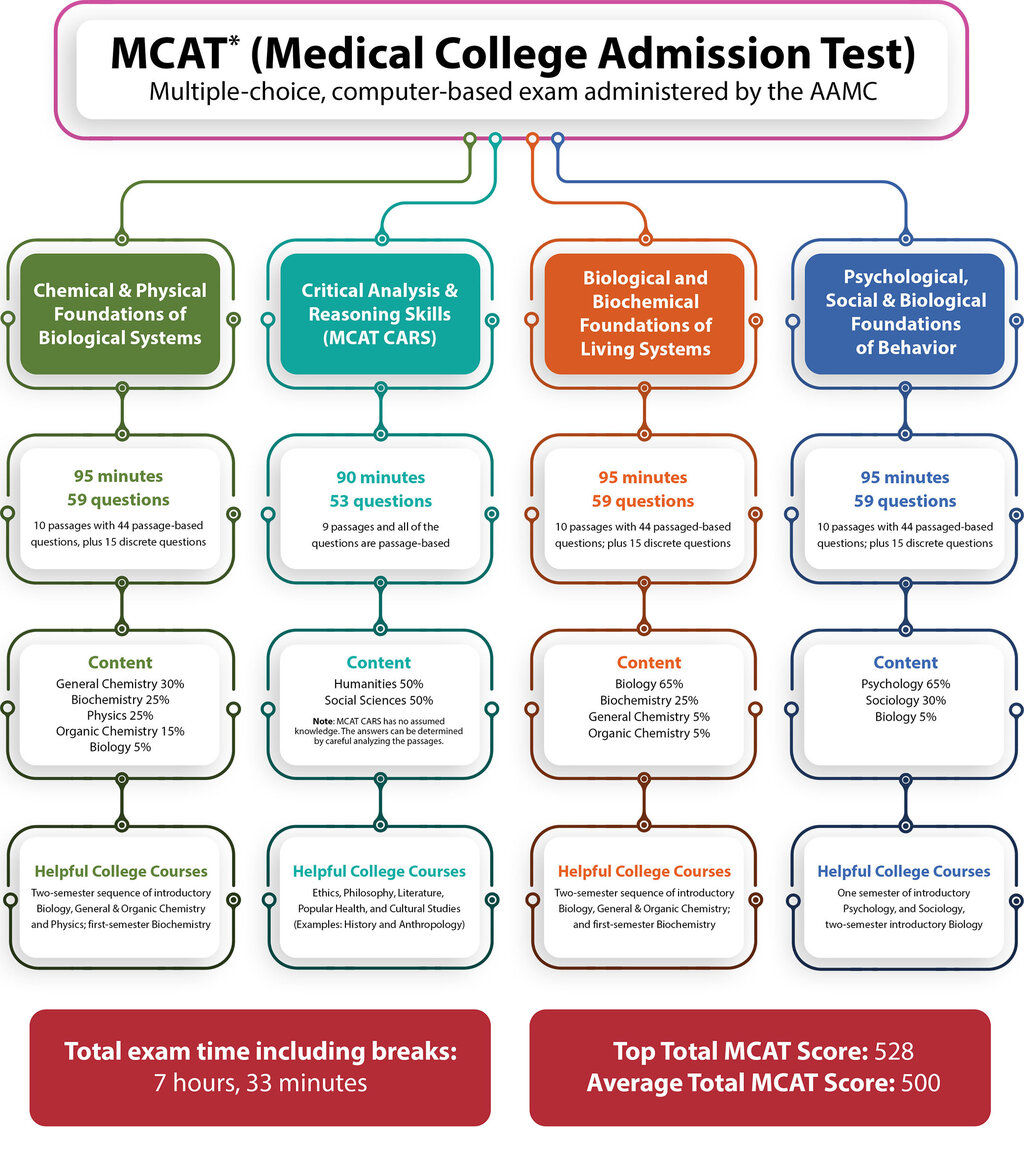
The exam is a marathon, lasting over seven hours. It's divided into four sections:
- Chemical and Physical Foundations of Biological Systems
- Critical Analysis and Reasoning Skills (CARS)
- Biological and Biochemical Foundations of Living Systems
- Psychological, Social, and Biological Foundations of Behavior
Preparing for the MCAT is a significant undertaking. Most students dedicate hundreds of hours over several months to studying. This involves reviewing prerequisite coursework, taking practice tests, and honing time-management skills. Your score is a major component of your application, so giving yourself enough time to prepare is essential.
Let's check your understanding of these foundational steps.
To be a competitive medical school applicant, you must major in a science like biology or chemistry.
When evaluating an undergraduate's academic record, what do medical school admissions committees prioritize?
Your undergraduate years set the stage for your medical career. By choosing a major you're passionate about, mastering the prerequisite courses, and preparing diligently for the MCAT, you build a strong application and develop the skills needed for the challenges ahead.