Become a Certified Pilates Instructor
Teaching Methodologies
Guiding Movement Effectively
Knowing Pilates and teaching Pilates are two distinct skills. Your personal mastery of an exercise doesn't automatically translate into effective instruction. The true art of teaching lies in bridging that gap, guiding clients to understand the movements not just in their minds, but in their bodies. It's about clear communication, sharp observation, and the ability to adapt to the person in front of you.
The Art of Cueing
Effective instruction hinges on your ability to cue. A good cue helps a client connect with the correct muscles and achieve the purpose of an exercise. Cues are not one-size-fits-all; they fall into several categories, and a skilled instructor blends them seamlessly.
Verbal cues are the most common, using words to describe an action or feeling. Instead of just saying "Engage your core," try a more descriptive cue like, "Gently draw your navel towards your spine." This creates a clearer internal picture.
Visual cues involve demonstrating the movement yourself or using your hands to show a shape or direction. Showing the correct form is often faster and more effective than a lengthy verbal explanation.
Tactile cues are a powerful tool when used appropriately. A light, professional touch can provide instant feedback, helping a client find a specific muscle or correct their alignment. Always ask for permission before using tactile cues.
Imagery cues use metaphors to explain a concept. For the Hundred, telling a client to "imagine slapping the surface of water with your hands" can create the intended energy and movement quality more effectively than a purely technical description.
Cue for the feeling, not just the position. Help clients discover what the exercise should feel like internally.
| Cue Type | Description | Example (for a spine stretch) |
|---|---|---|
| Verbal | Using spoken words to guide. | "Exhale as you peel your spine off the mat, one vertebra at a time." |
| Tactile | Using light touch to guide. | "A gentle tap on the upper back to encourage more rounding." |
| Visual | Demonstrating the movement. | "Watch how I initiate the movement from my head, not my shoulders." |
| Imagery | Using metaphors or analogies. | "Imagine you are folding forward over a large beach ball." |
Managing Class Dynamics
A well-managed class feels effortless to the participants, but it requires careful planning from the instructor. The first step is to structure your session logically. A typical class includes a warm-up to prepare the body, a main body of work that flows through a series of exercises, and a cool-down to bring the body back to a state of rest.
The pacing of the class is crucial. It should be challenging enough to keep clients engaged but not so fast that form is compromised. Learn to read the room. If you see widespread confusion or fatigue, it's a sign to slow down, offer a modification, or revisit a key concept. Your plan is a guide, not a rigid script.
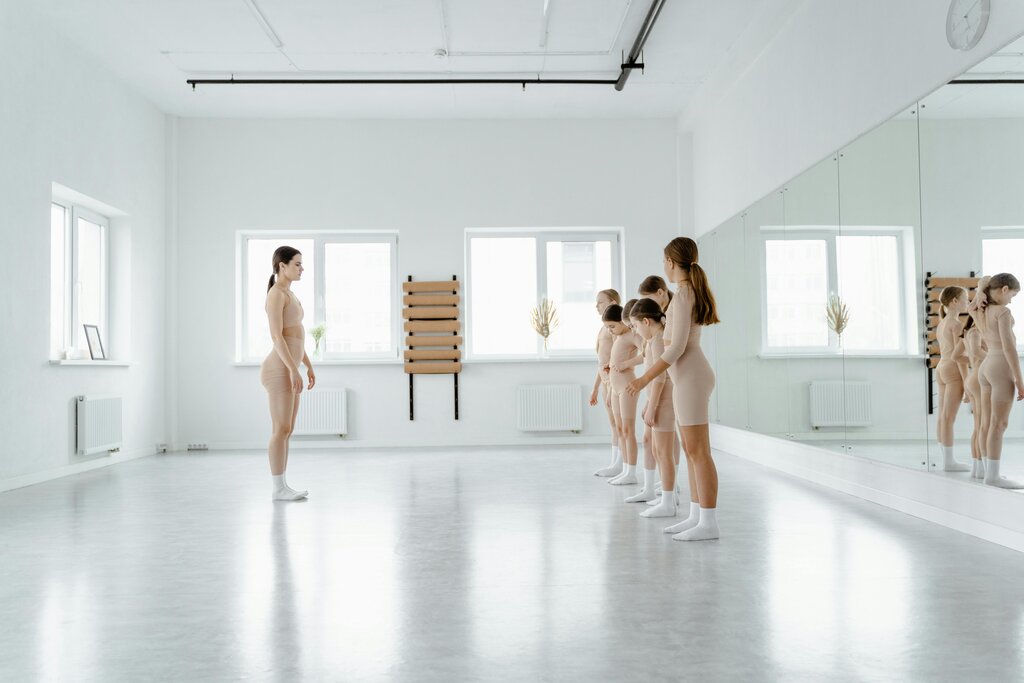
Managing a group with mixed abilities is a common challenge. The key is to teach to the average level in the room while providing both modifications and progressions.
- Modifications make an exercise more accessible. This could mean reducing the range of motion, using a prop for support, or breaking down a complex movement into smaller parts.
- Progressions make an exercise more challenging. This might involve increasing the range of motion, adding resistance, or challenging balance.
Introduce the standard version of the exercise first. Then, offer a modification for those who need it and a progression for those ready for a greater challenge. This approach empowers clients to work at their own level safely and effectively, fostering an inclusive environment where everyone feels successful.
Adapting to Different Learners
People learn in different ways. Acknowledging these preferences will make you a more versatile and effective instructor. The three main learning styles are:
-
Visual Learners: These clients learn best by seeing. They benefit most from clear demonstrations. Make sure they have a good line of sight to you when you're showing an exercise.
-
Auditory Learners: These clients respond well to verbal cues. The words you choose, your tone of voice, and the rhythm of your speech are important. They will listen carefully to your explanations and corrections.
-
Kinaesthetic Learners: These clients learn by doing and feeling. They connect with cues that describe physical sensations and often respond well to tactile feedback. They need to experience the movement in their own body to truly understand it.
Great instructors don't just stick to one style; they use a combination of all three. By demonstrating (visual), explaining (auditory), and using imagery or tactile cues (kinaesthetic), you create a rich learning environment that caters to everyone in the room.
Clear communication and adaptable teaching methods can make or break your personal training experience.
Flexibility is the hallmark of an excellent instructor. Your ability to adjust your communication, manage the classroom environment, and adapt to individual needs will define your success and the success of your clients.