Beat Making Fundamentals
Introduction to Rhythm and Tempo
The Pulse of Music
Rhythm is the pattern of sounds and silences in time. Think of it as the heartbeat of a song. It's what makes you want to tap your foot or nod your head. This pulse is made up of individual beats, which are the basic unit of time in music.
At its core, rhythm organizes time into patterns. It's the arrangement of long and short sounds that creates a sense of movement.
To keep these beats organized, we use a time signature. It looks like a fraction and tells us two things: how many beats are in each measure (the top number) and what kind of note gets one beat (the bottom number).
The most common time signature in modern music is 4/4, often called "common time." The top 4 means there are four beats in a measure. The bottom 4 means a quarter note gets one beat. So, you can count it out: "one, two, three, four, one, two, three, four..."
Setting the Pace
While rhythm is the pattern of the beats, tempo is the speed of those beats. It's how fast or slow the music is. We measure tempo in Beats Per Minute, or BPM.
Tempo
noun
The speed at which a piece of music is played, often indicated in beats per minute (BPM).
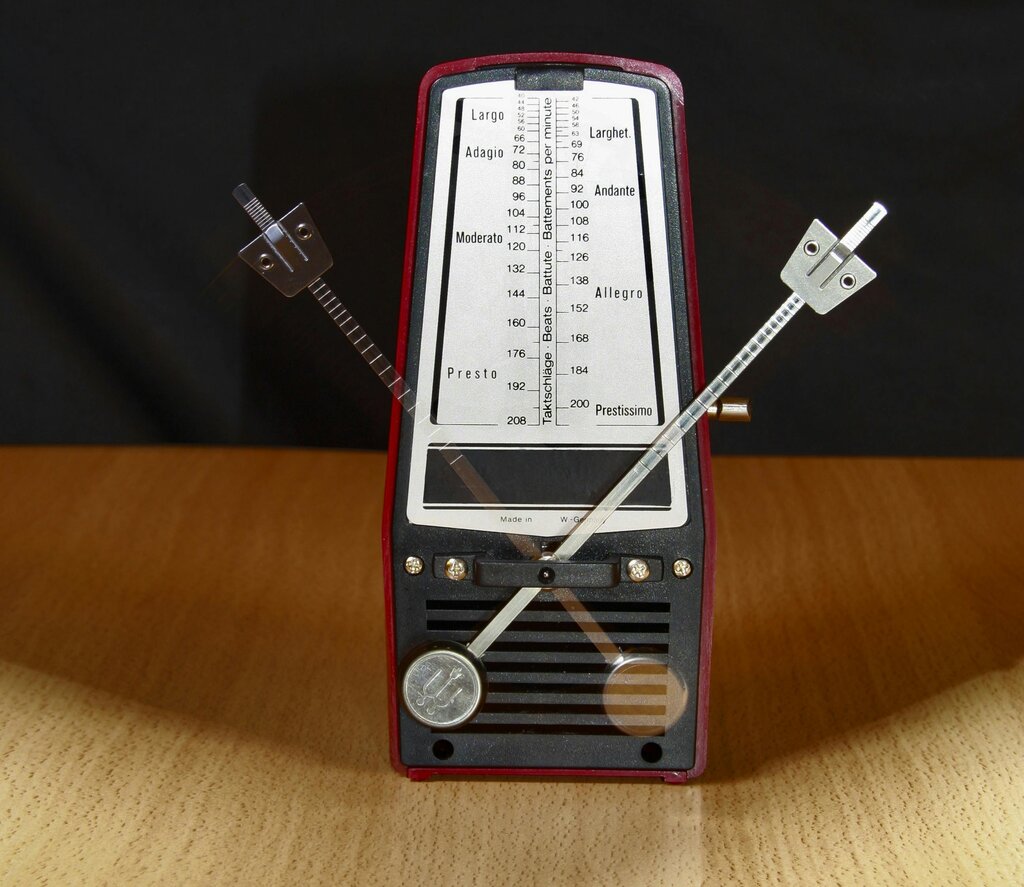
A low BPM, like 60, feels slow and relaxed, like a ballad. A high BPM, like 120, is much faster and more energetic, perfect for a dance track. The tempo sets the entire mood of a beat. A metronome is a tool that clicks at a steady tempo to help musicians keep time.
Note Values
Just like letters form words, different note lengths form rhythms. These are called note values, and they tell you how long to hold a sound. The most basic notes are whole notes, half notes, quarter notes, and eighth notes. Each one is half the length of the one before it.
In 4/4 time:
- A whole note lasts for all four beats.
- A half note lasts for two beats.
- A quarter note lasts for one beat.
- An eighth note lasts for half a beat.
There are also rests, which are just as important. A rest is a moment of silence with a specific duration, matching the note values.
Internalizing Rhythm
Reading about rhythm is one thing, but feeling it is another. The best way to understand rhythm is to internalize it. You can start by simply clapping or tapping along to a beat. Set a slow, steady tempo and try clapping these simple patterns.
Clap Rhythms Before You Play
Try clapping only on the numbered beats. Count "1 and 2 and 3 and 4 and" out loud to keep time.
Pattern 1 (Quarter Notes): Clap on: 1, 2, 3, 4
Pattern 2 (Half Notes): Clap on: 1, (hold for 2), 3, (hold for 4)
Pattern 3 (Eighth notes on the downbeat): Clap on: 1, and, 2, and, 3, and, 4, and
Pattern 4 (A simple beat): Clap on: 1, (skip 2), 3, 4
Practicing these simple exercises will build your internal clock. Once you can feel the pulse without thinking, you're ready to start building more complex beats.
Ready to test your knowledge? Take this quick quiz on the fundamentals of rhythm and tempo.
What does the tempo of a piece of music define?
In a 4/4 time signature, how many beats does a half note last?
With a solid grasp of rhythm and tempo, you have the foundational skills for making beats. Next, we'll explore how to apply these concepts in a digital environment.