Bayesian vs Frequentist Statistical Mastery
Defining Probability Frameworks
Two Ways to See the World
At the heart of statistics are two competing philosophies: Frequentist and Bayesian. They aren't just different methods; they represent fundamentally different ways of thinking about probability itself. Your choice of framework shapes how you ask questions, interpret data, and express uncertainty.
This approach contrasts with the traditional, or “frequentist,” view of probability, which often sees probabilities as long-run frequencies of events and parameters as fixed, unknown constants.
Let's start with the older, more established viewpoint.
The Frequentist View
For a Frequentist, probability is all about long-run frequency. Imagine flipping a coin. You don't know the exact probability of getting heads. To a Frequentist, this probability is a real, fixed constant out in the world, waiting to be discovered. Let's call this parameter . It might be exactly 0.5, or it might be 0.501 for a slightly biased coin. The key is that itself does not change.
How do we estimate it? By repeating an experiment many times. If you flip the coin 10,000 times and get 5,012 heads, your estimate of the probability of heads is 0.5012. The more you flip, the closer your observed frequency should get to the true, fixed value of . Probability is the proportion of times an event occurs if you repeat the experiment infinitely.
This framework requires repeatability. It makes perfect sense for coin flips, dice rolls, or measuring widget defects off an assembly line. It struggles with one-of-a-kind events.
For example, what is the probability that a specific candidate will win an upcoming election? For a strict Frequentist, this question is nonsensical. The election only happens once. There is no long-run frequency to measure. The candidate will either win or lose; the probability is either 1 or 0, and we just don't know which.
The Bayesian View
The Bayesian approach sees probability differently. It's not a frequency, but a measure of belief or confidence about a statement. This is often called subjective probability, but it isn't about wild guesses. It's about quantifying our uncertainty in a structured way.
The Bayesian definition of a probability is that it is a quantification of belief that something will occur.
In the Bayesian world, the parameter we're interested in is not a fixed constant. It's a random variable—something that has its own probability distribution. Before we see any data, we have some initial beliefs about this parameter, which we call the prior distribution. This distribution reflects our uncertainty. Maybe we think a coin is likely fair, so we set a prior that peaks at 0.5 but allows for other possibilities.
Then, we collect data. Using Bayes' Theorem, we update our prior beliefs with the new evidence. The result is a new, refined distribution called the posterior distribution. This posterior represents our updated belief about the parameter after seeing the data.
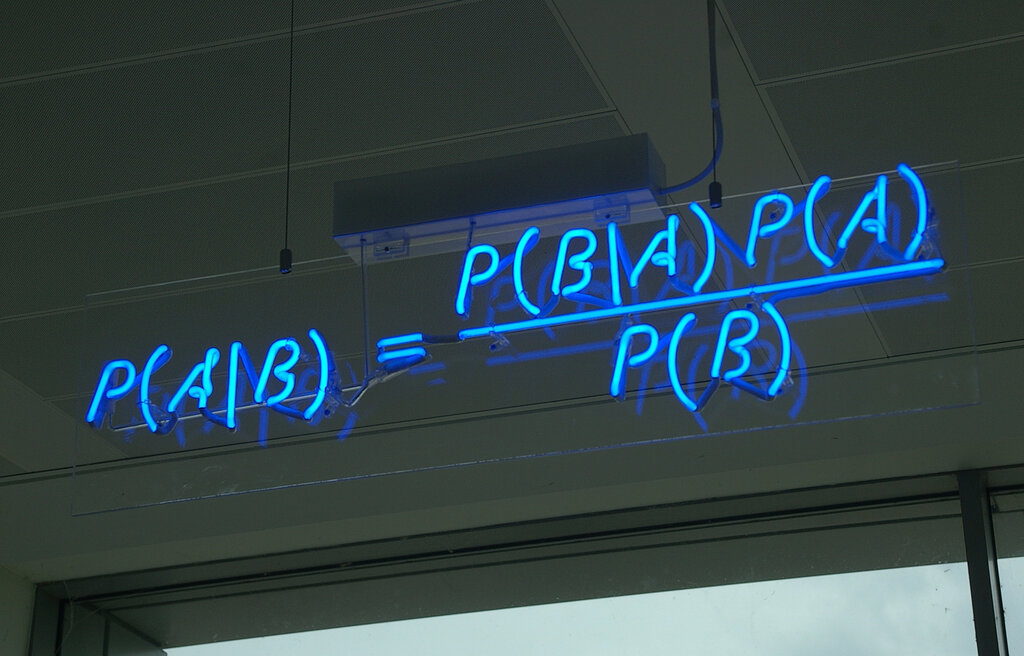
This approach allows us to answer questions the Frequentist framework cannot. A Bayesian can absolutely state the probability that a candidate will win an election. It might be 75%. This number doesn't represent a frequency. It represents a 75% degree of belief, based on prior knowledge (like polling data) and updated with new information as it comes in. This is a statement about our knowledge of the world, a concept known as epistemic uncertainty.
Key Philosophical Divides
The core differences in philosophy lead to dramatically different workflows and interpretations.
| Concept | Frequentist Approach | Bayesian Approach |
|---|---|---|
| Probability | Long-run frequency of a repeatable event. | Degree of belief or confidence about a statement. |
| Parameters | A fixed, unknown constant in the population. | A random variable with a probability distribution. |
| Uncertainty | Resides in the sampling process (confidence intervals). | Resides in our knowledge of the parameter (credible intervals). |
| Evidence | Data is used to estimate the single true parameter value. | Data is used to update beliefs about the parameter's distribution. |
A Frequentist confidence interval, for example, is a statement about the procedure. A 95% confidence interval means that if you repeated the experiment 100 times, 95 of the calculated intervals would contain the true parameter. It does not mean there is a 95% probability the true parameter is in your specific interval.
A Bayesian credible interval is more direct. A 95% credible interval means there is a 95% probability (representing your belief) that the true parameter lies within that range. This is often what people mistakenly think a confidence interval means.
According to the Frequentist philosophy, what is the best definition of probability?
In the Bayesian framework, a statistician starts with an initial belief about a parameter, which is then updated with data. What is this initial belief called?
These are not just academic distinctions. They affect how scientific results are reported and how we make decisions under uncertainty, from drug trials to financial modeling.