Battery Technologies Explained
Introduction to Battery Fundamentals
The Core Components
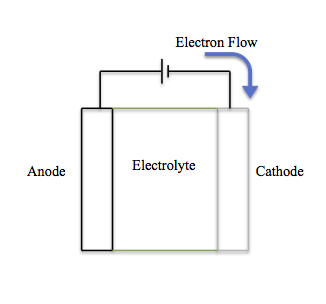
At its heart, every battery is a simple device with three main parts. Think of it like a tiny, self-contained power plant.
Anode
noun
The negative electrode of a battery, where electrons are released during discharge.
The anode is one of two electrodes. It's the negative side, often marked with a minus sign (–). This is where the electrical energy is stored and released from.
Cathode
noun
The positive electrode of a battery, where electrons are accepted during discharge.
The cathode is the other electrode. It’s the positive side, marked with a plus sign (+). It receives the electrical energy that the anode releases.
Electrolyte
noun
A chemical substance that contains ions and can conduct electricity when dissolved or molten.
Finally, there's the electrolyte. This is a chemical medium that separates the anode and cathode. It’s not just a barrier; it's a special substance filled with charged particles called ions. It acts like a shuttle, moving ions between the two electrodes.
Making Electricity Flow
So how do these three parts create power? It all comes down to a chemical dance called an electrochemical reaction. The materials in the anode are chosen because they want to give away tiny particles called electrons. The cathode materials are chosen because they want to accept them.
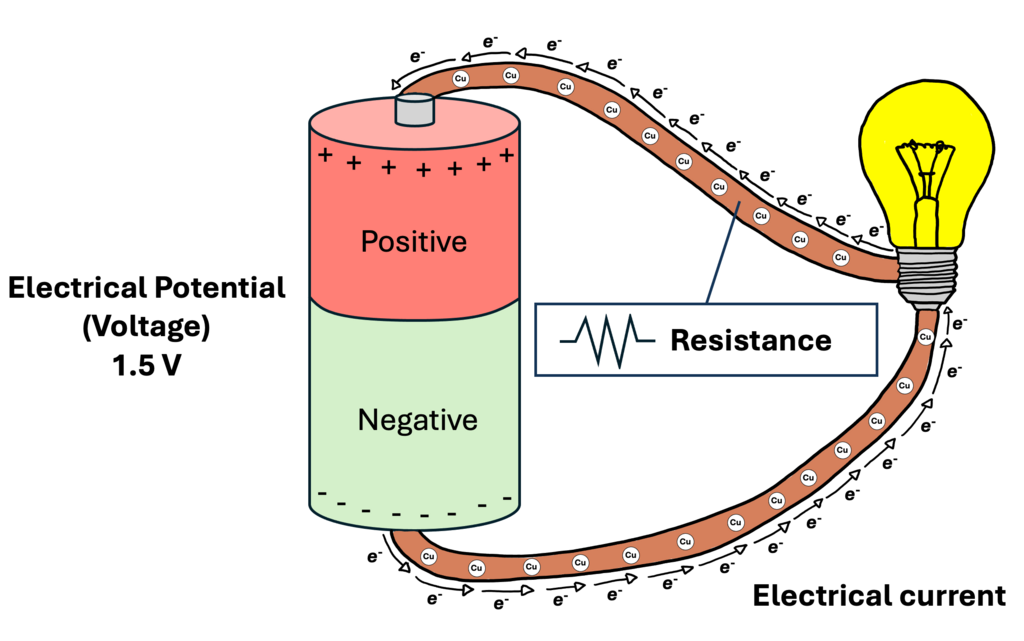
The electrolyte prevents the electrons from taking a direct shortcut from the anode to the cathode. Instead, when you connect a device like a lightbulb to the battery, you create an external path. The electrons eagerly rush out of the anode, travel through your device, and power it on their way to the cathode.
At the same time, the electrolyte gets to work inside the battery. It allows ions to travel between the anode and cathode to keep the chemical reaction balanced. If this internal flow of ions stops, the external flow of electrons also stops, and the battery dies.
A battery doesn't store electricity. It stores chemical energy and converts it into electrical energy on demand.
Measuring Performance
Not all batteries are created equal. We use a few key metrics to describe how they perform.
Voltage (V): This is the measure of electrical pressure. Think of it as the force pushing the electrons out of the anode. Higher voltage means a stronger push. A typical AA battery has 1.5 volts.
Current (A): This is the rate of electron flow. If voltage is the pressure in a hose, current is how much water is flowing through it. It's measured in amperes, or amps.
Capacity (Ah): This tells you how much charge a battery can hold. It’s like the size of the water tank connected to the hose. It’s usually measured in ampere-hours (Ah) or milliampere-hours (mAh). A battery with a 2,000 mAh capacity can supply 2,000 milliamps for one hour, or 1,000 milliamps for two hours, and so on.
Energy Density: This is a measure of how much energy a battery can store for its size or weight. A battery with high energy density can be made very small and light, which is why it's so important for smartphones and laptops.
A Brief History
The first true battery was invented in 1800 by an Italian physicist named Alessandro Volta. He stacked discs of copper and zinc, separating them with cloth soaked in salty water. This arrangement, called the voltaic pile, produced a steady electric current.
Volta's invention was revolutionary. It provided the first source of continuous, reliable electricity, paving the way for countless experiments and technologies. Over the next two centuries, scientists and inventors refined battery designs, making them smaller, safer, more powerful, and rechargeable.
Today, batteries are everywhere, from the tiny cells in a wristwatch to the massive battery packs that power electric cars and even store energy for entire power grids. They all operate on the same fundamental principles discovered by Volta over 200 years ago.
Let's review the key terms we've covered.
Now, check your understanding of these core concepts.
In a battery, what is the primary role of the electrolyte?
If a battery's voltage is like the water pressure in a hose, what does its capacity (Ah) represent?
Understanding these basics is the first step. Next, we'll explore the different types of batteries and the specific chemistries that give them their unique properties.