Basics of Mathematics
Whole Numbers
The Building Blocks of Numbers
Everything in math starts with a simple idea: counting. When we count objects, we use whole numbers. These are the numbers you first learned: 0, 1, 2, 3, and so on. They represent complete, undivided items. You can have 3 apples, but you can't have half of a parking spot.
Whole Number
noun
A number without fractions or decimals, including zero. It represents a whole quantity.
When we write numbers with more than one digit, the position of each digit matters. This is called place value. Each spot has a value ten times greater than the spot to its right.
Take the number 472. The '2' is in the ones place, so it just means 2. The '7' is in the tens place, meaning 7 groups of 10, or 70. And the '4' is in the hundreds place, meaning 4 groups of 100, or 400. So, 472 is really just a shorthand for $400 + 70 + 2$.
Basic Operations
Once we can count, we can start combining or separating groups of numbers. The four basic ways to do this are called arithmetic operations.
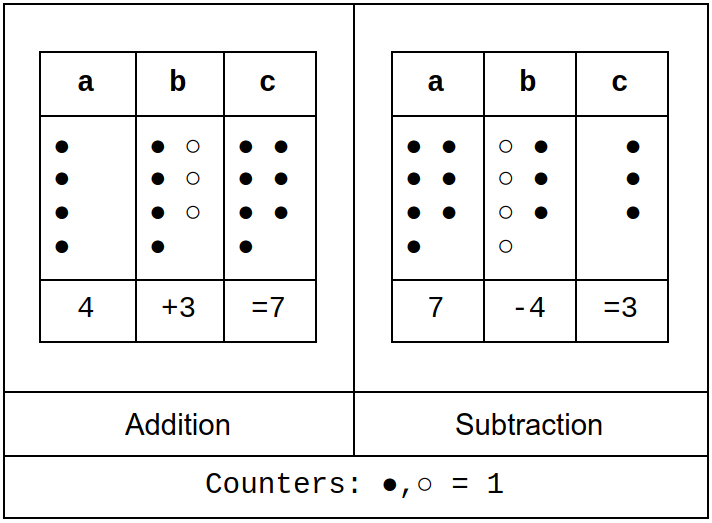
Addition (+) is about putting things together. If you have 4 books and get 3 more, you add them to find the total: books.
Subtraction (-) is the opposite. It's about taking away. If you start with 7 books and give away 3, you subtract to see what's left: books.
Multiplication (×) is a shortcut for repeated addition. Instead of adding , you can multiply. Three groups of five is . It saves a lot of time.
Division (÷) is a way of splitting a number into equal groups. If you have 15 cookies to share among 3 friends, you divide to find out how many each person gets: cookies each. It's the opposite of multiplication.
The Rules of the Road
To keep math consistent, there are a few rules everyone follows. Think of them as grammar for numbers. First are the properties of operations, which are handy shortcuts.
| Property | For Addition | For Multiplication |
|---|---|---|
| Commutative | The order doesn't matter. | The order doesn't matter. |
| (Order) | ||
| Associative | The grouping doesn't matter. | The grouping doesn't matter. |
| (Grouping) |
Notice that these properties don't work for subtraction or division. The order and grouping definitely matter for those!
There's one more big property that connects multiplication and addition.
The Distributive Property says that multiplying a number by a group of numbers added together is the same as doing each multiplication separately. For example, is the same as . Both equal 18.
When you have a calculation with multiple operations, the order you do them in is crucial. To avoid confusion, we use the order of operations, often remembered by the acronym PEMDAS.
Let's try an example: .
- Parentheses first: becomes 4. Our problem is now .
- No Exponents.
- Multiplication next: becomes 8. Our problem is now .
- Finally, Subtraction: .
The final answer is 2. If we had just gone left to right without following the rules, we would have gotten a completely different, incorrect answer.
Let's check your understanding of these concepts.
In the number 8,135, what is the value of the digit '1'?
You are organizing your bookshelf which has 120 books. If you want to put an equal number of books on 5 shelves, which operation would you use to find out how many books go on each shelf?
Understanding these basic building blocks is the first step toward mastering more complex math. They are the foundation for everything that follows.