Banjo Basics for Beginners
Banjo Basics
Getting to Know Your Banjo
Before you can play, it helps to know your way around the instrument. A banjo has a unique construction that gives it its signature bright, twangy sound. Let's look at the main parts.
The round body is called the pot, and the drum-like surface is the head. This is where the banjo's sound comes from. The long part you hold is the neck, which includes the fretboard and metal frets.
At the top is the headstock with tuning pegs for four of the strings. The fifth string, often called the drone string, has its own tuning peg partway down the neck. At the bottom, the strings go over a small wooden piece called the bridge and are held by the tailpiece.
Tuning Up
The most common tuning for a five-string banjo is called Open G. When you strum the open strings, they sound a G major chord. The strings are numbered 5 through 1, starting with the short drone string.
The tuning is gDGBD. The lowercase 'g' for the 5th string means it's a high note, higher than some of the other strings. This high drone string is a key part of the classic banjo sound.
| String Number | Note Name |
|---|---|
| 5th (drone) | G |
| 4th | D |
| 3rd | G |
| 2nd | B |
| 1st | D |
Use an electronic tuner or a tuning app to get each string to the correct pitch. Pluck one string at a time and adjust its tuning peg until the tuner shows you're on the right note. New strings tend to stretch, so you might need to re-tune frequently at first.
How to Hold the Banjo
Proper posture makes playing easier and helps prevent strain. Sit in a straight-backed chair without arms. Your feet should be flat on the floor. A strap is highly recommended, even when sitting, as it helps support the banjo's weight and keeps it stable.
The banjo pot should rest on your right thigh (for a right-handed player). The strap goes over your right shoulder. Adjust it so the banjo neck is angled upward, roughly parallel to the floor or slightly higher. You shouldn't have to use your left hand to hold the neck up; it should be free to move along the fretboard.
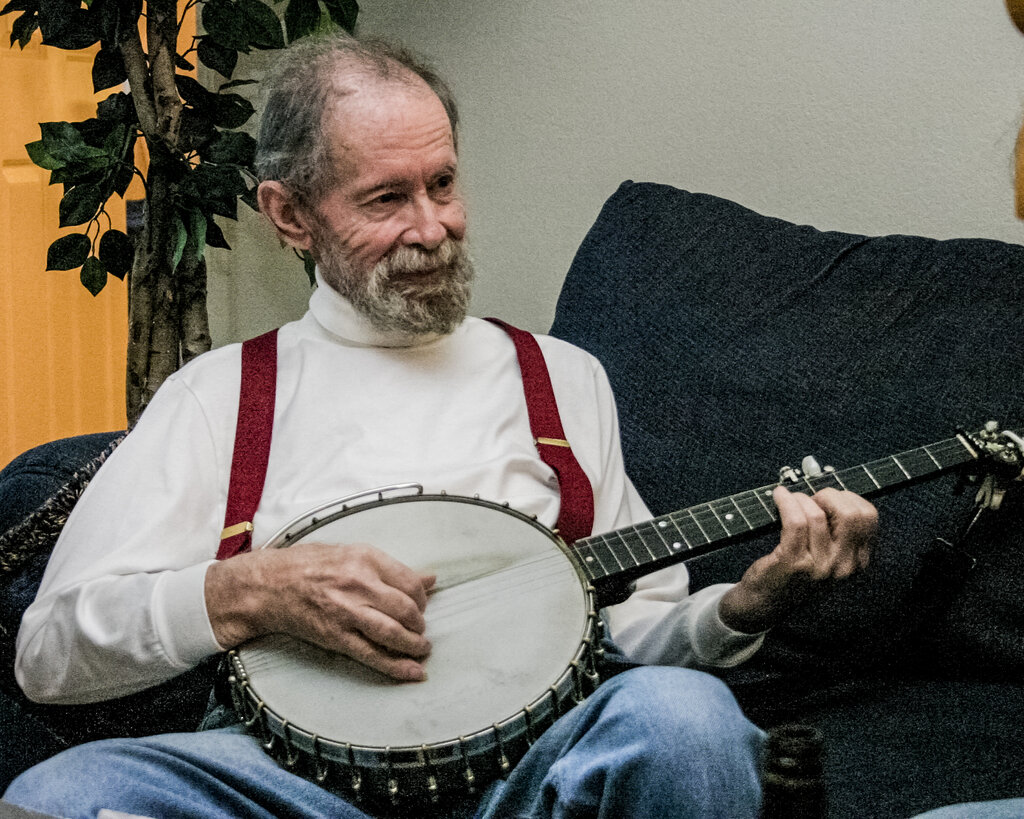
The goal is to be relaxed. If you feel any tension in your shoulders, back, or arms, take a break and readjust your position.
Hand Positioning
Correct hand placement is crucial for both comfort and clean playing.
Your Fretting Hand (Left Hand) Your thumb should rest on the back of the neck, roughly opposite your index or middle finger. This gives you leverage to press the strings down. Use the tips of your fingers to press the strings just behind the frets, not on top of them. Keep your fingers curved, like you're holding a ball. This prevents your fingers from accidentally touching and muting other strings.
Your Picking Hand (Right Hand) How you position your right hand depends on the style you're playing. For now, focus on finding a stable and comfortable anchor point. Lightly rest your pinky finger, and maybe your ring finger as well, on the banjo head just below the strings. This helps steady your hand. Your wrist should be relatively straight, not bent at a sharp angle. Your fingers and thumb should be curved and relaxed, ready to strike the strings.
With the banjo tuned and your posture set, you're ready to start making music. These fundamentals provide the base for all the techniques you'll learn next.