Ballistic Missile Technology Explained
Introduction to Ballistic Missiles
What Is a Ballistic Missile?
Think about throwing a baseball. You use your arm to give it a powerful push, and once it leaves your hand, it flies in a high arc before coming back down. For most of its journey, it's just coasting, pulled down by gravity.
A ballistic missile works on a very similar principle, just on a much larger and faster scale. It uses powerful rocket engines for only the first few minutes of its flight to gain immense speed and altitude. This initial powered flight is called the boost phase. After the engines cut off, the missile coasts for the majority of its journey on a predictable arc, a path known as a ballistic trajectory. It might travel above the Earth's atmosphere into space before gravity pulls it back down toward its target.
The key difference between a ballistic missile and a cruise missile is that a ballistic missile coasts, while a cruise missile is powered throughout its entire flight, like a small, pilotless airplane.
This flight path can be broken down into three distinct parts.
- Boost Phase: The rocket engines fire, pushing the missile up through the atmosphere. This is the only phase where the missile is accelerating.
- Midcourse Phase: The longest part of the journey. The engines have shut down, and the warhead (or warheads) separates and coasts through the vacuum of space.
- Terminal Phase: The warhead re-enters the atmosphere and falls towards its target at extremely high speed.
A Brief History
While the idea of rocket propulsion is centuries old, the story of the modern ballistic missile begins in the 20th century. Early pioneers like Robert Goddard in the United States laid the groundwork. However, the first true long-range ballistic missile was the German V-2 rocket, developed during World War II.
The V-2 was a terrifying weapon. It was liquid-fueled, could travel faster than the speed of sound, and carried a one-ton warhead over 200 miles. After the war, both the United States and the Soviet Union captured V-2 technology and scientists, kicking off a missile development race that defined the Cold War. This competition led to the creation of Intercontinental Ballistic Missiles (ICBMs), capable of striking targets on the other side of the world in under 30 minutes.
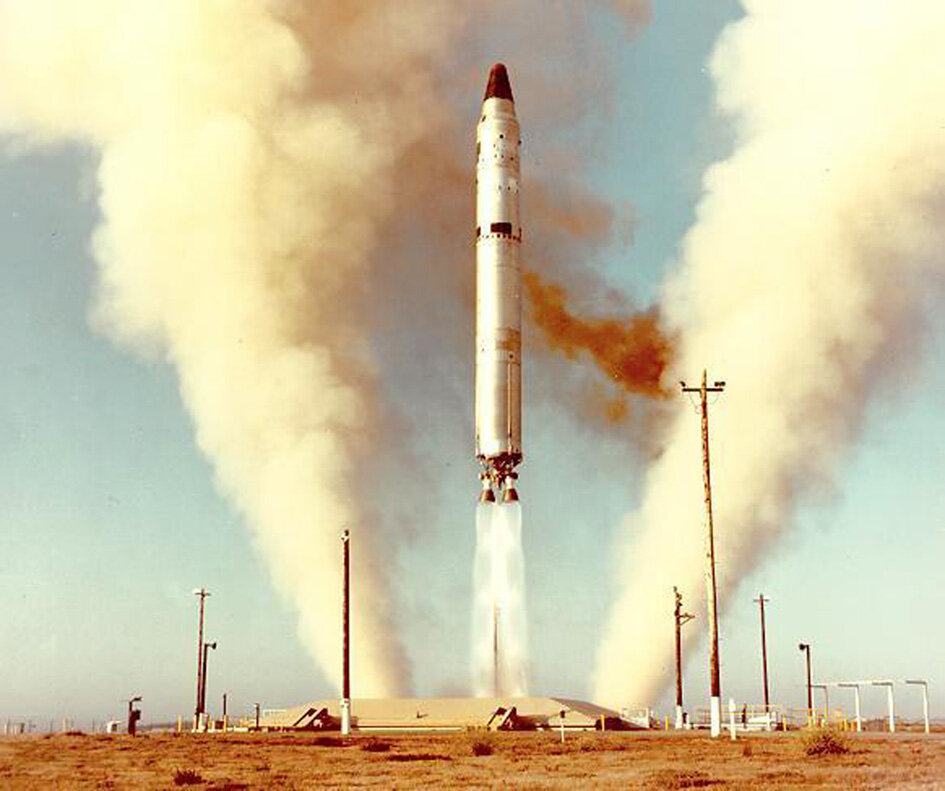
Missile Classifications
Ballistic missiles aren't all the same. They are primarily categorized by their range, which is the maximum distance they can travel. The payload, or what the missile carries, is another key characteristic. This can range from a single conventional explosive to multiple nuclear warheads.
| Category | Range (Kilometers) | Range (Miles) | Abbreviation |
|---|---|---|---|
| Short-Range Ballistic Missile | Under 1,000 km | Under 621 mi | SRBM |
| Medium-Range Ballistic Missile | 1,000 - 3,000 km | 621 - 1,864 mi | MRBM |
| Intermediate-Range Ballistic Missile | 3,000 - 5,500 km | 1,864 - 3,418 mi | IRBM |
| Intercontinental Ballistic Missile | Over 5,500 km | Over 3,418 mi | ICBM |
Short-range missiles are often considered tactical weapons for use in a specific theater of battle. As the range increases, the missiles become more strategic, capable of hitting targets deep within an enemy's territory. ICBMs, with their globe-spanning reach, are the ultimate strategic weapons.