Bacterial Chemotaxis with MCPs
Introduction to Bacterial Chemotaxis
Moving with Purpose
Bacteria, like all living things, need to find food and avoid danger. But without a brain, eyes, or a nose, how do they navigate their world? The answer is a sophisticated process called chemotaxis: the movement of an organism in response to a chemical stimulus.
chemotaxis
noun
The movement of a cell or organism in a direction corresponding to a gradient of increasing or decreasing concentration of a particular substance.
Think of it as a microscopic sense of smell. Bacteria can detect chemicals in their environment and decide whether to move toward them (attractants like sugars and amino acids) or away from them (repellents like toxins or waste products). This isn't just random wandering; it's a fundamental survival strategy that allows them to thrive in competitive environments, find nutrients, and escape harm.
The Run and Tumble
A bacterium's movement is a marvel of simplicity. It doesn't steer like a boat. Instead, it uses a two-part motion known as the "run and tumble."
- Run: The bacterium swims in a straight or gently curved line. This is its primary mode of travel.
- Tumble: It briefly stops and randomly changes its direction.
In a neutral environment with no chemical signals, the bacterium alternates between running and tumbling, resulting in a "random walk" that doesn't lead it anywhere in particular. But when it detects a chemical gradient, it adjusts this pattern.
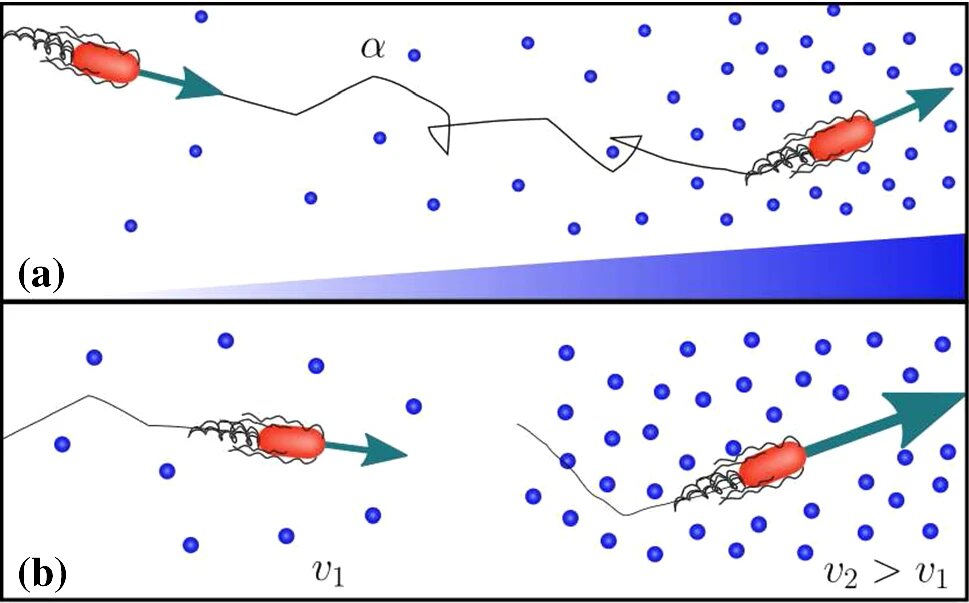
If a bacterium senses it's moving toward an attractant, it suppresses its tumbles and extends its runs, making more progress in the right direction. If it senses it's moving away from the food source or toward a repellent, it tumbles more frequently, essentially rolling the dice on a new, better direction. This biased random walk allows the bacterium to gradually climb up the concentration gradient of an attractant, even though it can't perceive the direction of the gradient directly.
A Simple Signaling System
This impressive navigational feat is managed by a relatively simple signaling pathway. It all starts with receptor proteins on the bacterium's surface. These proteins act as molecular sensors, constantly sampling the chemical environment.
When an attractant molecule binds to a receptor, it triggers a cascade of signals inside the cell. This signal travels to the flagellar motor, the tiny engine that powers the bacterium's whip-like tail (flagellum). The signal essentially tells the motor to keep spinning in a counter-clockwise direction, which produces a smooth "run."
Conversely, when the concentration of an attractant decreases, or when a repellent binds to a receptor, the signaling pathway tells the motor to switch its rotation to clockwise. This abrupt change causes the flagellum to fly apart, initiating a chaotic "tumble."
The key is not just detecting chemicals, but detecting changes in their concentration over time. Bacteria have a short-term memory that allows them to compare their current environment to where they were a few moments ago.
This system allows bacteria to respond rapidly to their surroundings. It's an elegant solution that enables them to find food patches, colonize hosts, and form complex communities like biofilms. Understanding chemotaxis is crucial for fields ranging from medicine, where it plays a role in infections, to biotechnology, where it can be harnessed for various applications.
What is the primary mechanism of bacterial chemotaxis?
When a bacterium is moving towards a source of nutrients (an attractant), how does it modify its 'run and tumble' behavior?
Now that we've covered the basics, let's look closer at the specific proteins that make this all possible.