Backgammon Dice Probabilities
Dice Probabilities
The 36 Possible Outcomes
Every roll in backgammon begins with the same simple action: tossing two six-sided dice. While it feels random, the outcomes follow predictable patterns. Understanding these patterns is the first step to moving beyond luck and into strategy.
Each die has six faces, numbered 1 through 6. When you roll two dice, the outcome of the first die doesn't affect the second. They are independent events. To find the total number of possible combinations, we multiply the number of outcomes for each die: . There are exactly 36 different ways the two dice can land.
This grid shows every possible combination, from a double 1 to a double 6. Notice that rolling a 1 and a 2 is different from rolling a 2 and a 1. Even though they result in the same sum, they are two distinct outcomes among the 36 possibilities.
Rolling a Specific Sum
In backgammon, you usually care about the sum of the dice. You don't move one checker by 1 and another by 2; you use the numbers on the dice for separate moves. However, understanding the probability of rolling a certain sum helps you anticipate your opponent's moves and evaluate risks.
Some sums are much more common than others. As you can see from the grid, there's only one way to roll a 2 (1-1) and only one way to roll a 12 (6-6). But there are six ways to roll a 7 (1-6, 2-5, 3-4, 4-3, 5-2, 6-1). This makes 7 the most likely sum to be rolled.
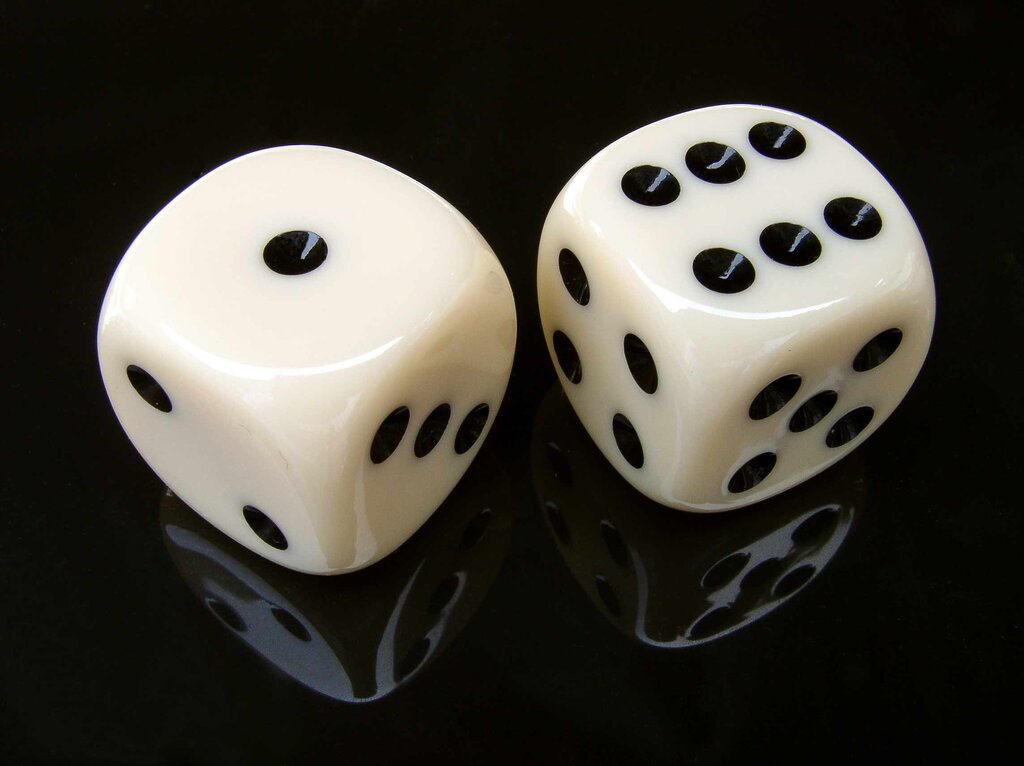
Here’s a breakdown of the probabilities for each possible sum.
| Sum | Combinations | Number of Ways | Probability |
|---|---|---|---|
| 2 | (1,1) | 1 | 1/36 (2.8%) |
| 3 | (1,2), (2,1) | 2 | 2/36 (5.6%) |
| 4 | (1,3), (2,2), (3,1) | 3 | 3/36 (8.3%) |
| 5 | (1,4), (2,3), (3,2), (4,1) | 4 | 4/36 (11.1%) |
| 6 | (1,5), (2,4), (3,3), (4,2), (5,1) | 5 | 5/36 (13.9%) |
| 7 | (1,6), (2,5), (3,4), (4,3), (5,2), (6,1) | 6 | 6/36 (16.7%) |
| 8 | (2,6), (3,5), (4,4), (5,3), (6,2) | 5 | 5/36 (13.9%) |
| 9 | (3,6), (4,5), (5,4), (6,3) | 4 | 4/36 (11.1%) |
| 10 | (4,6), (5,5), (6,4) | 3 | 3/36 (8.3%) |
| 11 | (5,6), (6,5) | 2 | 2/36 (5.6%) |
| 12 | (6,6) | 1 | 1/36 (2.8%) |
This pattern is key. The numbers in the middle (6, 7, and 8) are the most common. Knowing this helps you position your checkers. If you leave a checker vulnerable, it's most likely to be hit by an opponent who is 6, 7, or 8 pips away.
The Power of Doubles
Rolling doubles is a game-changer in backgammon. When you roll a double, say two 4s, you get to move four times by that number. Instead of moving an 8, you get four moves of 4. This can dramatically change your position, allowing you to build primes, hit opposing checkers, or bear off quickly.
But how likely is it to roll doubles? There are six possible doubles: (1,1), (2,2), (3,3), (4,4), (5,5), and (6,6). Since there are 36 total outcomes, the probability of rolling any double is:
So, you can expect to roll doubles about once every six rolls. While you can't count on them, you should always be aware of the possibility. A timely double can turn a losing game into a winning one.
Strategic insight: Leaving a checker 7 pips away from an opponent's checker is the riskiest position, as 7 is the most common sum. Conversely, leaving a checker 1 pip away is much safer, as the opponent can only hit with a roll that includes a 1.
Now, let's see how well you've grasped these fundamental probabilities.
When you roll two standard six-sided dice, how many total unique combinations are possible?
What is the probability of rolling any double in a single toss of two dice?
Understanding these odds is the foundation of smart backgammon play. It transforms the game from one of pure chance to one of calculated risk.