Backgammon Basics and Beyond
Backgammon Basics
The Backgammon Board
Backgammon is played on a board with 24 narrow triangles called points. These points are grouped into four quadrants of six points each. A ridge down the middle, called the bar, divides the board in half. The points are a continuous track, and each player moves their checkers in opposite directions.
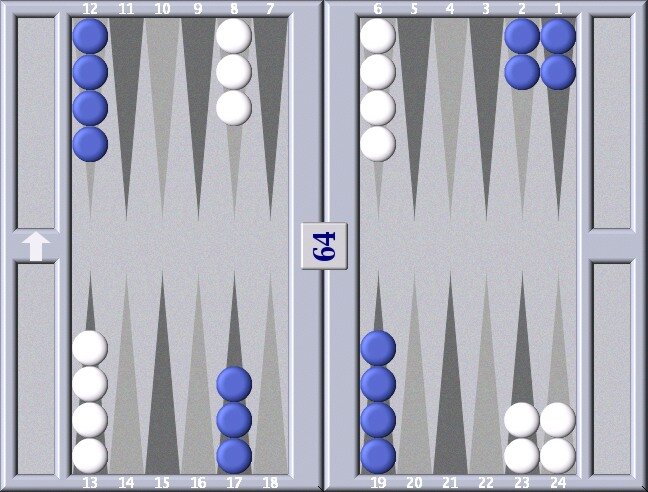
Each player starts with 15 checkers. The setup is always the same. If you are playing as white and moving counter-clockwise, your 15 checkers are placed like this:
- Two checkers on your opponent's 1-point (the 24-point)
- Five checkers on your opponent's 12-point (the 13-point)
- Three checkers on your 8-point
- Five checkers on your 6-point
Your opponent's checkers mirror this setup on their side of the board.
The Objective
The goal in backgammon is simple: be the first player to move all 15 of your checkers into your home board and then remove them from the board entirely. The player who gets all their checkers off first wins.
Your home board is the quadrant containing points 1 through 6. Your opponent's home board is directly opposite, containing points 19 through 24. You must bring all your checkers around the board into this final quadrant before you can start taking them off.
The race is to get your checkers home, then off the board.
Making a Move
Each turn begins with a roll of two dice. The numbers you roll determine how many points you can move your checkers. For example, if you roll a 5 and a 2, you can move one checker 5 points and another checker 2 points. Alternatively, you can move a single checker a total of 7 points, as long as the move is done in two steps (a 5 and a 2) and the intermediate point is open.
You must use both numbers of your roll if a legal move is available. If you can only play one number, you must play the higher one if possible.
If you roll doubles, like two 3s, you get a special bonus. You play the number four times instead of two. A roll of double 3s means you have four moves of 3 points to use among your checkers.
Landing and Hitting
So where can your checkers land? You can move a checker to any point that is unoccupied or occupied by only one of your opponent’s checkers. You can also land on any point that already has your own checkers on it.
A point occupied by two or more of your opponent’s checkers is "made" or "blocked." You cannot land on a blocked point.
If you land a checker on a point where your opponent has only a single checker, this is called a "hit." Your opponent's checker is moved to the bar in the center of the board. A single, vulnerable checker is called a "blot."
A checker on the bar is temporarily out of play. If you have a checker on the bar, your first priority is to bring it back onto the board. You do this by using a dice roll to move it to an open point in your opponent's home board. For example, a roll of 3 allows you to enter your checker on your opponent's 3-point (the 22-point), provided it isn't blocked. You cannot make any other moves until all of your checkers are off the bar.
Now that you know the basics of setting up the board, moving, and hitting, you're ready to start playing.
In the standard backgammon setup, how many checkers does each player place on their opponent's 12-point (the 13-point)?
What is the primary objective of backgammon?