Backend Development Fundamentals
Introduction to Backend Development
The Engine Room of the Web
Every time you use an app or a website, you interact with two distinct parts. The part you see and touch—the buttons, the text, the images—is called the frontend. It's like the dining room of a restaurant. You see the tables, the menu, and the decor. It's designed for your experience.
But behind the kitchen doors, there's a whole other world. That's the backend. It's the kitchen, the pantry, and the manager's office all in one. It’s where your order is received, your food is cooked, and the inventory is managed. You don't see it, but it makes everything in the dining room possible.
While frontend focuses on user interfaces and experience, backend development handles the behind-the-scenes logic, databases, and server-side processes that power web applications.
Backend developers are the chefs and kitchen staff of the digital world. They build and maintain the technology that powers the frontend. Their work ensures that when you click a button to buy a product, your order is processed, payment is taken, and the product is marked as sold.
The Client and the Server
This interaction between the frontend and backend happens through a model called the client-server architecture. It’s a simple but powerful concept.
The Client: This is the device you're using, like your web browser or a mobile app. It's responsible for displaying the user interface. When you want to do something, like search for a video, the client sends a request for information.
The Server: This is a powerful computer somewhere that receives the client's request. It runs the backend code, finds the information you asked for, and sends it back in a response. The client then displays this response to you.
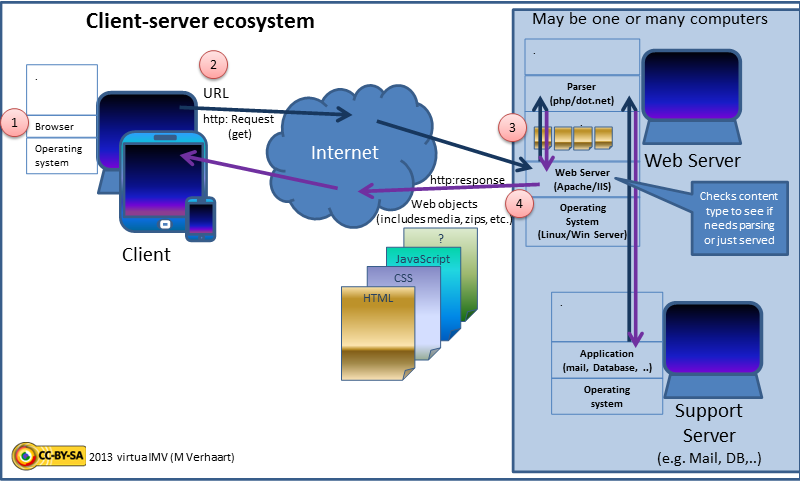
This back-and-forth communication is the foundation of the modern web. Every time you load a webpage, post a photo, or check your email, you are initiating a client-server interaction.
What Happens on the Server
The server's job is more than just sending files. It's where the application's core logic lives. This server-side logic handles tasks that the user shouldn't—and can't—do on their own device. For example, when you sign up for a new account, the server's logic handles checking if your chosen username is already taken, validating your password strength, and securely storing your information.
Server-side logic is the brain of an application. It processes data, makes decisions, and ensures the rules of the application are followed.
A huge part of this logic involves managing data. Websites and apps need to store vast amounts of information, from user profiles and passwords to product inventories and blog posts. This is where databases come in.
A database is an organized collection of data, managed by a system that makes it easy to store, retrieve, and update information. Backend developers are responsible for designing and interacting with these databases. They write the code that saves a new user's information or fetches the latest comments on a post.
But how does the frontend talk to the server's logic and its database? It uses an Application Programming Interface, or API.
API
noun
A set of rules and protocols that allows different software applications to communicate with each other. It acts as an intermediary, processing requests and ensuring seamless functioning between the client and the server.
Think of an API as the waiter in our restaurant analogy. You (the client) don't go into the kitchen (the backend) to get your food. Instead, you give your order to the waiter (the API). The waiter takes your request to the kitchen, which prepares the order. The waiter then brings the food back to you. The API does the same for data, providing a clean and secure way for the frontend to get what it needs from the backend without needing to know all the messy details of how it's made.
Let's review these key ideas.
Ready to check your understanding?
In the restaurant analogy, what does the 'backend' represent?
What is the primary responsibility of the 'client' in the client-server architecture?
Understanding these core components—the client-server relationship, server-side logic, databases, and APIs—is the first step into the world of backend development. It's the hidden machinery that makes our digital lives possible.