Backend Coding Fundamentals
Introduction to Backend Development
The Engine Room of the Web
When you visit a website, you interact with its frontend. You see the layout, click buttons, and fill out forms. But what happens after you click "submit" on a login form or "buy now" in an online store? That's where the backend comes in.
Backend development is all the work that happens behind the scenes. It's the server, the database, and the application logic that powers the website from the inside. Think of a restaurant. The frontend is the dining room where you order your food and enjoy your meal. The backend is the kitchen, where chefs cook the food, manage ingredients, and make sure every order is prepared correctly. You don't see the kitchen, but without it, there's no restaurant.
If the frontend is the face of an application, the backend is the brain and nervous system.
The backend has three main jobs:
- Store and organize data: It manages databases that hold user information, product details, comments, and everything else the application needs to remember.
- Process requests: When you perform an action on the frontend, the backend processes that request. It might mean verifying your password, fetching the right articles, or calculating the cost of your shopping cart.
- Ensure security and reliability: It handles user authentication to make sure only authorized people can access certain data, and it keeps the application running smoothly.
Client-Side vs. Server-Side
The key difference between frontend and backend boils down to where the code runs. Frontend code runs on the client-side—your web browser. Backend code runs on the server-side—a powerful computer that lives somewhere else and is accessible over the internet.
When you type a web address into your browser, you're sending a request to a server. The server's backend code processes this request, gathers the necessary data (like your user profile or the latest news), and sends a response back to your browser. Your browser then uses its frontend code (HTML, CSS, JavaScript) to display that information as a webpage.
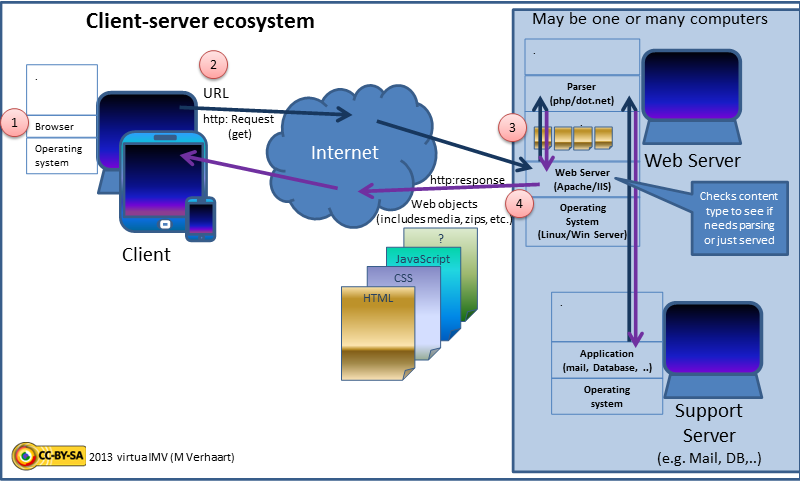
This separation of concerns is powerful. It allows the frontend to focus on creating a great user experience, while the backend handles the heavy lifting of data management and complex logic.
The Backend Toolkit
Backend developers use a specific set of tools to build and maintain the server-side of an application. The main components are programming languages, databases, and APIs.
A backend isn't built with just one tool. It's a stack of technologies working together to deliver a seamless experience.
Server-Side Languages Just as frontend developers use JavaScript to add interactivity to websites, backend developers use programming languages to write instructions for the server. Some popular choices include:
- JavaScript (via Node.js): Allows developers to use JavaScript on both the frontend and backend, which simplifies the development process.
- Python: Known for its clean syntax and powerful libraries, making it a favorite for data science, machine learning, and web development.
- Java: A robust, high-performance language that's a cornerstone of large, enterprise-level applications.
- PHP: One of the oldest and most widely used languages for web development, powering a significant portion of the web, including platforms like WordPress.
- Ruby: Valued for its elegant syntax and the popular Ruby on Rails framework, which enables rapid development.
Databases Databases are where an application's data lives. They are organized systems for storing, managing, and retrieving information. When you create a user account, the backend stores your username and password in a database. When you log in, it queries the database to verify your credentials. Common database systems include PostgreSQL, MySQL, MongoDB, and Redis.
APIs An API, or Application Programming Interface, is a set of rules that allows different software applications to communicate with each other. In web development, APIs are the messengers that connect the frontend to the backend. When the frontend needs data, it makes an API call to the backend. The backend processes the request, gets the data from the database, and sends it back through the API. This allows the user interface to remain separate from the underlying data and logic, making the whole system more flexible and scalable.
Together, these components form the foundation of almost every modern web application you use.
Using the analogy of a restaurant, what part corresponds to the backend of a website?
Which of the following is NOT a primary responsibility of the backend?
This introduction covers the core ideas behind backend development. It's the invisible but essential part of the web that makes rich, interactive experiences possible.