Ayn Rand's Objectivist Epistemology and Cognitive Science
Introduction to Epistemology
What Do We Know?
How do you know that the sky is blue? Or that two plus two equals four? You might say you can see the sky, and you learned the math problem in school. But how do you really know? What does it even mean to "know" something?
These are the kinds of questions that drive epistemology, the branch of philosophy focused on knowledge itself. It doesn't just ask what we know, but how we know it and what the limits of our knowledge might be.
Epistemology, the study of knowledge, is a core branch of philosophy that examines the nature, sources, and limits of human knowledge.
For centuries, philosophers have tried to pin down a precise definition of knowledge. The most famous starting point is the idea that knowledge is a "justified true belief." This model suggests that for you to know something, three conditions must be met:
- You must believe it.
- It must be true.
- You must have a good reason, or justification, for believing it.
For example, if you believe a coin will land on heads, and it does, you had a true belief. But you didn't know it would land on heads, because you had no justification. It was just a lucky guess.
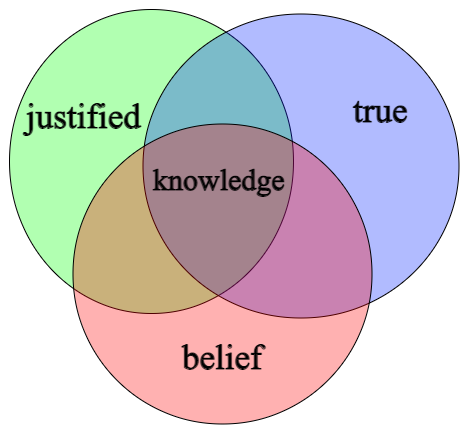
This framework seems simple, but it raises deeper questions. What counts as a good justification? And how do we get that justification in the first place?
Two Paths to Knowledge
Historically, two major schools of thought have offered different answers about the primary source of our knowledge: rationalism and empiricism.
Rationalists argue that reason is the chief source of knowledge. They believe we can understand the world through logic and intellect, independent of sensory experience. This kind of knowledge is called a priori, meaning "from the earlier." A classic example is mathematical truth. You don't need to conduct an experiment to know that $2+2=4$. You can figure it out just by thinking about it.
A priori knowledge comes from reason alone.
Empiricists, on the other hand, argue that knowledge comes primarily from sensory experience. They believe we are born as blank slates (a concept known as tabula rasa) and build our understanding of the world by seeing, hearing, touching, and tasting it. This is called a posteriori knowledge, or "from the later."
You know that fire is hot because you've felt its warmth. You know lemons are sour because you've tasted them. For an empiricist, experience is our only real teacher.
A posteriori knowledge comes from sensory experience.
| Theory | Source of Knowledge | Example |
|---|---|---|
| Rationalism | Reason & Logic | All bachelors are unmarried. |
| Empiricism | Sensory Experience | The sun rises in the east. |
Of course, most thinkers agree that we use both reason and experience. The debate is about which one is more fundamental.
The Problem of Doubt
But what if our senses deceive us? And what if our reasoning is flawed? This leads to a third major position in epistemology: skepticism.
Skepticism is the view that we should doubt our claims to knowledge. A skeptic might not say that we can't know anything, but they would argue that we can't be certain about what we know. They challenge us to question our assumptions.
For example, how can you be sure you're not dreaming right now? Your dream experiences can feel just as real as your waking ones. While this might seem like a strange thought experiment, it highlights a core skeptical point: our justifications for belief might not be as solid as we think they are.

Skepticism serves as a crucial check on our beliefs. It forces rationalists and empiricists to strengthen their arguments and be more rigorous in defining what it means to truly know something.
Ready to test your understanding?
What is the central focus of epistemology?
You guess that a flipped coin will land on heads, and it does. According to the 'justified true belief' model, why can't this be considered knowledge?
These three perspectives—rationalism, empiricism, and skepticism—form the foundation of epistemology. They frame the conversation about how we justify our beliefs and connect our minds to the world around us.