AWS CloudOps Engineer Exam Prep
AWS CloudOps Fundamentals
The Pillars of Cloud Operations
Cloud computing is like using a power grid instead of owning your own generator. You get access to massive computing resources over the internet, paying only for what you use. This model is built on a few key principles that make it so powerful.
Instead of buying, owning, and maintaining your own data centers and servers, you can access technology services, such as computing power, storage, and databases, on an as-needed basis from a cloud provider like Amazon Web Services (AWS).
| Principle | What It Means |
|---|---|
| On-demand self-service | You can provision resources like servers and storage yourself, anytime, without needing to talk to a human. |
| Broad network access | You can access your resources from anywhere with an internet connection, using a phone, laptop, or tablet. |
| Resource pooling | The provider's resources are shared among multiple customers, with different physical and virtual resources dynamically assigned according to demand. |
| Rapid elasticity | You can scale your resources up or down quickly, sometimes automatically, to match your needs. Think of a retail site getting more servers during a holiday sale. |
| Measured service | Resource usage is monitored, controlled, and reported, providing transparency for both you and the provider. You only pay for what you consume. |
AWS's Global Footprint
To deliver services quickly and reliably, AWS builds data centers all over the world. This physical infrastructure is organized into a simple hierarchy: Regions and Availability Zones.
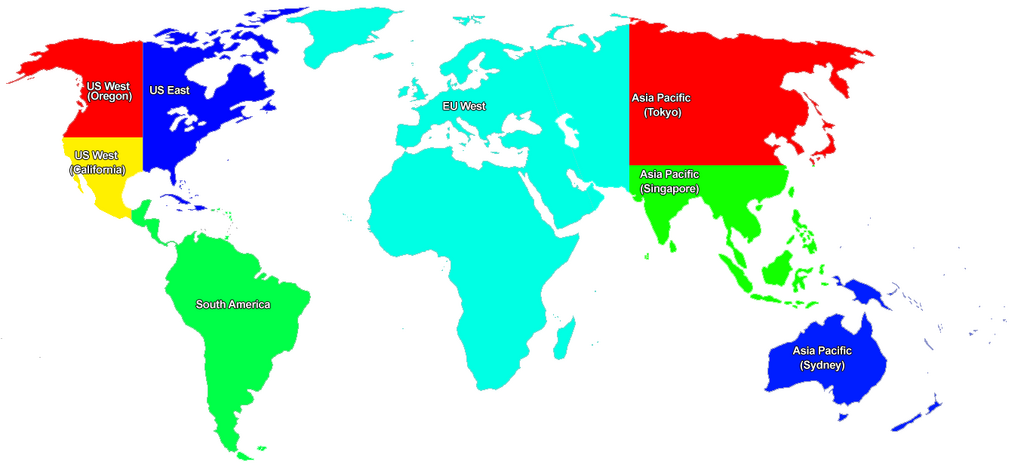
A Region is a physical location in the world where AWS has multiple data centers. Think of it as a major metropolitan area.
Within each Region are multiple Availability Zones, or AZs. An AZ is one or more discrete data centers with redundant power, networking, and connectivity. They are housed in separate facilities, making them isolated from each other in case of a local failure like a fire or power outage. Deploying your application across multiple AZs is a core strategy for achieving high availability.
The Shared Responsibility Model
When you move to the cloud, security becomes a shared effort between you and AWS. It’s crucial to understand who is responsible for what. AWS calls this the Shared Responsibility Model.
AWS is responsible for security of the Cloud. The customer is responsible for security in the Cloud.
Think of it like renting an apartment. The building management is responsible for securing the building itself: the foundation, the external walls, and the locks on the main doors. That's AWS's job. They manage the physical security of data centers, the hardware, and the software that runs all AWS services.
However, you are responsible for locking your own apartment door and securing your belongings inside. In the cloud, this means you manage your data, configure access permissions, encrypt sensitive information, and set up network firewalls. You control who has the keys to your data and how it's protected.
A Few Core Services
AWS offers hundreds of services, but most cloud operations are built on a handful of fundamental ones. Here are three you must know.
EC2
noun
Amazon Elastic Compute Cloud (EC2) provides resizable compute capacity in the cloud. It's essentially a virtual server that you can use to run applications.
EC2 is the workhorse of AWS. Whenever you need a server to run code, host a website, or perform calculations, you'll likely use an EC2 instance.
S3
noun
Amazon Simple Storage Service (S3) is an object storage service that offers industry-leading scalability, data availability, security, and performance.
Think of S3 as an infinitely large hard drive in the cloud. It’s perfect for storing files of any size, from website assets and log files to data backups and archives.
RDS
noun
Amazon Relational Database Service (RDS) makes it easy to set up, operate, and scale a relational database in the cloud.
RDS automates time-consuming administration tasks such as hardware provisioning, database setup, patching, and backups. It supports familiar database engines like MySQL, PostgreSQL, and SQL Server. This lets you focus on your application instead of database management.
Most successful cloud projects stick to 10–15 core AWS services that cover the basics — computing, storage, databases, and security.
Let's review these foundational concepts.
What is the relationship between an AWS Region and an AWS Availability Zone (AZ)?
Under the AWS Shared Responsibility Model, which task is AWS responsible for?
Understanding these core principles, infrastructure components, and key services is the first step in mastering AWS CloudOps. They form the foundation upon which all other cloud skills are built.