AWS Cloud Fundamentals
AWS Global Infrastructure
The Foundation of the Cloud
Amazon Web Services (AWS) isn't a single, monolithic entity. It's a massive, globally distributed network of physical hardware. This global infrastructure is the foundation that allows businesses to deploy applications that are fast, reliable, and available to users anywhere in the world. Understanding its structure is the first step in designing effective cloud solutions.
The entire AWS network is built around the concepts of geographic isolation and redundancy. At the highest level, AWS organizes its infrastructure into Regions.
Region
noun
A physical, geographic area in the world where AWS has multiple, isolated data centers. Each Region is designed to be completely independent of the others.
Think of Regions as major hubs, like Northern Virginia, London, or Tokyo. When you decide to launch a service, like a virtual server, you must first choose the Region where it will live. Several factors influence this choice:
- Latency: To reduce lag, you want to choose a Region that is physically close to the majority of your users.
- Cost: Pricing for AWS services can vary slightly from one Region to another.
- Service Availability: While most core services are available everywhere, the newest AWS services sometimes roll out to specific Regions first.
- Compliance: Data sovereignty laws may require you to store user data within a specific country's borders. Choosing the right Region helps meet these legal requirements.
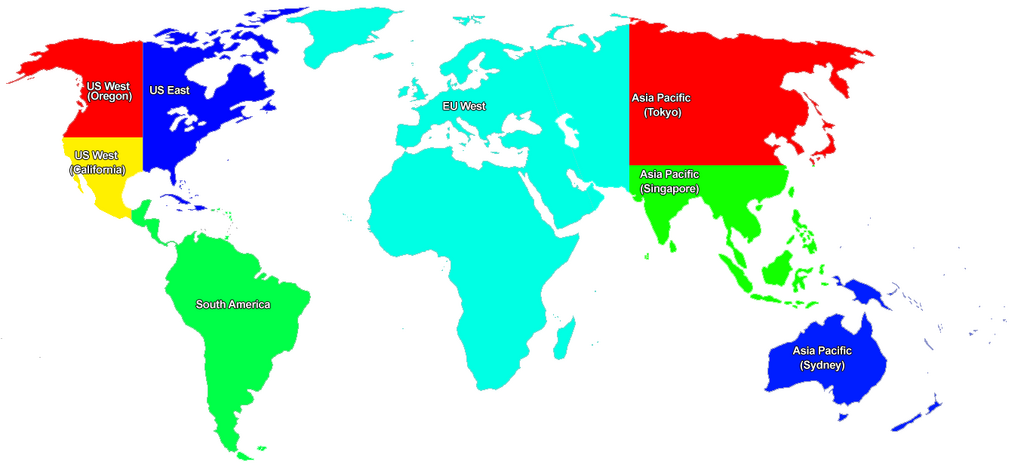
To minimize latency and guarantee that data is near end users, AWS Regions are positioned strategically throughout the world.
Building for Resilience
Simply choosing a Region isn't enough to build a robust application. What happens if a disaster, like a flood or a massive power outage, affects an entire data center? To solve this, each AWS Region is subdivided into smaller, isolated units called Availability Zones.
Availability Zone
noun
One or more discrete data centers with redundant power, networking, and connectivity within an AWS Region. AZs are physically separate from each other.
Think of an Availability Zone (AZ) as an independent island of infrastructure. While all AZs within a Region are connected with high-speed, low-latency private networking, they are miles apart physically. This separation is crucial. If a fire were to take out a data center in one AZ, the data centers in the other AZs within that same Region would be unaffected.
This structure is the key to achieving high availability and fault tolerance. High availability means your application remains operational for a very high percentage of time, even when components fail. Fault tolerance is the property that enables a system to continue operating properly in the event of the failure of some of its components.
By deploying your application across multiple AZs, you build a system that can withstand the failure of an entire data center without interrupting service to your users. If one AZ goes down, traffic is automatically redirected to the healthy instances in the other AZs.
The standard architectural pattern on AWS is to distribute your application's components across at least two Availability Zones within a Region.
The Big Picture
So, what are the primary benefits of this layered global infrastructure?
-
Fault Tolerance and High Availability: As we've seen, spreading applications across multiple AZs protects them from single points of failure. For even greater resilience, you can design applications to run across multiple Regions, protecting against large-scale regional events.
-
Low Latency: By placing resources in Regions closer to end-users, you significantly reduce the time it takes for data to travel, resulting in a faster, more responsive application.
-
Scalability: The global infrastructure allows you to scale your application seamlessly. If you gain a new user base in another part of the world, you can easily deploy resources in a nearby Region to serve them effectively.
-
Global Reach: Without needing to invest in physical hardware, any developer or company can deploy their services globally in minutes.
What is the main reason for an AWS Region being subdivided into multiple, physically separate Availability Zones?
You are designing an application for users primarily located in France. To ensure the lowest possible latency and comply with European data privacy laws, which of the following is the most important factor to consider first?
Understanding the distinction between Regions and Availability Zones is fundamental to architecting anything on AWS. It’s the framework that supports everything else you will build.