AWS AI Specialty Certification Prep
AI and ML Basics
What is Artificial Intelligence?
Artificial Intelligence (AI) is the broad science of making machines smart. The goal is to create systems that can perform tasks that typically require human intelligence, like understanding language, recognizing images, and making decisions. Think of AI as the entire universe of intelligent machines.
Within this universe, there's a specific field called Machine Learning (ML). Instead of programming a machine with explicit rules for every possible situation, ML allows a machine to learn from data. It finds patterns and makes predictions on its own. For example, instead of writing code to identify a cat by its pointy ears and whiskers, you show an ML system thousands of cat pictures, and it learns to recognize them.
Going one level deeper, we find Deep Learning. This is a specialized type of machine learning that uses complex structures called neural networks, which are loosely inspired by the human brain. Deep learning is the powerhouse behind many recent AI breakthroughs, from self-driving cars to advanced medical diagnoses.
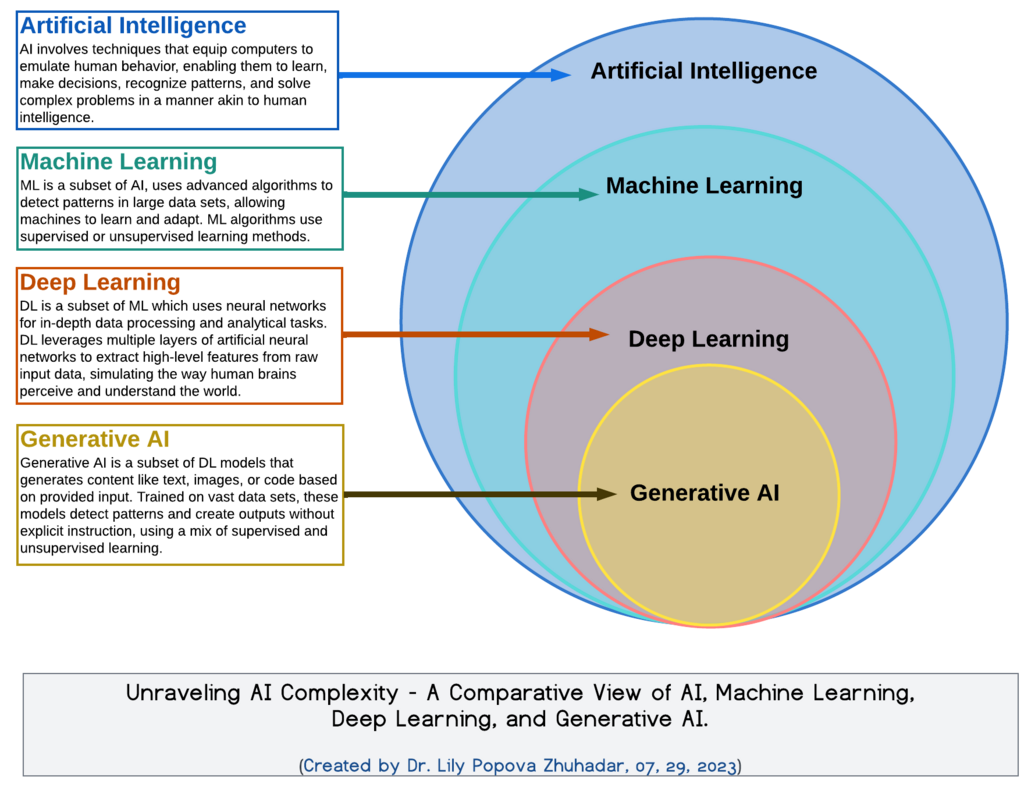
In short: AI is the goal, Machine Learning is a way to achieve that goal, and Deep Learning is a powerful technique within Machine Learning.
The Building Blocks of ML
To understand how machine learning works, we need to know a few key terms. These are the fundamental concepts you'll encounter again and again.
Algorithm
noun
A process or set of rules followed in calculations or other problem-solving operations, especially by a computer.
An algorithm is like a recipe. It's the step-by-step procedure that analyzes the data. The output of running a machine learning algorithm on data is a model.
The model is the brain of the operation. It's the specific system that has been trained to recognize patterns or make predictions. If the algorithm is the recipe for baking a cake, the model is the actual cake you baked. You can then use this cake (the model) to, say, guess the flavor of other cakes based on their ingredients.
The process of using data to create the model is called training. When the trained model is used to make predictions on new data, it's called inference.
A crucial part of training is the data itself. If the data used to train a model is flawed or unrepresentative, the model will be, too. This leads to bias, where a model makes systematic errors in favor of certain outcomes.
For example, if a hiring model is trained only on resumes of past successful male employees, it might develop a bias against qualified female candidates. Ensuring fairness means actively working to identify and mitigate these biases so that the model's predictions are equitable and just.
Data and Learning
Data is the fuel for machine learning. Without it, models can't learn anything. Data comes in different forms, and the type of data you have often determines the type of learning you can do.
First, we distinguish between structured and unstructured data.
- Structured Data: This is data that is highly organized and formatted, like a spreadsheet or a database table. Think of customer records with neat columns for name, age, and purchase amount.
- Unstructured Data: This is data without a predefined format. Examples include text from an email, images, videos, and audio files. Most of the world's data is unstructured.
Data can also be labeled or unlabeled.
- Labeled Data: This data has a target or outcome already tagged. An email might be labeled "spam" or "not spam." A picture of an animal might be labeled "cat."
- Unlabeled Data: This data has no predefined tags or outcomes. It's just a collection of raw photos, documents, or sensor readings.
The type of data you have directly influences which learning paradigm you use.
-
Supervised Learning: This is the most common type of ML. You use labeled data to train a model. The goal is to learn a mapping function that can predict the output for new, unseen data. It's "supervised" because we provide the correct answers during training.
-
Unsupervised Learning: Here, you work with unlabeled data. The algorithm tries to find patterns, structures, or relationships within the data on its own, without any pre-existing labels to guide it. Think of it as discovering insights without knowing what you're looking for.
-
Reinforcement Learning: This paradigm is about taking actions in an environment to maximize a reward. The model, often called an "agent," learns through trial and error. It gets positive feedback (rewards) for correct actions and negative feedback (penalties) for incorrect ones. It's the same way you might train a dog with treats.
Now that you've got the basics down, let's test your knowledge.
Which statement best describes the relationship between Artificial Intelligence (AI), Machine Learning (ML), and Deep Learning?
An algorithm is like a recipe, and a _______ is like the cake you bake from that recipe.
These foundational concepts are the starting point for understanding how more complex AI and ML systems work. Grasping the relationships between AI, ML, and deep learning, along with the core learning paradigms, is essential for building and deploying intelligent applications.