AWS Agent Core Fundamentals
Introduction to Agent-Based Modeling
What is Agent-Based Modeling?
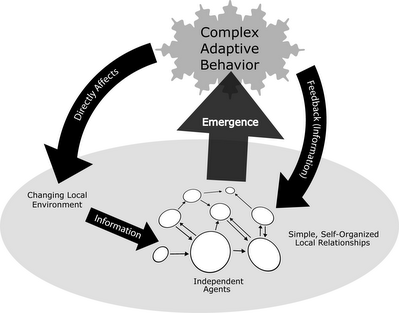
Imagine trying to understand a traffic jam. You could look at overall traffic flow, average speeds, and density. That's a top-down view. Or, you could model each individual car as its own entity. Each car has a driver with simple goals: get to a destination, avoid crashing, and maybe switch lanes if it seems faster. When you simulate thousands of these individual cars interacting, a traffic jam might naturally appear. You didn't program a 'traffic jam'—it emerged from the simple rules of the individual drivers.
This second approach is the core idea behind Agent-Based Modeling (ABM). It’s a way to simulate systems by focusing on the individual components, or 'agents,' and their interactions. Instead of writing equations for the whole system, you create simple rules for the agents and let them loose in a simulated environment. The large-scale patterns you see are the result of all their small-scale interactions.
ABM is a bottom-up approach. It builds complex system behavior from the ground up, starting with the actions of individual agents.
Agent
noun
An autonomous, decision-making entity within a model. An agent follows a set of rules and interacts with its environment and other agents.
The key is that agents are autonomous. They make their own choices based on the information they have. They can also be heterogeneous, meaning not all agents have to be the same. In our traffic example, some drivers might be aggressive, while others are cautious. This diversity can lead to more realistic and surprising results.
A Quick History
The ideas behind ABM have been around for a while. In the 1940s and 50s, mathematicians like John von Neumann explored 'cellular automata,' which are grids of cells that change state based on the states of their neighbors. You might have heard of the most famous example: John Conway's Game of Life, created in 1970. In it, a few simple rules about cells living or dying based on their neighbors create incredibly complex and unpredictable patterns.
While the concepts were powerful, building these models required a lot of computing power. It wasn't until the 1990s, when personal computers became more powerful and accessible, that ABM really took off. Researchers in fields like ecology and social science started using it to explore questions that were difficult to answer with traditional methods.
Where is ABM Used?
The flexibility of ABM makes it useful in many different fields. It shines wherever the interactions between individual parts are important for understanding the whole.
In biology, ecologists use ABM to model predator-prey dynamics or the flocking behavior of birds. Epidemiologists model the spread of diseases by simulating individual people interacting, which helps predict how an outbreak might unfold and how interventions could stop it.
In economics, ABM can simulate financial markets by modeling individual traders, each with their own strategy. This can reveal how market crashes or bubbles can form from collective behavior. Social scientists use it to study how opinions, fads, or rumors spread through a population, or how cities grow and change over time.
For example, city planners could use an ABM to test evacuation plans for a natural disaster. By modeling how individual people would react and move, they can identify potential bottlenecks before a real emergency happens.
Different Ways to See the World
ABM is just one tool in the modeling toolbox. Another common approach is equation-based modeling, which takes a top-down view. Think back to the traffic jam. An equation-based model might use differential equations to describe the overall flow of traffic as if it were a fluid. This is great for getting a high-level picture and predicting average conditions.
| Feature | Agent-Based Modeling | Equation-Based Modeling |
|---|---|---|
| Approach | Bottom-up | Top-down |
| Focus | Individual agents and interactions | The system as a whole |
| Level | Micro | Macro |
| Key Question | How do system patterns emerge? | How does the system behave on average? |
Neither approach is better than the other; they're suited for different tasks. Equation-based models are powerful when the components of a system are mostly uniform and their interactions can be averaged out. ABM is the right choice when the individual differences and local interactions are what drive the system's behavior. It helps answer questions not just about what will happen, but why it happens.
Which of the following best describes the fundamental approach of Agent-Based Modeling (ABM)?
In the context of ABM, the term 'heterogeneous' means that all agents in the model are identical and follow the exact same rules.