Avian Mastery and Conservation Science
Biomechanics and Flight Anatomy
A Fused and Rigid Frame
A bird's skeleton is a marvel of engineering, optimized for the immense stresses of flight. Unlike the flexible skeletons of mammals, many of a bird's bones are fused together to create a rigid, sturdy airframe. This rigidity prevents the body from twisting or bending under the force of powerful wingbeats.
Three key areas of fusion are crucial. The , commonly known as the wishbone, is formed by the fusion of the two clavicles. It acts like a spring, compressing on the downstroke and recoiling on the upstroke, storing and releasing elastic energy with each flap. This helps conserve energy during sustained flight.
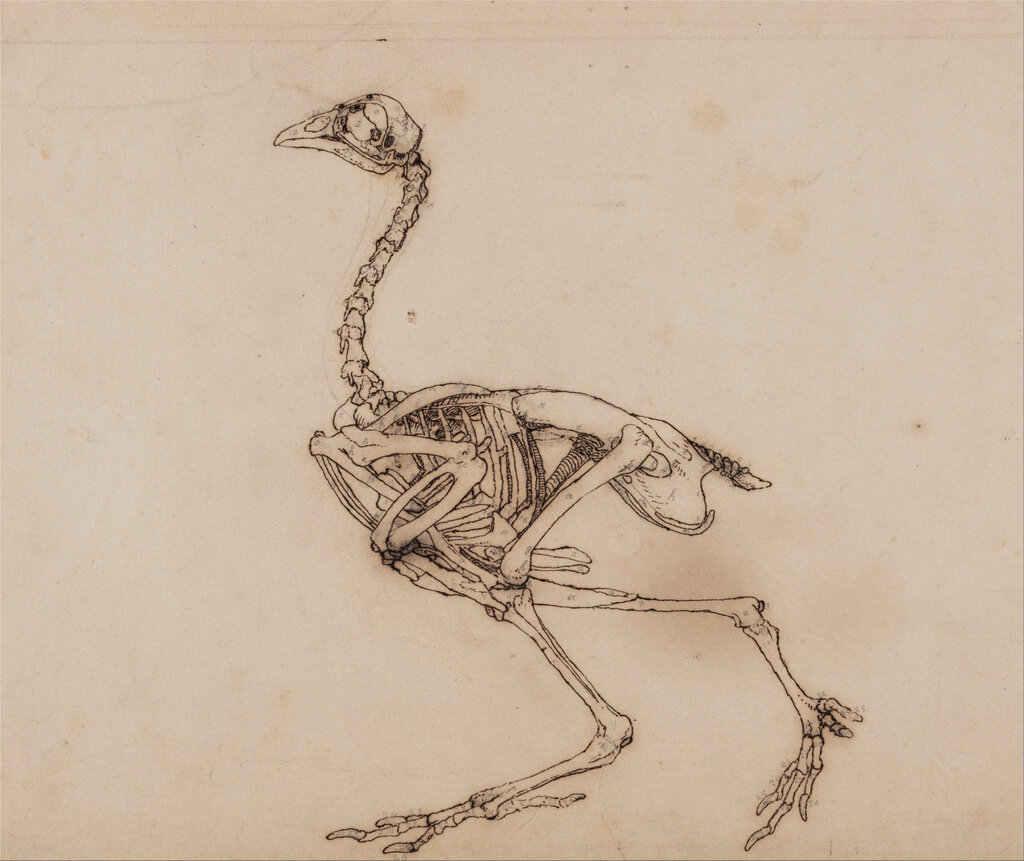
Further back, the spine and pelvis are extensively fused to form the synsacrum, a solid plate of bone that connects the spine to the hips. This creates a rigid platform to absorb the impact of landing and provides a stable base for the powerful leg muscles.
At the very end of the spine, the final few tail vertebrae are fused into a structure called the pygostyle. This flattened bone serves as the attachment point for the long, steering tail feathers, giving the bird precise control over direction and braking.
Hollow Bones, Hidden Strength
To minimize weight, most of a bird's larger bones are pneumatic, meaning they are hollow and filled with air. These are extensions of the respiratory system's air sacs. This design drastically reduces the skeleton's weight compared to the solid, marrow-filled bones of mammals.
Hollowness alone would make bones weak and prone to buckling. To counteract this, the interior of pneumatic bones is reinforced with a network of thin, bony struts called trabeculae. These act like the internal trusses of a bridge, distributing stress and providing remarkable strength with minimal material.
The Engine and Pulley System
Flight is powered by enormous pectoral muscles, which can account for up to 35% of a bird's body weight. These muscles need a large, stable attachment point. The sternum, or breastbone, is highly modified for this purpose. In flying birds, it features a large, flat keel, called the carina, that extends outward, providing a massive surface area for muscle attachment.
The wing's downstroke is the power stroke, driven by the massive pectoralis major muscle. But lifting the wing for the next stroke requires a clever solution. A smaller muscle, the supracoracoideus, is responsible for the upstroke. Instead of sitting on top of the skeleton, it is also located in the chest. Its tendon passes through a pulley-like opening in the shoulder called the triosseal foramen, looping over the top of the humerus to pull the wing up from below. This keeps the bird's center of gravity low and stable.
A Revolutionary Respiratory System
A bird's metabolic rate during flight is incredibly high, demanding a constant and massive supply of oxygen. The mammalian system of breathing in and out of tidal lungs simply isn't efficient enough. Birds evolved a completely different system.
They have a set of nine air sacs that extend into their body cavity and even into their hollow bones. These sacs act like bellows, storing air and pushing it through the lungs in a single direction. This creates a , meaning fresh, oxygen-rich air is always flowing across the gas exchange surfaces, unlike the mix of fresh and stale air in our own lungs.
This system ensures that the air flowing through the lungs is always fresh, maximizing the amount of oxygen that can be absorbed.
The gas exchange itself is also superior. In birds' rigid lungs, air flows through tiny tubes called parabronchi. Blood capillaries are arranged to flow at a 90-degree angle to the airflow. This crosscurrent exchange is far more efficient at extracting oxygen from the air than the simple diffusion in mammalian alveoli. This entire system allows birds to fly at high altitudes where oxygen is scarce, a feat impossible for most mammals.
What is the primary advantage of the fused, rigid nature of a bird's skeleton?
Which structure is formed by the fusion of the final tail vertebrae and serves as the attachment point for steering feathers?
These interconnected skeletal and respiratory adaptations create an organism perfectly tuned for the demands of powered flight.