Avian Evolution and Phylogeny
Theropod Origins
The Great Reptile Split
Roughly 250 million years ago, a major group of reptiles called the Archosauria divided. This evolutionary split created two distinct lineages. One branch, the Pseudosuchia, led to modern crocodiles and their extinct relatives. The other, Avemetatarsalia, gave rise to pterosaurs and, most famously, the dinosaurs.
This second group is our focus. Within the vast dinosaur family tree, we find the direct ancestors of every bird alive today. To trace this path, we must first navigate to a specific branch: the theropods.
Walk Like a Dinosaur
Dinosaurs are divided into two main groups based on their hip structure: the "lizard-hipped" Saurischia and the "bird-hipped" Ornithischia. Ironically, birds evolved from the lizard-hipped group, not the bird-hipped one.
Within the saurischians, one lineage stands out: the Theropoda. This group consists almost entirely of bipedal, carnivorous dinosaurs. It includes icons like Tyrannosaurus rex and Allosaurus, but it also encompasses a huge variety of smaller, agile predators. Their two-legged stance freed their forelimbs, setting the stage for these arms to evolve into something entirely new.
The Blueprint for a Bird
As we zoom in on the theropod family tree, we find a specialized group called Maniraptora, which means "hand snatchers." These dinosaurs display a stunning collection of traits we now associate with birds. These shared features, or synapomorphies, are the smoking guns of their evolutionary relationship.
One of the most significant is the , or wishbone. Formed by the fusion of the two collarbones, this bone acts as a spring in modern birds, storing and releasing energy during the flight stroke. Finding a furcula in dinosaurs like Velociraptor was a pivotal moment, directly linking the avian flight apparatus to theropod anatomy.
Another key feature is the semi-lunate carpal—a half-moon shaped wrist bone. This specific bone allowed maniraptoran hands to swivel sideways in a motion very similar to the folding of a bird's wing. It also facilitated a powerful downward flick, a precursor to the flight stroke. Other shared traits include hollow, pneumatic bones to reduce weight and, as fossil discoveries have shown, the widespread presence of feathers.
starting in the 1990s, a series of bombshell fossil finds established that feathers were widespread among several lineages of the bipedal, carnivorous dinosaurs known as theropods and that birds had inherited these structures from their theropod ancestors.
Close Cousins
The final step before we reach true birds is the clade Paraves, which means "near birds." This group contains modern birds (Aves) and their closest extinct relatives, the dromaeosaurids and troodontids. Dromaeosaurids, like the famous Velociraptor and Deinonychus, were incredibly bird-like. They had long feathers on their arms and legs, a swiveling wrist, and a furcula.
However, they couldn't fly. Their bodies were too large, their arms too short, and their feathers weren't arranged for powered flight. They represent a crucial data point: the avian body plan was not assembled in a single, rapid burst of evolution. Instead, its components—feathers, hollow bones, the wishbone—were pieced together over tens of millions of years in terrestrial predators. These traits were initially adapted for functions like balance, insulation, or display, only later being co-opted for flight in one small lineage of paravians that became birds.
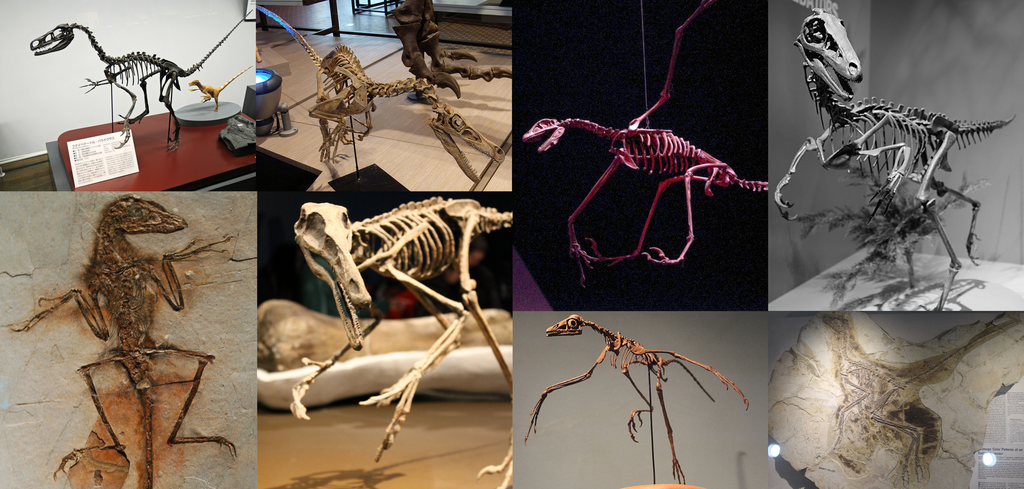
Skeletal modifications continued down the bird line. The long, bony tail of dinosaurs like Archaeopteryx eventually shortened into a fused structure called a , which serves as an anchor point for tail feathers used in steering. Limb proportions also shifted dramatically, with forelimbs elongating into wings and hindlimbs adapting for perching or walking. This gradual accumulation of traits shows that birds are not just related to dinosaurs; they are dinosaurs, a surviving lineage of small, feathered theropods that took to the air.
Let's check your understanding of these ancient ancestors.
Which major group of dinosaurs, known for being mostly bipedal carnivores, includes the direct ancestors of birds?
What is the primary function of the semi-lunate carpal, a key wrist bone found in maniraptoran dinosaurs?
The evolution of birds from theropod dinosaurs is a perfect example of how complex features can arise from simpler structures over immense spans of time.