Avian Bodily Systems Explained
Introduction to Avian Anatomy
Built for the Sky
Birds are remarkable creatures, evolutionary marvels shaped by the demands of flight. While they share a common ancestry with other vertebrates, particularly reptiles, their bodies have undergone a dramatic transformation. Nearly every aspect of a bird's anatomy, from its bones to its breathing, is a specialized adaptation for life in the air.
To understand a bird is to understand a body built for efficiency and lightness. Imagine stripping a machine down to its essential parts, reinforcing the frame, and powering it with a high-performance engine. That's essentially what evolution did to create the modern bird.

Unlike their terrestrial relatives, birds carry no unnecessary weight. Their skeletons are a masterpiece of structural engineering, providing maximum strength for minimum mass. This principle of lightweight design is the foundation upon which all other flight adaptations are built.
A Lightweight Frame
The most famous avian adaptation is a skeleton that seems almost impossibly light. Many bird bones are pneumatic, meaning they are hollow and filled with air. These bones are not fragile; they are reinforced with internal struts and trusses, similar to the supports inside an airplane wing. This creates a structure that is both sturdy and feather-light.
A frigatebird, with a wingspan of over seven feet, can have a skeleton that weighs less than its feathers.
Beyond hollow bones, birds achieve rigidity and reduce weight by fusing bones together. While a mammal's spine is flexible, a bird’s thoracic vertebrae are fused into a solid structure. The pelvis and lumbar vertebrae are also fused to form a light but incredibly strong plate called a synsacrum. This rigid trunk provides a stable platform for the powerful wing muscles to pull against during flight.
Other parts of the body are also streamlined for weight reduction. Birds lack heavy jaws and teeth, possessing instead a lightweight keratin beak. They also have no urinary bladder, which means they don't store heavy liquid waste. Every ounce is accounted for.
The Power of Feathers
Feathers are the defining characteristic of birds. They are intricate, lightweight structures that are crucial for flight, insulation, and communication. Like the bones, they are marvels of being strong yet light. A flight feather is composed of a central shaft with interlocking barbules that create a smooth, continuous surface to push against the air.
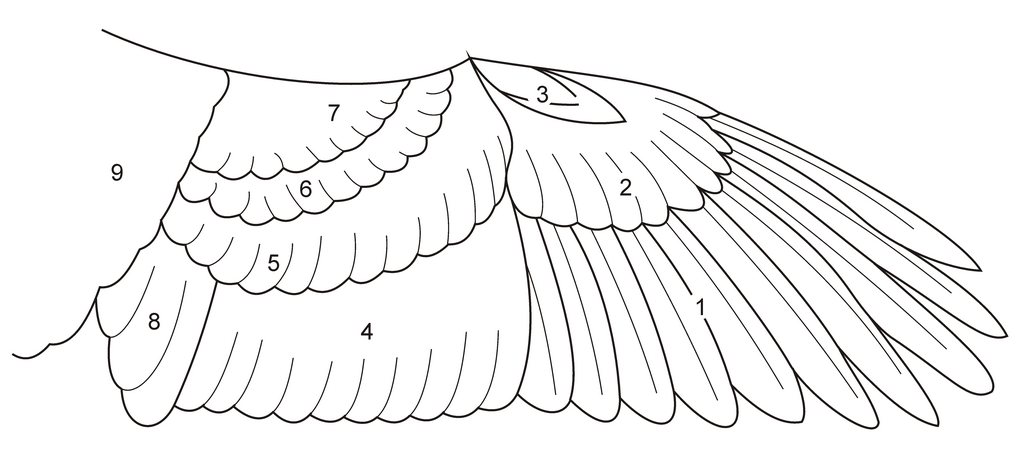
This design creates an airfoil, a shape that generates lift when air moves over it. The stiff, asymmetrical flight feathers on the wings provide thrust, while softer, fluffier down feathers close to the body trap air for insulation, keeping the bird warm. This dual function is a key difference from other vertebrates. Reptilian scales, for example, offer protection but nothing for flight or insulation.
Compared to the fur of mammals or the scales of reptiles, feathers offer a unique combination of aerodynamic performance and thermal regulation.
What does it mean for a bird's bones to be "pneumatic"?
A bird's rigid, fused trunk provides a stable platform for the powerful wing muscles.